

I don’t like baseball.
But that’s not the point. The point is that Cubans like baseball, and they are very good at it. As many as 30 Cubans are currently playing in the American Major League Baseball (MLB), many of them after departing the island illegally.
More than a million African slaves were imported into Cuba before Spain finally abolished the institution in the 1880s, leaving a heavy legacy that still weighs on Cuban society until this day. Partly due to that legacy, baseball and other sports serve a greater purpose in Cuban society than just keeping Cubans entertained. In contrast to competition in areas like politics and business, sports provide a public stage where Afro-Cubans outperform other Cubans, often holding the top national positions. Star MLB players like Yordan Álvarez, Yennier Canó, Randy Arozarena and Aroldis Chapman illustrate this point.
Well, in the cases of Álvarez and Chapman, their names also illustrate another aspect of Afro-Cuban history. Álvarez’s full name, following Spanish naming customs, is Yordan Rubén Álvarez Cadogan. Rubén is his second given name while Cadogan is his maternal surname, inherited from his mother’s family (Chapman’s maternal surname is De la Cruz). What are the odds that two prominent Black MLB players from a Spanish-speaking country would have British surnames? Turns out, not as low as you might think. Maybe close to the odds of finding two British-surnamed ministers among the very few Afro-Cubans who serve on Cuba’s Council of Ministers1.
During the late 19th and early 20th centuries, Cuba became a major destination for Spanish migrants. These migrants were generally unwilling to work in the island’s sugar fields, so after the banning of the slave trade, and especially after slavery itself was abolished in 18862, the sugar industry began actively looking for new sources of cheap labor to complement, and later partly replace, the island’s enslaved workforce.
The first source that Cuban sugar producers drew upon was China. Starting in 1847, more than 100,000 Chinese indentured workers3 were recruited in Macao to cut cane in the sugar fields. This flow lasted until 1974, when the Chinese government sent a fact-finding commission to investigate the living conditions of Chinese laborers in Cuba. What they found in Cuba’s sugar plantations was widespread abuse and brutal working conditions, and their report directly led to the end of Chinese migration to Cuba.
The rapid expansion of sugar production in the 1910s, brought about by a wave of American investment following Cuba’s independence, reignited the search for cheap labor. This time, sugar workers came from nearby lands: the neighboring Caribbean islands of Jamaica and Haiti. Between the years 1913 and 1921, around 75,000 Haitians and 76,000 Jamaicans entered Cuba legally4. They continued to arrive in Cuba in large numbers, both legally and otherwise, until the Great Depression caused sugar prices to collapse in 19305.
Not all of these Caribbean immigrants remained in Cuba. Some of them worked only seasonal jobs, returning to their home islands regularly. Many stayed permanently and integrated into Cuban society, as you can see by the West Indies surnames - more common in the British West Indies than in the UK6 - carried by their prominent descendants. Among West Indian immigrants, Jamaicans in particular appear to have achieved relative economic success. At the time of their arrival, the Jamaican per capita income was half that of Cuba, yet by the time of the Cuban Revolution average Jamaican incomes had overtaken those in Cuba (and yes, that’s another piece of evidence against the myth that Cuba ranked “near the top“ in terms of development).

Then there are the Spanish migrants. As I’ve mentioned before, they tended to avoid work in the sugar mills and fields, instead preferring to try their hand at commerce or small scale agriculture. We can learn more about these Spanish migrants too, by examining the surnames of Afro-Cubans who have excelled at the top tier of baseball (nobody is perfect), and maybe other fields I actually care about.
I’ve already droned on and on about the large share of Canarian migrants among Spaniards who came to Cuba. Nonetheless, other Spanish regions also contributed large numbers of migrants to Cuba, particularly Galicians and Asturians during the late 19th and early 20th century.
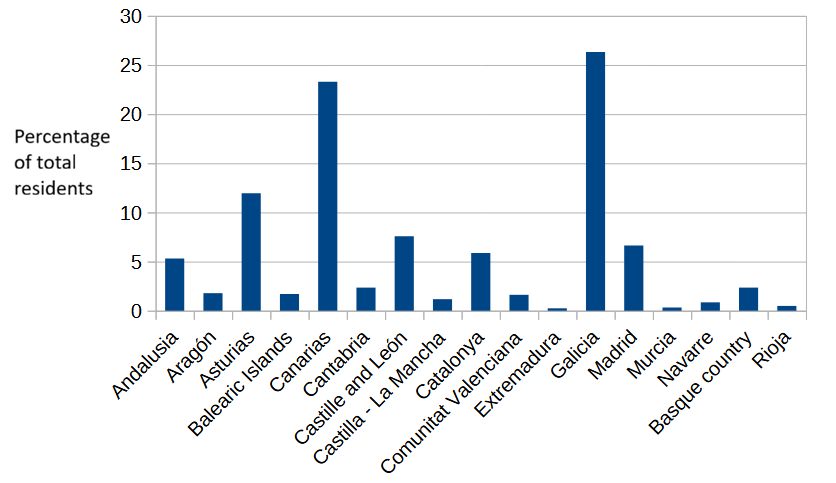
The following bar chart shows the percentage of Spanish nationals residing in Cuba in the year 2010 by region of birth. Mind you, this is not a perfectly representative sample of 20th century Spanish migration to Cuba, being obviously skewed towards the 1940s and 1950s rather than the more significant early 20th century, and likely including a substantial number of young expats.
A more accurate breakdown of Spanish regional ancestry in Cuba can be obtained by a surname analysis of the current Cuban population, assigning each of the 350 most common Cuban surnames to the Spanish region it originated from7. This is the same methodology I used in a previous post, and it groups Spain’s official autonomous communities into larger regions for easier comparison (e.g. Cantabria-Rioja-PV-NV corresponds to four northern autonomous communities: Cantabria, La Rioja, Basque Country and Navarre).
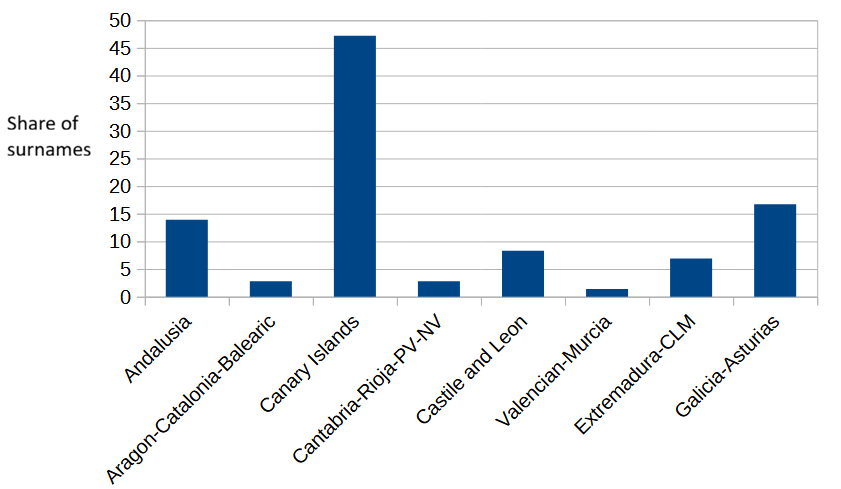
According to this analysis, around two thirds of Cuban Spanish ancestry comes from the Canary Islands, Galicia and Asturias, with most of the remainder originating in Andalusia and Castile. No surprises there.
Let’s now repeat the analysis with a sample of surnames from Afro-Cubans. Since I don’t have a list of the most common surnames among Afro-Cubans, I’ll just use the surnames of the most successful Afro-Cuban athletes (according to Wikipedia) in two sports where Cuba stands out: baseball and boxing8.
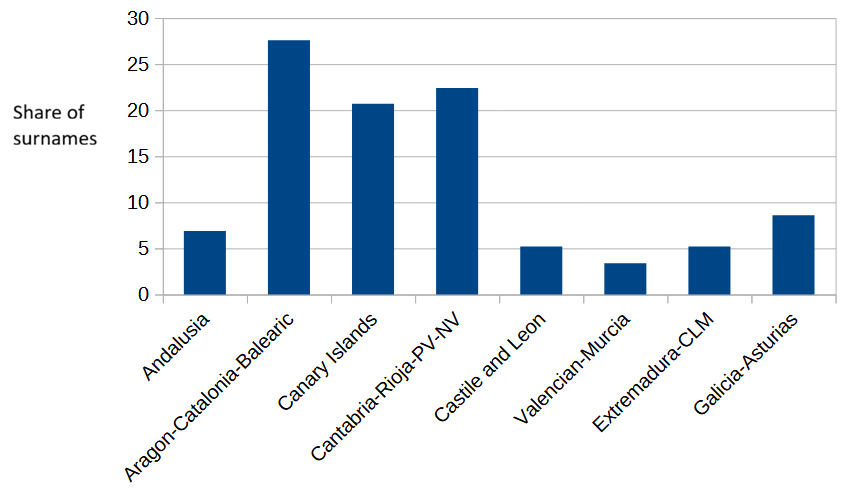
This is a very rough analysis9, but despite its limitations, it clearly reveals major differences in the regional distribution of Spanish surnames between the general Cuban population and Afro-Cubans:
Among Afro-Cubans, the highest share of surnames (27.6%) originates from the region that includes Catalonia and the Balearic Islands (Aragon-Catalonia-Balearic).
The Central-Northern region of Spain, encompassing Cantabria, La Rioja, the Basque Country and Navarre, increases its share to nearly a quarter of all surnames among Afro-Cubans (22.4%).
The share of surnames from Andalusia, the Canary Islands and Galicia-Asturias decrease substantially, compared to the general population. Other regions show smaller decreases or increases, or their share is so small that any change might just be noise.
Why does the regional distribution of surnames among Afro-Cubans differ so much from the Spanish regional distribution among the general population?
Well, in a slaveholding society where the main economic activity relies on the effort of an enslaved workforce, economic success was largely measured by having a bigger piece of that activity’s economic pie, the sweet sugar pie. Economic success usually meant owning more and larger sugar plantations, and owning more slaves to work them. If certain groups of Spanish immigrants achieved greater economic success than others, it’s not surprising these groups eventually controlled a larger share of the Cuban sugar industry and owned more slaves.
The surnames of these successful Spaniards were inherited by Afro-Cubans, who now carry in their names a vivid testimony of Cuba’s economic history. Catalans and Basques were particularly successful in 19th-century Cuba, far above other Spanish immigrant groups, and their wealth was often based on sugar and on the enslavement of the Africans who worked on their plantations. A striking example of this success was the Basque immigrant Juan Zulueta10:
Zulueta was born in Anucita, an obscure agricultural village in the Basque province of Alava. The son of a common laborer with no education and no money, he followed the example of thousands of Basques and Spanish of his age and circumstances: he migrated to Cuba. By his own account, Zulueta’s goal was to save approximately 2,500 pesos to return to Alava and become a middle-level proprietor, owning anywhere from 10 to 100 hectares. Once in Havana, Zulueta entered the slave trading operation as a middleman, and within twenty years had become one of the richest and most powerful men in Cuba.
Another notable example is Facundo Bacardí, of Bacardí rum fame, who was born in Sitges, Catalonia11:
[Facundo Bacardí] arrived in Santiago de Cuba in 1838, a poor, struggling Catalán, apprenticed to a family firm. Experimenting in the kitchen of his patron’s house, Bacardí succeeded in distilling a rum superior in body, flavor, smell and taste to any previously offered on the market. The light amber color and taste, and the virtual absence of ammonia smell, made addicts of an ever-widening circle of aficionados. From Santiago the fame of Bacardí’s kitchen distillery spread to Havana; from Havana to Madrid, New York, Philadelphia, Baltimore, London and Shanghai.
The success of these Catalans and Basques - and also Cantabrians and Baleares - compared to other Spanish immigrants (Canarians, Galicians) was so pronounced that it distorted the regional distribution of surnames among the descendants of slaves.
There’s also a corollary to the high rate of Basque and Catalan surnames among Afro-Cubans. This result suggests that the regional distribution of surnames among White Cubans is even more skewed towards the Canary Islands, Andalusia and Galicia-Asturias than the distribution among the general population.
The general population distribution somewhat averages the regional frequencies of surnames among Afro-Cubans and White Cubans. Given that Basque and Catalan surnames are so much more frequent among Afro-Cubans, we should expect the share of these surnames among White Cubans, which I have no direct way of observing, to be even lower than the 5%-6% seen in the general population.
That is, by Latin American standards, very low.
(Credit for this post’s thumbnail: Wikipedia. The guy hitting a ball with a wooden stick is Yordan Rubén Álvarez Cadogan)
The only other Afro-Cuban member of the Council of Ministers appears to be Oscar Manuel Silveira.
Abolition was preceded by the 1870 Free Birth Law, marking the beginning of the gradual end of slavery over the next decade and a half.
According to Nicolás Narváez (“Chinese coolies in Cuba and Peru: Race, labor, and immigration, 1839-1886“) 140,000 Chinese men went to Cuba, while according to Denise Helly (“IDÉOLOGIE ET ETHNICITÉ. Les Chinois Macao à Cuba : 1847-1886”) the number of Chinese who reached Cuba was 125,000.
Problems of the new Cuba: Commission on Cuban Affairs, 1935, page 214.
Some were simply expelled. In 1933, the revolutionary government of Ramón Grau deported 8,000 Haitians. See Problems of the new Cuba: Commission on Cuban Affairs, 1935, page 216.
The Cadogan surname, of Welsh and Irish origin, is more common in Barbados (1 in 319) than in Ireland (1 in 9,900). And Waugh, the maternal surname of minister Inés María Chapman Waugh, is more common in Jamaica (1 in 1,700) than in Scotland (1 in 2,700).
I only assigned surnames to a specific region when its frequency in that region was several times higher than in any other region. If a surname appeared with similar frequency in more than one region, I excluded that surname.
Restricting the sample to baseball players alone would have made it too small for my liking. Also, the results likely hold up if I extend the analysis to areas outside of sports, as a short list of prominent Afro-Cuban writers demonstrates: Nicolás Guillén Batista, Gustavo Urrutia, Regino Pedroso y Aldama, Marcelino Arozarena Ramos, Lydia Cabrera Marcaida, Nancy Morejón Hernández, Georgina Herrera Cárdenas, Pedro Pérez Sarduy, Alberto Guerra Naranjo, Inés María Martiatu Terry, Manuel Granados, Lourdes Casal Valdés, Alberto Abreu Arcia (Basque, Riojan and Navarre surnames in bold).
A clear example of the limitations of this analysis is the case of Cuban baseball player Luis Robert Moirán Jr. His paternal surname, Robert, is likely of French origin (frequency in Haiti is 1 in 1.6k), indicating that he might descend from one of the aforementioned early 20th century Haitian migrants. Yet, my code classifies the surname as Catalonian because 1 in 6.6k Catalans is named Robert, and I don’t check the existence of the surname outside Spain. I have no way to know which one is its true origin.
Origins of Wealth and the Sugar Revolution in Cuba, 1750-1850, by Franklin W. Knight, 1977.
Origins of Wealth and the Sugar Revolution in Cuba, 1750-1850, by Franklin W. Knight, 1977.
Wait, what? I just like couldn't read past this: "I don’t like baseball."
My brain locked up, dude. If you're gonna say something as obviously batshit insane as that, you at the very least need to write an essay as thorough as this one: https://www.noelmaurer.com/p/soccer-is-an-acquired-taste.
Oh, right, you had some sort of interesting point here. Well, I've got a bottle of tequila and the bambini are asleep, so I'll try to get back to you. No promises. I will need to drink a lot to get past that doozy of an opening line.
:-D
Yet another essay of yours that I have to interrupt my reading of every couple of paragraphs to read aloud to my indulgent husband, “Ok, and here’s *another* cool thing….”
Thank you, Javiero!