

I have argued in earlier posts that the most likely explanation for why the New Settlements municipalities in Andalusia, a group of colonies founded in the mid-18th century by non-Andalusian immigrants, were distinctly more literate than the rest of Andalusia is simply their non-Andalusian origin. The large majority of the immigrants who settled in these colonies came from other European countries (or Spanish regions) which had higher literacy levels than Andalusia throughout the 19th century and early 20th century.
How unusual were the low illiteracy rates of San Sebastián de los Ballesteros, La Carolina, and Aldeaquemada in high-illiteracy Andalusia? Are they unusual enough to attribute them to their partially non-Andalusian populations? I can’t be completely certain, but I believe their population is very likely the reason for their exceptional performance.
If Andalusia’s low literacy in the 19th century indeed had an endogenous cause, that would seem to fit with the persistent low academic performance that the region has exhibited until today, as I discussed in my previous post.
And any alternative explanation would have to account for how the former New Settlements, despite being subject to the same institutions as the rest of Andalusia, achieved such high literacy levels.
One alternative explanation I did not mention at the time is that the exceptional literacy of the New Settlements may derive from the unusual way in which they were conceived. The colonies were planned and founded at the height of the Enlightenment by one of the most prominent figures of the Spanish Enlightenment, the Peruvian-born Pablo de Olavide.
Olavide was born in Lima, Peru, the son of a highly successful Navarrese merchant who emigrated to Peru in the early 18th century1. After receiving a very thorough education, Olavide made the opposite journey to the one his father had done, traveling to Spain, where he became a successful businessman and later senior government official.
Following the Enlightenment principles that he and many others in the Spanish government admired, Olavide set out to create a new kind of town: rationally planned, free from the shackles of the old regime (which would die anyway half a century later), and free from the extreme land inequality that afflicted Andalusia. Every colonist received an equal allotment of land2, monasteries were forbidden from establishing themselves in the colonies, and the hoarding of land by any single settler was prohibited.
In the minds of their creators, the New Settlements were intended to become model colonies; a showcase of agricultural communities founded on enlightenment principles3.
So, was the New Settlements’ exceptionally high literacy a consequence of their founding as model, fairly egalitarian, colonies?
This may seem like a strange question to ask, but once we consider the somewhat related question of why is Andalusia poorer than most of Spain it makes sense to pose it. This broader question is, as you can probably imagine, one that has been posed many times, and to which many pages have been devoted.
The relative poverty of Andalusia, and of southern Spanish regions more generally, has been the subject of many works by both Andalusians and non-Andalusians. And the general consensus among historians and economists is that one of the major causes for Andalusia’s “underdevelopment” is its long history of land concentration.
The central element is the latifundist agrarian structure: large estates concentrated in few hands generated a polarized society with little incentive to invest in education, technological innovation, or industrialization. While northern Spain and Catalonia developed modern industry and a network of small and medium-sized enterprises, Andalusia remained specialized in extensive, low-value-added agriculture and primary exports. This was compounded by historically lower human capital (significantly lower literacy and school enrollment rates during the 19th and much of the 20th centuries), which limited the adoption of new technologies and the formation of a dynamic business class. Inherited extractive institutions (the power of large landowners, clientelism, and a weak local government) reinforced this pattern of path dependence4.
Or, in the words of economists Daniel Oto-Peralías and Diego Romero-Ávila:
“At that time, kings and individual settlers had more difficulty organizing the colonization of the territory effectively”, recalls the economics professor. “Many of the land grants didn’t work, leading to the accumulation of property and control of localities by the nobility”
”A rapid reconquest is associated with imperfect colonization, characterized by an oligarchic political balance, and therefore creates the conditions for an unequal society with negative consequences for long-term economic development.”
“Until industrialization, inequality didn’t necessarily translate into lower per capita output, because human capital wasn’t as important in agricultural work as other factors like land productivity,” the researcher explains. “By the 18th century, it was already empirically observed that there were many more day laborers in the regions that were conquered more quickly. If we examine the data related to education levels and crime rates, living conditions were worse in the South during the 19th century.”
…because, following Acemoglu and Robinson, to be successful, the participation of broad sectors of the population is key,” recalls Oto-Peralías. The entrepreneurial culture usually appears in regions where the land is more distributed, since “an agricultural operation is like a company, so it is easier to move from that economic activity to another of a more industrial and service nature when industrialization arrives.”5
So, in short, the theory goes: accumulation of property, mostly land, produces an unequal society characterized by an oligarchic political order. This oligarchy has little interest in expanding human capital, such as by increasing literacy, and therefore regions (or towns) suffering an unequal distribution of property remained less literate and eventually poorer.
Recall that even today, when literacy is almost universal across Spain (>98%) and regional differences in literacy rates have become practically meaningless, significant differences in academic performance among Spanish regions still persist, with Andalusia ranking near the bottom.
You can see now why I have to highlight the highly equal land distribution in the New Settlements. If inequality stunted the growth of human capital in Andalusia, then the colonies may simply have enjoyed higher 19th-century literacy rates because they didn’t suffer from the highly unequal land distribution that afflicted the rest of Andalusia. Maybe the enlightened principles on which they were founded acted as a protection against the social processes that hindered the growth of human capital in Andalusia.
If only many other Andalusian towns had enjoyed the same fairly equal distribution of land, Andalusia might have adopted primary schooling more widely and more rapidly, avoiding the widespread illiteracy that still characterized it in the early 20th century. Faster expansion of human capital through schooling might have allowed it to reach a level of development on par with that of northern Spain today.
The town of Prado del Rey, bordering the mountain range of Grazalema in the province of Cádiz, was founded in 1768. Although sources disagree on whether it was ruled by the same special administrative regime (fuero) as the New Settlements, there is agreement that Pablo de Olavide was involved in its establishment, that it was founded according to the same enlightened principles as the New Settlements, and that land was equitably distributed among the new colonists6.
…to declare that the New Settlements of Almajar7 and Prado del Rey shall enjoy the same privileges granted to those of Sierra Morena, following their example, and that the settlers shall enjoy the same exemptions and the same legal protections for their cases, until their full establishment is complete… an establishment that can serve as a model for many others; for this is the means by which, at no cost, what is now depopulated in Spain can be repopulated8.
The initial colonists of Prado del Rey were 189 families, drawn from the surrounding areas of the Grazalema and Ronda ranges rather than from other European countries or other Spanish regions. While the other colonies included a share of Andalusian settlers, Prado del Rey was the only new colony entirely settled by Andalusians.
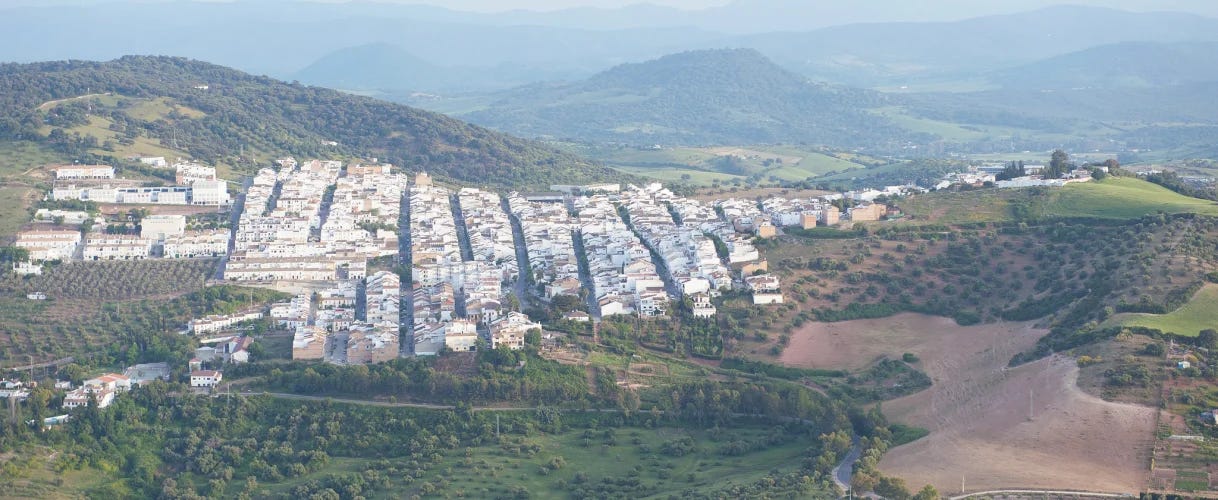
And the new town grew and prospered:
It was in the second half of the 19th century that prosperity became noticeable in the population: 2,209 inhabitants in 1848, 2,390 in 1861, and more than four thousand at the end of the century9.
But did its human capital grow as rapidly as that of the other colonies?
Before answering that question, let me introduce you to the town of Nueva Carteya, in Córdoba province.
The founding of Nueva Carteya took place in 1822, when a large portion of the common lands of the town of Baena was divided into allotments and raffled among the town’s residents.
Baena, like Écija and many other mid-sized Andalusian towns, possessed extensive common lands for use as pastures, source of wood, or simply rented out to generate municipal income. In the case of Écija, part of these common lands was appropriated for the founding of the New Settlements. In the case of Seville, Prado del Rey was established in what used to be Sevillan common lands.
Nueva Carteya, like Prado del Rey before it, was founded with a relatively equal distribution of land. Moreover, they were not the only Andalusian towns established during the late 18th or early 19th century that avoided the strongly unequal distribution of property typical of Andalusia:
Algar was founded in 1775 as a private colony on lands bought by Domingo López de Carvajal, a Galician who made his fortune in Mexico10. 90 families received equal allotments of land and Olavide was at least involved in supporting the establishment of the new town11.
Rosal de Cristina (nowadays called Rosal de la Frontera) was founded around 182212 near the location of the abandoned village of Aldea del Gallego13, in Huelva province.
Around 1840-1850 a colony was founded in Chilluévar (Jaén province) by Manuel Gómez Calderón, a businessman from Almería province14. The town already seems to have had a sizeable population before land was distributed in the colony15.
Now that we have a sample of four or five towns (Chilluévar is somewhat doubtful) characterized by highly equal land distribution and settled entirely by locals, we can take a look at the literacy rate of each and compare them to the New Settlements.
So here’s a map of illiteracy rates in Andalusia (1900-1910 average), by municipality.
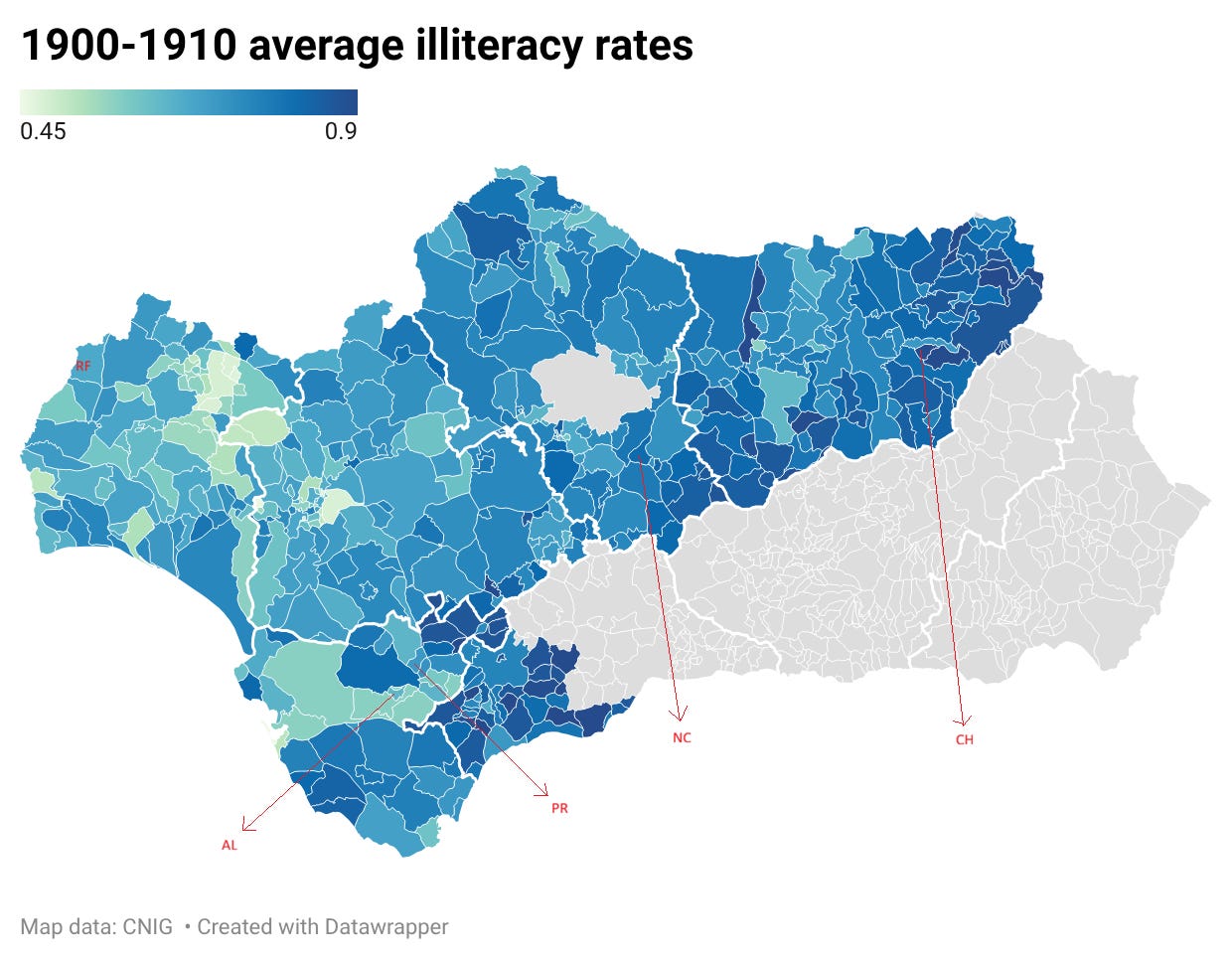
As you can see, none of the colonies settled by locals stands out for its low illiteracy rate. There’s a flaw in the map though: Chilluévar (labeled “CH”) only became an independent municipality in 1926, so the color shown corresponds to the rate for La Iruela, the municipality to which it belonged at the time16. More on that later.
Perhaps it could be argued that Algar (labeled “AL”) has a relatively low illiteracy rate (64.1%), yet this rate is nearly the same as the provincial average (64.3%). Even more, it’s very similar to the average rate of the four nearby towns from which its settlers originated: Ubrique, Villaluenga del Rosario, Benaocaz and Bornos17. The situation is similar for Prado del Rey (labeled “PR”) and Nueva Carteya (labeled “NC”), both of which show relatively high rates, similar to those of the towns of origin of their settlers18.
In contrast to the New Settlements, none of the towns settled by Andalusians appears to show an illiteracy rate significantly lower than that of the surrounding municipalities.
Except for Chilluévar. Since Chilluévar only became an independent municipality in 1926, the first chance to compare it with its neighbors is the 1930 census. And its illiteracy rate was substantially lower than that of its neighbors in 1930 (58.3%).
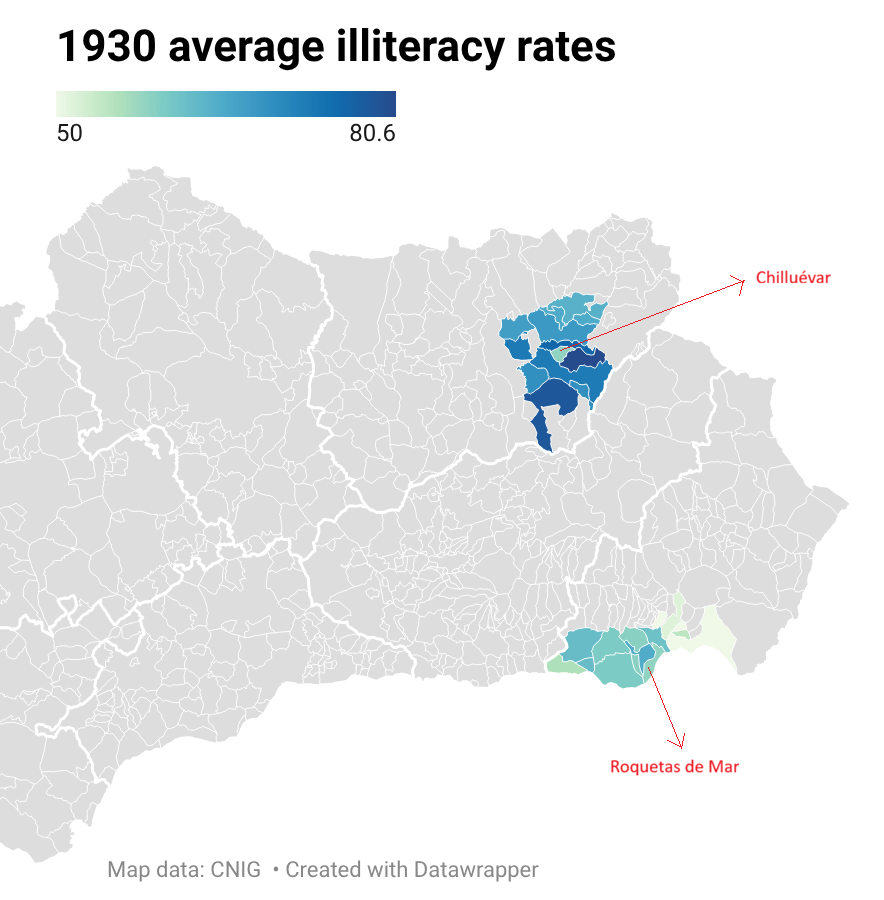
Nevertheless, I cannot attribute Chilluévar’s low illiteracy to its more equal land distribution. As I mentioned before, the founder of the colony came from Almería province, specifically from the town of Roquetas de Mar, and recruited settlers from his own province19. Turns out that illiteracy in Roquetas de Mar was just as low as in Chilluévar (58.1%), and that most neighboring towns had rates in the 56%-62% range.
Chilluévar looks more like a case of higher literacy due to its colonists coming from a region with higher literacy than a case of land equality producing higher literacy.
These five Andalusian colonies are the only ones I could find that a) were founded during the same time period as the New Settlements or a few decades later; b) deliberately avoided inequality among settlers; and c) were independent municipalities by the year 1900, so that we can compare their illiteracy rates with those of neighboring towns20.
Their illiteracy rates suggest that land equality had no influence on literacy levels, and thus probably little or no effect on the accumulation of human capital in Andalusia.
We can also rule out the availability of primary schooling as an explanation for their unexceptional literacy. According to Madoz, Prado del Rey, Nueva Carteya, Rosal de Cristina and Algar all had primary schools around 1845-185021.
This analysis makes me more confident that low literacy in Andalusia cannot be entirely explained by social or economic factors, given that the non-Andalusian communities of the New Settlements experienced the same social and economic environment as the rest of Andalusia. Or, if inequality is assumed to be the one decisive factor, they at least experienced the same environment as the five Andalusian colonies I’ve just described22.
Perhaps more importantly, it makes me doubt the consensus view on Andalusian underdevelopment. If literacy is a reliable measure of human capital, then the experiments in equal land distribution that these colonies represent suggest that more equality does not result in greater human capital.
Yes, Spanish merchants from the northern belt were already migrating to the Americas, and making fortunes there, in the early 18th century. Actually, Olavide’s father was born in central Navarre; arguably just outside the northern belt, but very close to it.
Plots were not always exactly equal. In some cases additional land was allocated for each child in the family.
See “The Enlightenment’s New Settlements“, by Vicente Palacio Atard.
This is the consensus view on the question, according to my preferred AI assistant.
See “Why Andalusia is poor and the north is rich: Spanish inequality originated in the Reconquista“. El Confidencial, 2019-10-24.
See “Reseña Histórica“, Municipality of Prado del Rey, and “Prado del Rey”.
The town of Almajar was eventually merged into Prado del Rey.
Statement from Pablo de Olavide to the Council of Castile, Fundación de Municipios Pablo de Olavide.
See “Prado del Rey“, Fundación de Municipios Pablo de Olavide.
From “La colonización agraria del siglo xviii en Andalucía: el proyecto ilustrado para el espacio de Doñana“, by Domingo Muñoz Bort: “Simultaneously, [Olavide] implemented the royal resolutions on the distribution of municipal wastelands in Seville, creating an agricultural colony in the pastures of Almajar and Prado del Rey within the municipality of Villamartín.“
“Historia”, Excelentísimo Ayuntamiento de Rosal de la Frontera. Madoz mentions that allotments were given to anyone who requested them.
“The Galician’s village”. The name is not surprising given its location bordering the Banda Gallega (Galician Belt), an area I mentioned in a previous post.
See “History of Chilluévar“.
Madoz says the town’s population was 480 before the colonization scheme.
Chilluévar’s population was roughly a fourth of the total at the time.
See “Historia de Algar“.
Nueva Carteya’s 1900-1910 average illiteracy rate (81.9%) is higher than Baena’s (72.8%). The rate for Rosal de la Frontera (labeled “RF”) was 67.4%, higher than Huelva’s provincial average, although I couldn’t find information on the towns of origin of its settlers.
Sources say settlers were recruited from Almería province, but don’t specify which towns in Almería. I assume they came from Roquetas and neighboring towns.
In the late 19th century, San José del Valle (near Algar) was somewhat colonized, but not in a systematic way. More importantly, it didn’t become an independent municipality until 1995, so we can’t compare its illiteracy rate in 1900-1910 (or at least 1930) to that of its neighboring towns.
See Pascual Madoz’s “Geographical-Statistical-Historical Dictionary of Spain”.
I’ve mentioned before that the New Settlements with a higher share of descendants of non-Andalusians show higher literacy rates.
Blas Infante, in the second part of his book "el ideal andaluz" gives out concrete data and proposals according to the georgism discourse of his Era and his influences from the I.L.E and the regenerationists, It could be useful for this study on Land distribution and its effects, along with the illiteracy rates.
Andalusia is an example of why colonies must do a revolution and land reform or remain colonies forever. I can only imagine the thread of so many families transitioning from Roman servus (slave, later also applied to coloni, from which our "serf") to Andalusi fellah to Castilian (or "Spanish") bracero without ever owning a single acre of land. All that to this very day.
The tragedy of Andalusia... or Sicily... or Togo for that matter is immense.