

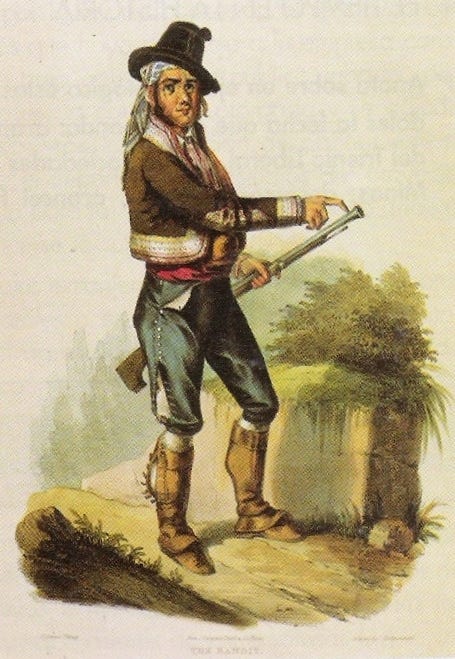
18th-century century Southern Spain, particularly Andalusia, suffered from a social affliction that had long plagued much of Southern Europe: Banditry. Spanish bandits spread fear among travelers, disrupted commerce, kidnapped and even murdered those who braved the roads of Andalusia.

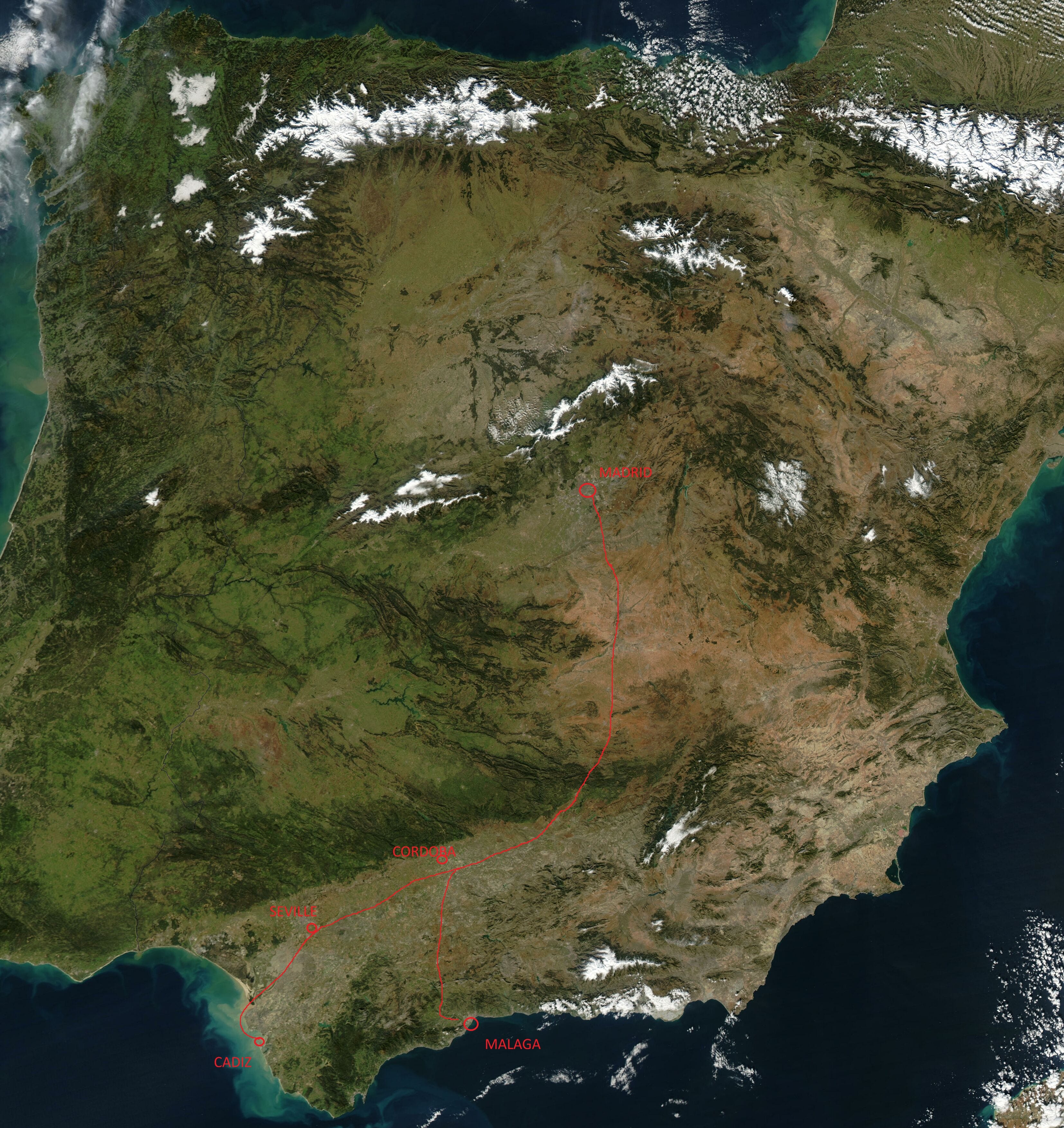
Banditry was specially severe and disruptive along the main road linking central Spain, where Madrid is located, with Andalusia. This road passes through the narrow Despeñaperros pass in the sparsely populated Sierra Morena mountains, which separates the fertile Guadalquivir valley from the central Spanish plateau.
The Spanish King did not like bandits, whether Andalusian - who probably had more flair - or otherwise. He would have liked to capture them, but they were hard to catch. After robbing travelers or stealing cattle, the bandits would often vanish into the sparely populated mountains and forests of Southern Spain. Building and maintaining roads through these mountains and forests presented a chicken-and-egg problem: banditry made those areas unappealing for settlement1, while at the same time their lack of population made it harder to suppress the bandits.
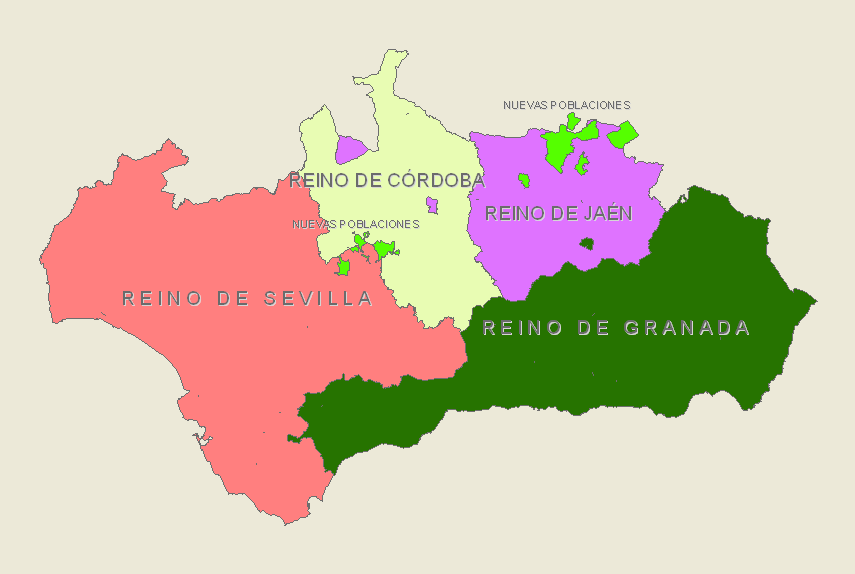
In 1766, a Bavarian adventurer named Johann Kaspar Thürriegel came to the King with a plan: he would recruit 6,000 German and Flemish colonists to settle the unpopulated areas along the road, in present-day Córdoba and Jaén provinces, so they would become productive, populated and safe lands. The kind of lands the King liked.
The King liked this plan and gave it his approval. But then, things didn’t go exactly as planned. Recruiting colonists turned out to be harder than expected. When not enough colonists could be found in Germany and Flanders, Thürriegel turned to French, Swiss and Italian settlers. When even these were not enough, additional colonists were recruited from the Spanish regions of Catalonia and Valencia.
Between 1767 and 1770, the lands assigned to the colonization scheme were cleared and prepared for agriculture, new villages were founded, and houses were built. These colonies, officially known as the New Settlements of Sierra Morena and Andalusia (“Nuevas Poblaciones de Sierra Morena y Andalucía“), were now productively cultivating what used to be wasteland and wilderness2, and helping to secure the main road to Madrid. Their new residents - a mix of various Central European settlers, Catalonian and Valencian colonists, and even some local Andalusians - must have presented a remarkable contrast to the surrounding Andalusian population in the early years of the colonies.
Gradually, Spanish replaced their original languages, foreign chaplains were replaced by Spanish priests, and more Andalusian farmers moved into the settlements. By the time their special administrative regime was scrapped in 1835, most visible markers of distinctiveness were fading away3. But what about deeper, less visible aspects of their culture? Did any deeper non-Andalusian cultural traits remain in the colonies?

In my previous post, I noted that current differences in academic performance across Spanish regions roughly mirror 19th-century differences in literacy rates between them. Southern Spanish regions, which today perform below the national average in academic tests like PISA, also had higher illiteracy rates in the late 19th century.
You can see that the geographic pattern of literacy improvement is not exactly the same as the patterns of 1860 or 1900 literacy, but it’s nevertheless broadly similar: Northern Spain mostly in blue and Southern Spain in red. Southern Spain began the period with lower literacy levels in 1860 and improved more slowly, while Northern Spain started with higher literacy and improved faster.
Andalusia in particular had very low literacy levels in 1860 and improved little during the late 19th century. But some Andalusian provinces diverged from this pattern: Cádiz province, home to the prosperous port of Cádiz and a booming Sherry wine industry, and also Huelva province4. Beyond these exceptions, most of Andalusia remained highly illiterate.
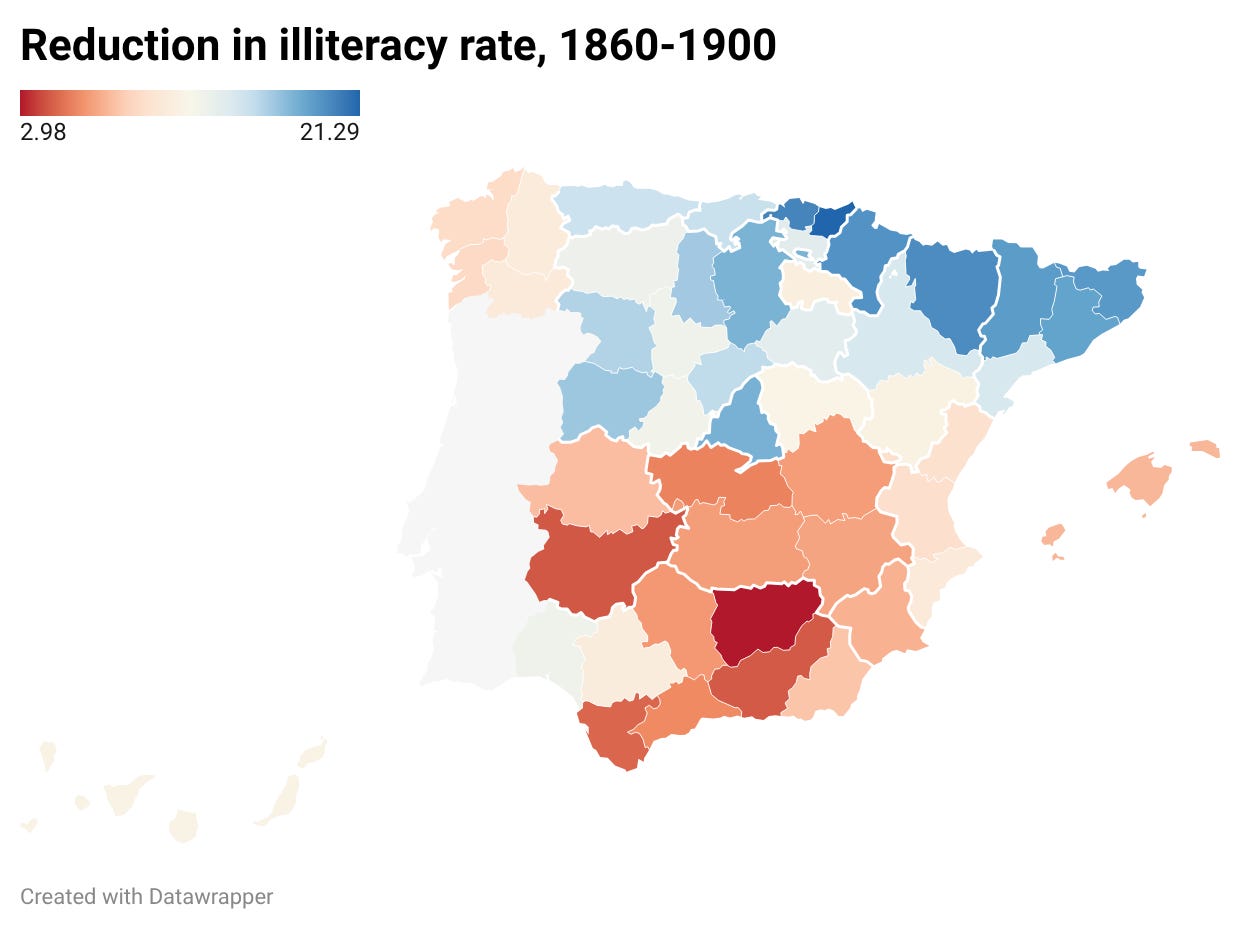
The general picture of the region seems to be one of low literacy, broken only by relatively higher literacy rates in provincial capitals, larger cities, and a few economically prosperous areas. This suggests that 19th century economic growth may have been the dominant factor in rising Spanish literacy. Maybe Northern Spain was more literate because it was wealthier than Southern Spain?
Wealth certainly played a role in rising Spanish literacy. The most straightforward way to increase literacy was to expand primary schooling, and in small Spanish towns this depended mainly on the town’s financial capacity (and willingness) to pay for a primary school teacher.
To explore this relationship between wealth and literacy, and maybe identify other factors that influence illiteracy rates, I’ll take another look at the 19th-century Spanish census data which we examined in the previous post, this time looking at municipal-level data from Jaén and Córdoba provinces in Andalusia rather than provincial data.
Jaén
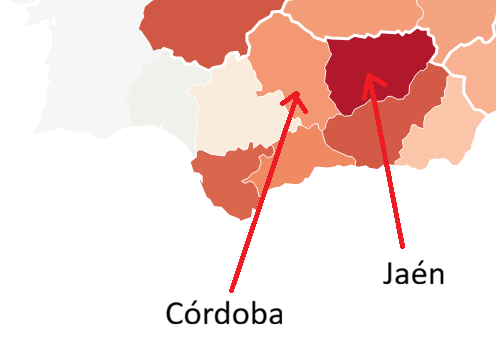
As you can see in the map above, Jaén is located in the northeastern corner of Andalusia and was the Spanish province that experienced the least progress in reducing its illiteracy rate between 1860 and 1900 (reddest province on the map).
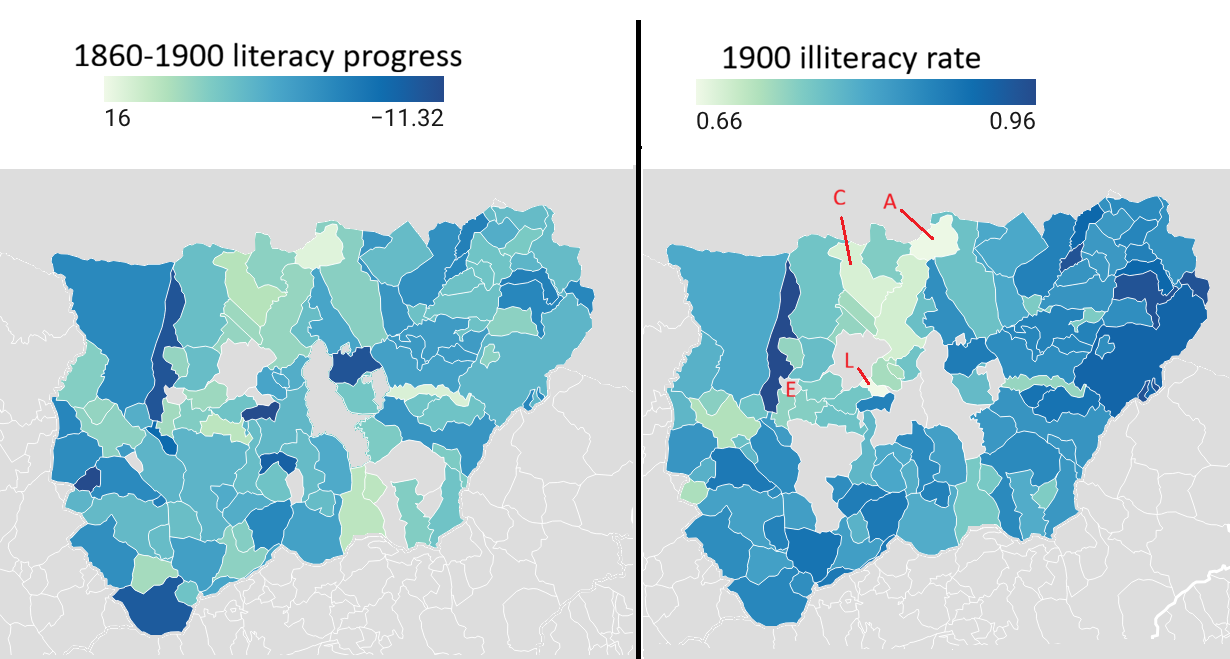
The following maps show illiteracy rates in Jaén (1900), along with progress made in reducing illiteracy (1860-1900) in every municipality of the province.
A few caveats before analyzing the above maps:
To isolate the effect of large cities on literacy, I grayed out the cities of Jaén (provincial capital), Linares, Úbeda and Baeza in the 1900 illiteracy map. Also Linares in the literacy progress map.
I grayed out the municipality of Quesada in the literacy progress map because the 1860 census reported an implausibly low illiteracy rate of 28.9%.
I excluded several other municipalities from the maps, due to errors in their illiteracy rates. You can find the full list here5.
I grayed out the town of Espeluy (letter E on the map), even though I have no doubt that its illiteracy rate in 1900 was exceptionally low (61.2%)6. See below.
Of the two maps, the 1900 municipal illiteracy rates map (right one) appears to show the clearest pattern: two concentrations of lower-illiteracy (lighter colored) municipalities, one in the central area of the province and another one in the north. The literacy progress map on the left shows a similar geographic pattern, though not as obvious and clear.
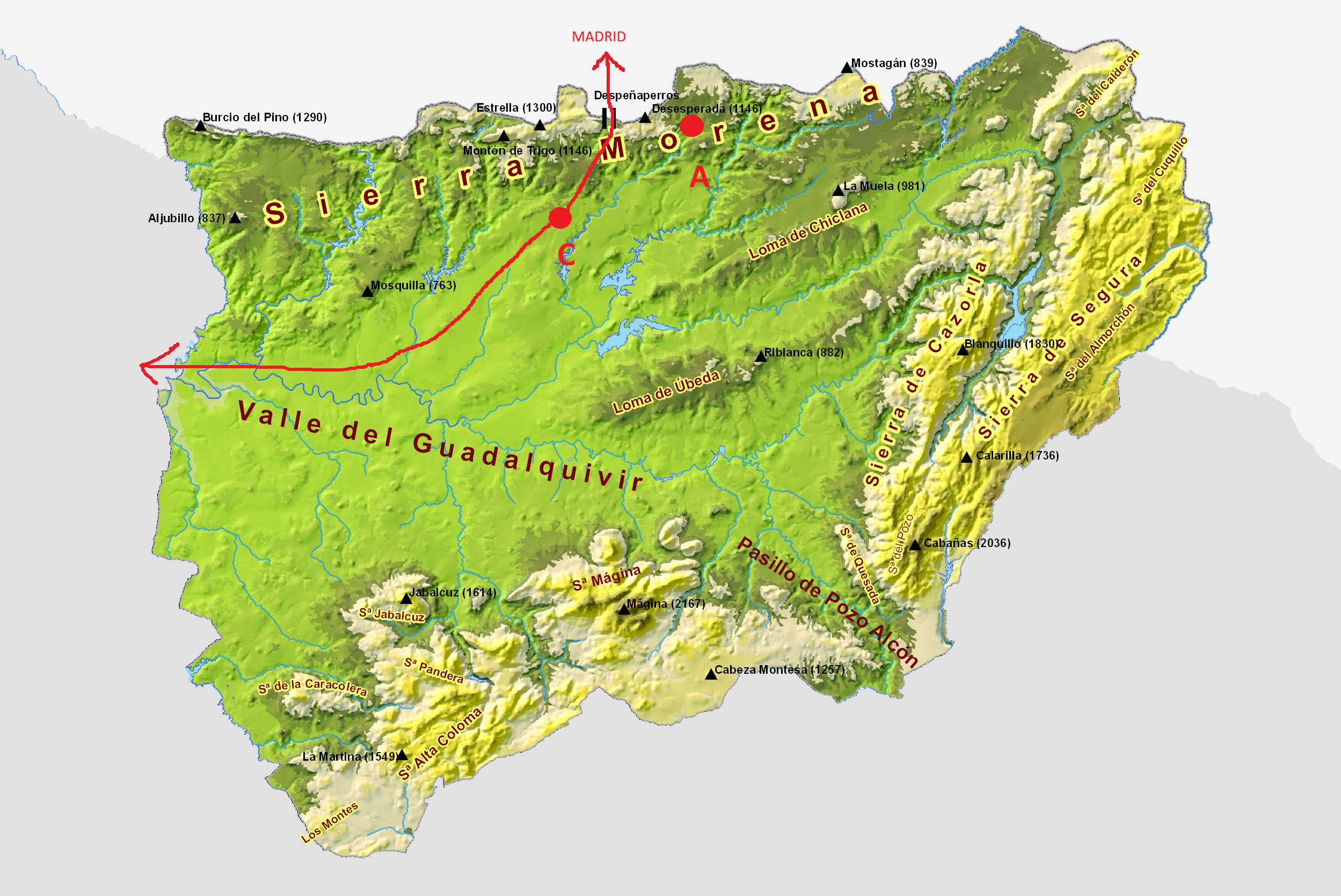
The central area of Jaén province is the most densely populated part of the province. Towns in this area were less isolated than the ones located in the more mountainous southern, eastern and northern border regions. And this proximity to the more urbanized and literate regions of Andalusia probably explains their higher literacy.
You can see this in the following relief map of Jaén, where I’ve marked the locations of La Carolina (C) and Aldeaquemada (A), both in the northern area, with red dots.
#/media/Archivo:Relieve_Provincia_de_Jaen_200ppp.png)
La Carolina and Aldeaquemada were both founded as part of the New Settlements of Sierra Morena and Andalusia. In 1900, both had some of the highest literacy rates in the province, fourth-highest and third-highest respectively. Even higher than the provincial capital. Aldeaquemada also experienced one of the largest drops in illiteracy from 1860 to 1900: 14 percentage points.
The only two municipalities with higher literacy were the previously mentioned Espeluy and Lupión (letters “E” and “L” in the 1900 literacy rates map). I can’t offer any good explanation for why Lupión achieved such a high literacy level (see footnote 5), but I do think I know why Espeluy did. One of Spain’s earliest major railways lines reached Espeluy in 1866, and during the next few decades the town developed into an important railway junction. Given its small population (less than 400), it is likely that a large share of its residents became relatively educated railway workers7.
You might think I’m now going to argue that La Carolina and Aldeaquemada achieved high literacy simply due to the peculiar circumstances under which they were founded in the late 18th century. Well, not exactly.
Mining data
The northern area of Jaén province is not just known as the location of the New Settlements of Sierra Morena colonies, but also as a historic mining region8 by the name of Linares-La_Carolina Mining District. The Romans had already exploited the region’s lead deposits, yet there was little further mining activity until the mid-19th century, when foreign capital and engineers brought modern mining techniques (yes, steam engines) to the Sierra Morena9.
Mining made the region’s towns prosperous and attracted many new residents to work in the mines. The resulting wealth meant more funds for primary schooling, which was probably the main driver of rising literacy, while the new arrivals substantially changed the demographic composition of the colonies.
An illustrative example of the effect of mining wealth would be the municipality of Vilches, sandwiched between La Carolina and Aldeaquemada. Unlike its neighbors, Vilches was not founded as a colony; its history goes back to at least the 13th century. Yet it became an important mining town during the late 19th century, and its literacy rate was almost as high as those of La Carolina and Aldeaquemada. So maybe mining wealth is the real cause of La Carolina and Aldeaquemada’s high literacy?
Well, not quiet. Aldeaquemada was a colony, but it never became a mining town. In fact, it appears to be the Sierra Morena colony that has best preserved its original demographic composition, even to this day10. In contrast to La Carolina, there’s no reason to link its high literacy to Jaén’s 19th-century mining boom.
To summarize, the factors associated with higher literacy in Jaén’s municipalities appear to be:
Being a railway junction (Espeluy).
Being a big city11.
Having been founded as a New Settlements colony (at least Aldeaquemada; maybe La Carolina).
Being a mining town (e.g. Vilches, La Carolina).
This is hardly conclusive evidence for a connection between the 18th-century colonization process and the pattern of literacy rates we see in the 19th century. But we’ve only looked at Jaén province. Let’s now move on to Córdoba province.
Córdoba (which I consider the nicest province of Spain because I live there)
The colonies founded in what is now Córdoba province are sometimes called New Settlements of Andalusia12, to distinguish them from the Sierra Morena ones. Their geographic setting was quite different. Rather than being situated in the foothills and mountain valleys of the Sierra Morena, these settlements lay in the mostly flat central Guadalquivir valley.
Let’s look at Córdoba’s municipal-level illiteracy rates maps.
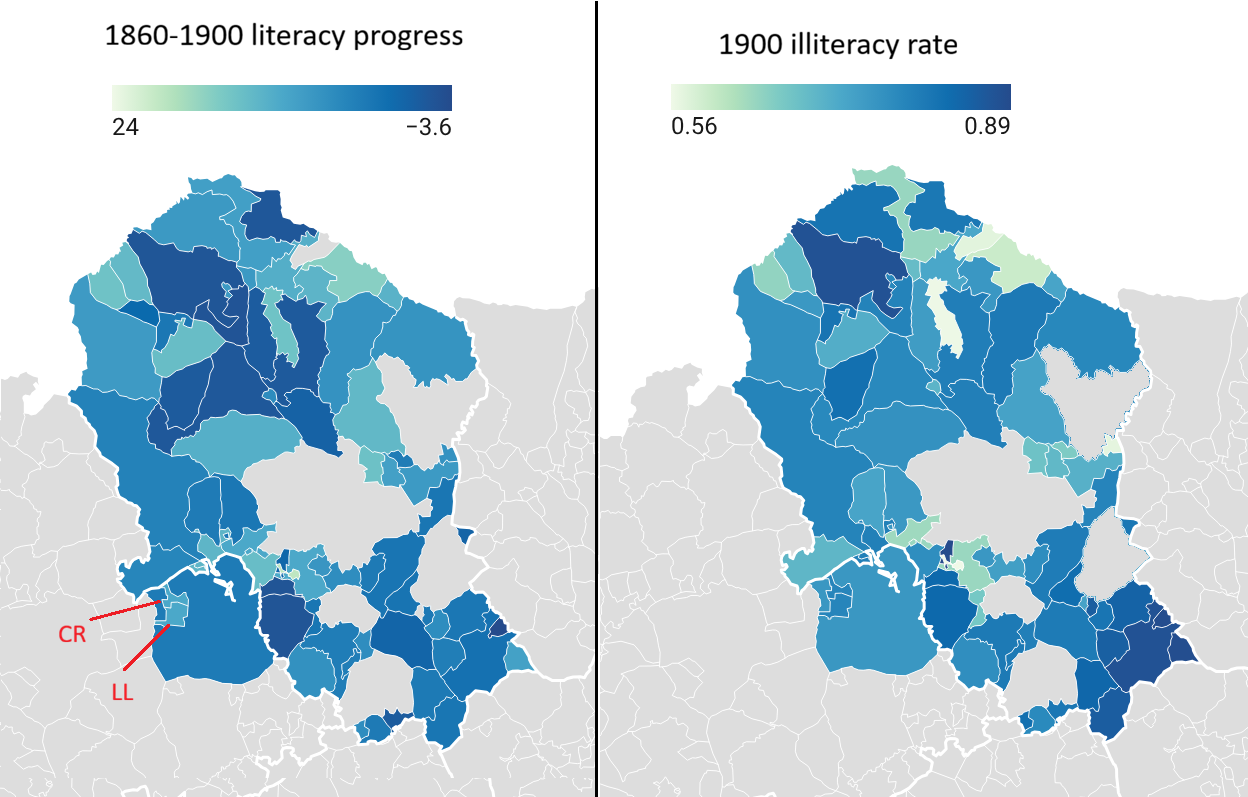
A few points regarding the above maps:
To isolate the effect of large cities on literacy, I grayed out the cities of Córdoba (provincial capital), Lucena, Montoro, Baena and Montilla in both maps.
I’ve included the two New Settlements colonies now located in Seville province: La Luisiana and Cañada Rosal (labeled “LL” and “CR” on the map). I also included the Seville municipality of Écija, even though it’s a big city, because it surrounds La Luisiana and Cañada Rosal.
I grayed out the municipality of El Guijo in the literacy progress map because its illiteracy rates seemed implausible. Several other municipalities had implausibly high (e.g. Alcaracejos, Hinojosa del Duque) or implausibly low (e.g. El Guijo) rates in 1900. In those cases, I calculated their literacy progress as the difference between the 1877 census illiteracy rate and the 1910 rate. You can find the full list here13.
Both maps appear to show similar patterns: higher 1900 literacy rates and greater literacy progress in the northern half of the province than in the southern half. In fact, the only notable area of higher literacy in the southern half lies to the southwest of Córdoba city (the big gray hole in the center of the province).
That southwestern area is where the New Settlements of Andalusia were situated. Let’s zoom in on the area.
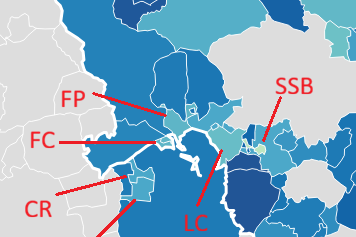
By zooming in, I wanted to make the very small municipality of San Sebastián de los Ballesteros (“SSB” on the map) clearly visible. It’s so small that you can barely see it on the map of the whole province. As you can imagine, San Sebastián de los Ballesteros is one of the New Settlements, but not all municipalities in the area were founded as colonies. The other colonies are:
La Carlota (“LC” on the map). Founded as the main colony in this area.
The aforementioned La Luisiana and Cañada Rosal in Seville province14.
Fuente Palmera (“FP” on the map).
Fuente Carreteros (“FC” on the map). Another municipality with a very small territory15.
The main reason why these municipalities have small and often fragmented territories is that they were assigned whatever unused (or barely used) land was available at the time, and this made it difficult to create larger, more contiguous territories.
San Sebastián de los Ballesteros (SSB from now on) may be tiny, but it is central to the argument I’m trying to make in this post. In 1900, it had the lowest illiteracy rate in the province. It also recorded the second-largest drop in illiteracy from 1860 to 190016. Besides SSB, the other nearby colonies don’t have exceptionally high literacy rates, at least compared with some high literacy municipalities in northern Córdoba or those located immediately east of Córdoba city (the big gray hole in the center of the province).
Regarding these two other high literacy areas, I can’t come up with any reason why the area east of Córdoba city shows higher-than-expected literacy17, yet the northern area does have a strong candidate: a coal mining boom. Although coal mining dated back to the late 18th century in this region, a combination of factors caused a large expansion in the mid-19th century. One was the building of railways connecting the coalfields to the rest of Spain; another was the emergence of lead mining in the Sierra Morena district of neighboring Jaén - as I mentioned earlier - which created a strong demand for coal to smelt the ore.
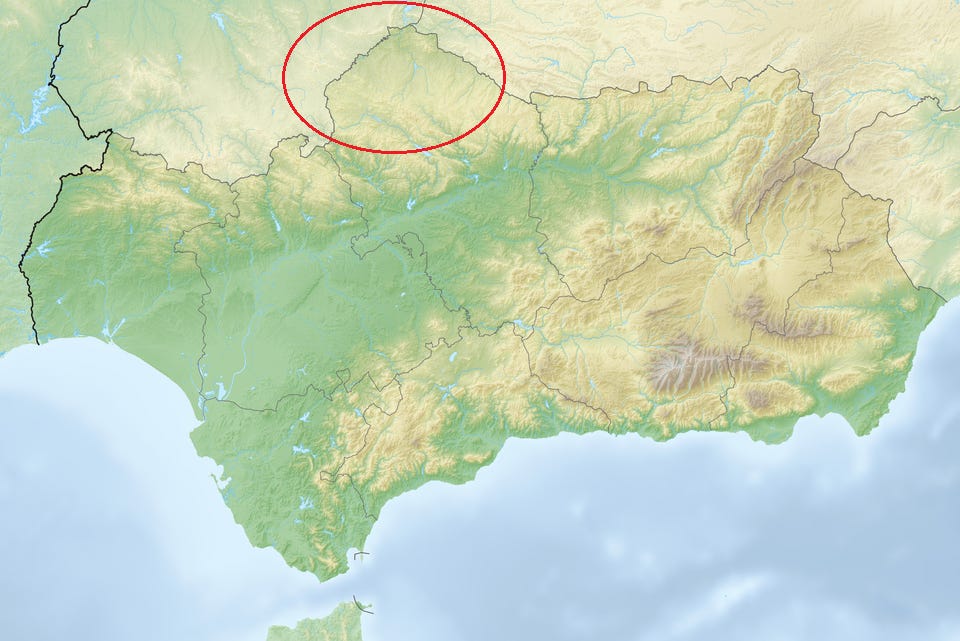
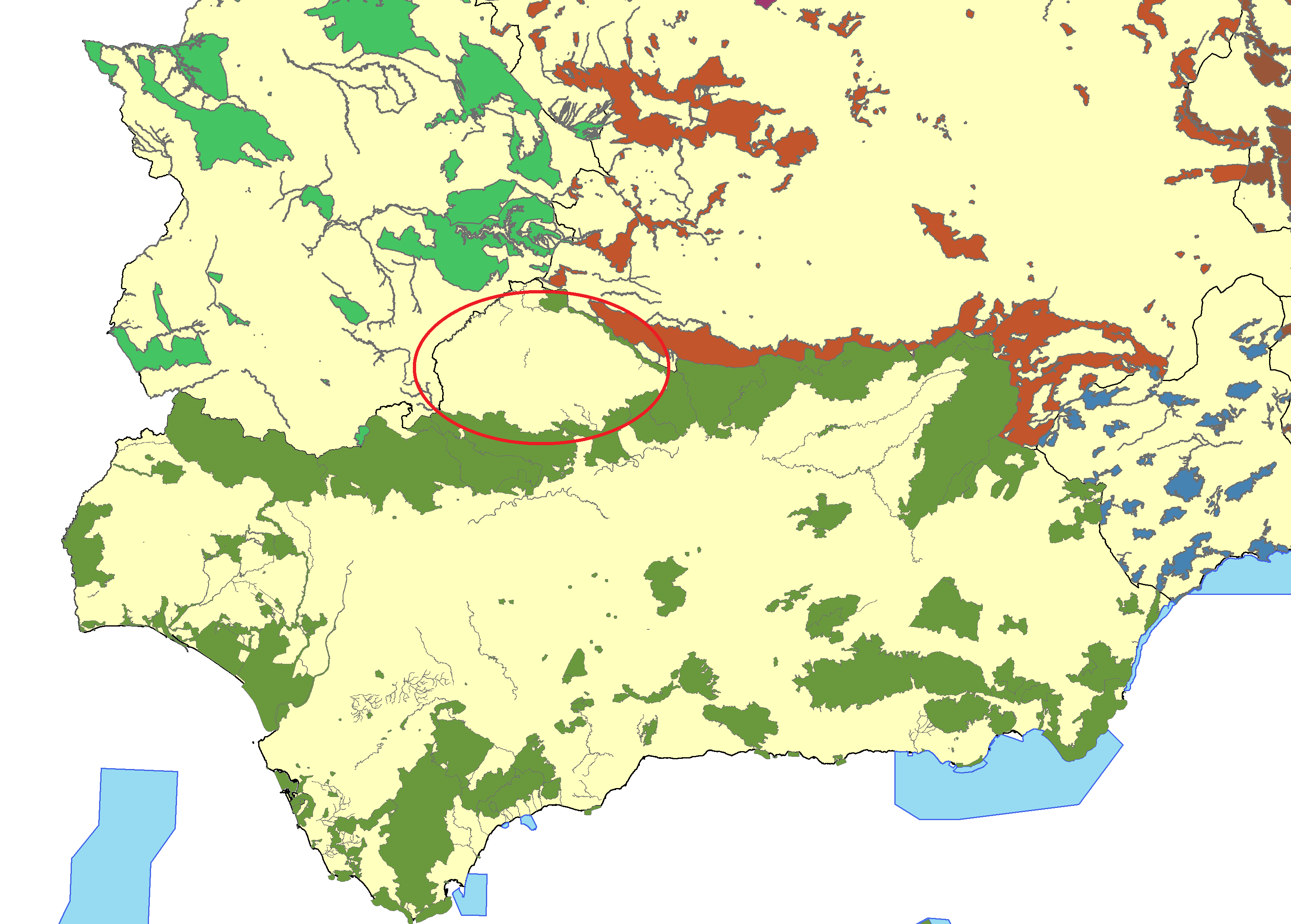
There’s a problem with that explanation though. The municipalities where coal mining was centered on (Belmez, Espiel, Peñarroya, Pueblonuevo, Fuente Obejuna) are not the ones that show the greatest improvement in literacy among northern municipalities. So I have to admit I’m uncertain about the cause of higher literacy in the northern part of Córdoba province. Nevertheless, the geography of the area suggests another possible explanation. As you can see in the following map, northern Córdoba is separated from the rest of the province by the Sierra Morena mountains, and its landscape has more in common with the neighboring areas of Badajoz province to the northwest and Ciudad Real province to the northeast)18.

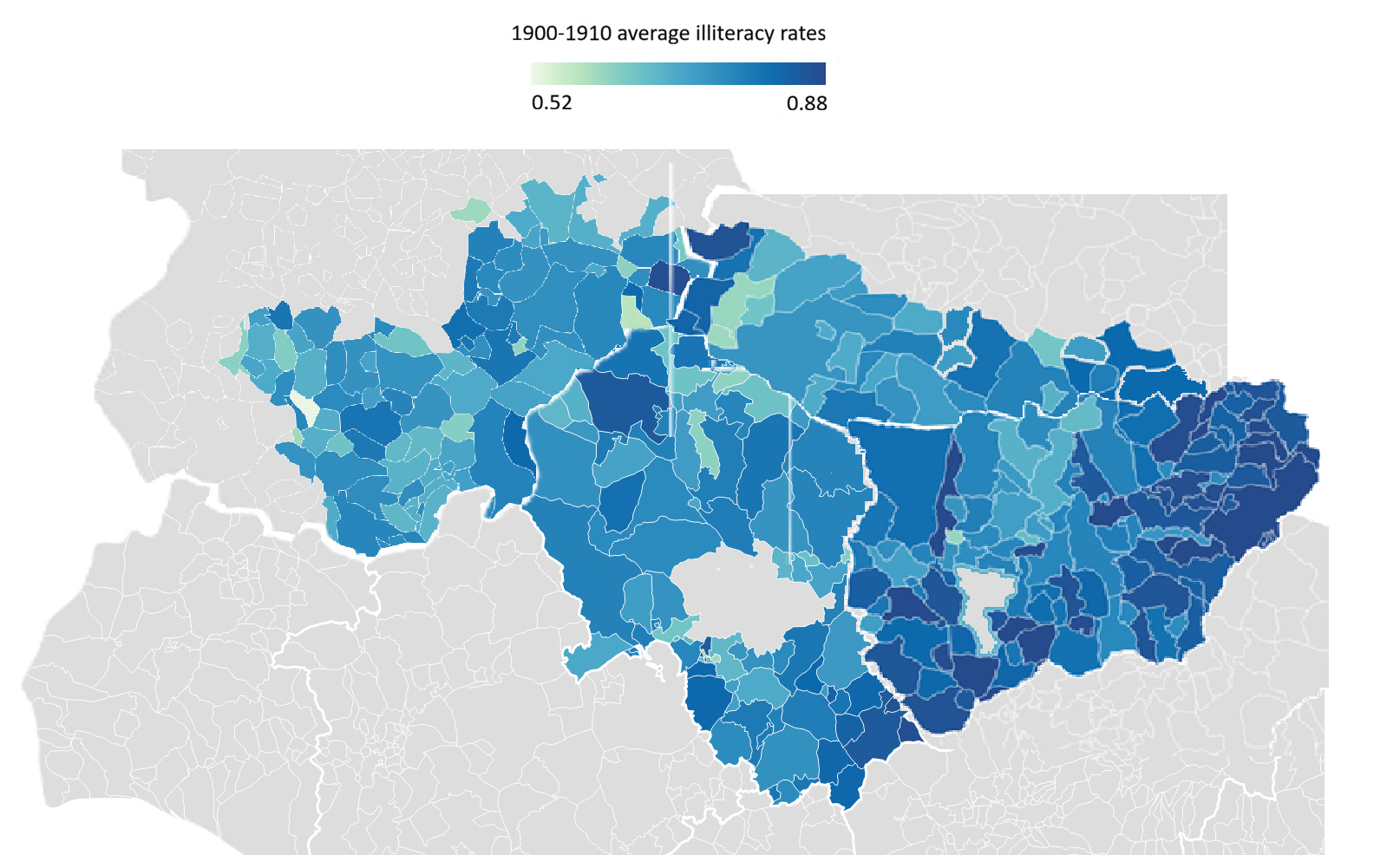
In fact, a few municipalities across the border in Ciudad Real also show very high literacy, as you can see in the very crappy map you can find here19. A possible explanation then is simply that Córdoba province follows the general Spanish pattern: the further north, the higher the literacy. And the population of northern Córdoba seems to share this trait with populations to its north.
Regarding why SSB’s non-Andalusian population appears to have had such a strong effect on its literacy while nearby colonies (such as La Carlota) don’t show similarly high rates, this is likely a function of SSB’s higher share of non-Andalusian colonists and their descendants. Although we don’t have 19th-century data on the proportion of SSB’s residents who were descendants of settlers, we can roughly estimate their share by looking at the number of non-Andalusian surnames among present day SSB-born people20.
That share is 44.4%. A rough estimate of non-Andalusian ancestry in San Sebastián de los Ballesteros would be around 40%-50%. For comparison, applying the same methodology to La Carlota21 gives a rough estimate of less than 10%22, and for La Carolina around 7%-8%. The less Andalusian town is the one with the highest literacy.
To summarize
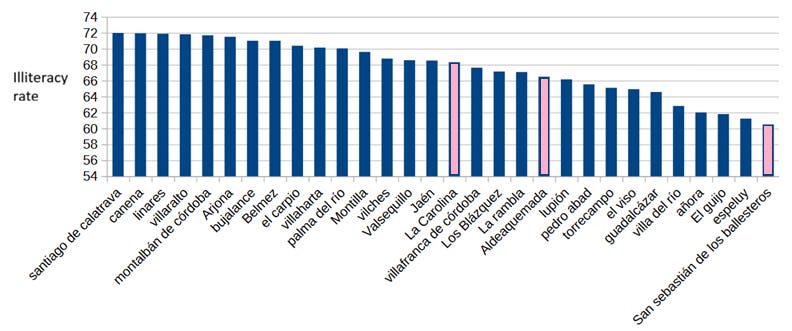
How unusual were the low illiteracy rates of San Sebastián de los Ballesteros, La Carolina, and Aldeaquemada in high-illiteracy Andalusia? Are they unusual enough to attribute them to their partially non-Andalusian populations? I can’t be completely certain, but I believe their population is very likely the reason for their exceptional performance.
In case you are not yet convinced of how exceptional these towns were - or the maps weren’t clear enough - here is a bar chart showing the 30 municipalities with the lowest illiteracy rates in Córdoba and Jaén provinces (out of 178 total).
If Andalusia’s low literacy in the 19th century indeed had an endogenous cause, that would seem to fit with the persistent low academic performance that the region has exhibited until today, as I discussed in my previous post.
And any alternative explanation would have to account for how the former New Settlements, despite being subject to the same institutions as the rest of Andalusia, achieved such high literacy levels.
I’m sorry for the delay in posting this piece. I had to transcribe all the census illiteracy data by hand, and it took me longer than I expected. The good news is that all the data is here (including even more municipalities), in case anyone wants to take a look.
Not the only reason they were unappealing. Sparsely populated areas generally corresponded to regions with poor or infertile soil where yields would have been low, particularly in the lower Andalusia area.
Not everyone liked the new colonies though. Some of the land given to the settlers used to be the commons of neighboring villages and cities. The residents of those villages and cities decided to express their displeasure by burning the colonists’ houses and fields.
There were still a few reports of German use in the colonies during the 1840s.
The rapid improvement in literacy in Huelva might be related to the mining boom that the province experienced during the second half of the 19th century. Perhaps Seville province could also be considered an exception, but I haven’t had time to take a closer look at Seville yet.
Villardompardo (only progress map): 97.4% in 1860, 83.5% in 1877, 78.7% in 1900, 71.1% in 1910; the drop from 1860 to 1877 seems implausibly large. Lupión (only progress map): 84.5% in 1860, 69.4%, 66.1%, 61.4%; the 1860 rate seems inconsistent with later rates. Albanchez de Mágina (only progress map): 93.8%, 86.2%, 80.1%, 85.9%; the 1900 rate seems inconsistent with all other rates. Hinojares (only progress map): 86.0%, 71.3%, 75.5%, 77.2%; rates are all over the place. I did not exclude a few municipalities that showed suspiciously large declines in literacy: Villanueva de la Reina (possible error in 1900 rate); Higuera de Calatrava; Sabiote (possible error in 1900 rate); Begíjar (possible error in 1900 rate).
I excluded Espeluy from the literacy progress map (91.1% in 1860, 61.2% in 1900) because its improvement was so great that it distorted the general pattern seen on the map. But I’m certain that it’s low illiteracy rate and very rapid increase in literacy are real, and due to its development as a major railway junction.
Something similar happened in Moreda, Granada province, which became an important railway junction when a major railway line was built through the municipality (1890-1899). Illiteracy dropped significantly, from 96.5% in 1877 to 82.3% in 1900.
Officially, the area is known as Comarca de Sierra Morena, which I’ve decided to translate as The Dark Mountains Shire.
If you are interested in the history of mining in the Sierra Morena, I recommend this article.
Looking at the list of former mayors and current municipal councillors of Aldeaquemada, you can see several Catalonian and Valencian surnames (though no German or French ones).
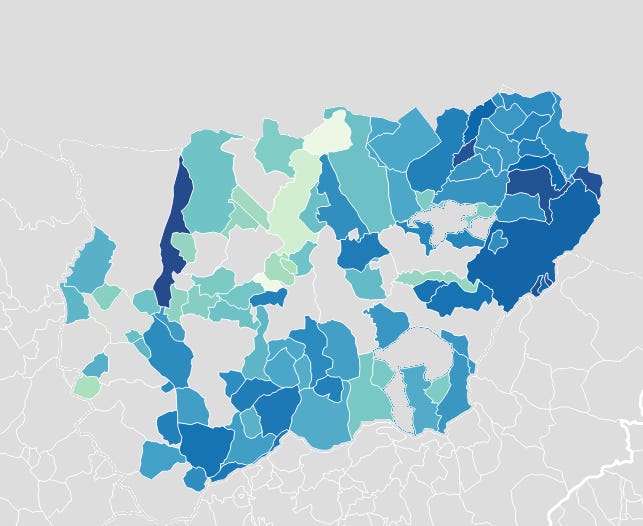
To highlight how exceptional other high-literacy municipalities were, I created another illiteracy rates map that excludes all municipalities with more than 7,000 people in 1900. Notice that La Carolina (population 9,726 in 1900) is also grayed out.
One of the New Settlements of Andalusia, La Luisiana, was actually founded in what is now Seville province, although located close to the Córdoba colonies.
Alcaracejos: 68.1% in 1860, 68.0% in 1877, 74.7% in 1900, 69.7% in 1910; La Granjuela: 64.2% in 1860, 71.6% in 1877, 75.4% in 1900, 70.6% in 1910; Belalcázar: 63.8% in 1860, 86.7%, 81.9% in 1900, 78.2% in 1910; Los Blázquez: 87.1%, 83.7%, 64.6%, 69.6% ; El Guijo: 85.6%, 75.9%, 57.1%, 82.1%; Hinojosa del Duque: 80.6%, 78.5%, 88.0%, 81.9%; Torrecampo: 84.4%, 86.4%, 59.4%, 70.7%; Villaharta: 87.0%, 75.3%, 70.5%, 69.7%; Villa del Río: 75.9%, 72.1%, 56.8%, 68.8%; Villaralto: 92.1%, 82.6%, 69.0%, 74.6%.
Actually, Cañada Rosal only became an independent municipality, splitting from La Luisiana, in 1986. Which is really annoying because it seems to be the second Córdoba colony that has best preserved its original demographic composition.
Fuente Carreteros only split from Fuente Palmera in 2018.
The largest drop was experienced by El Guijo, but I don’t trust El Guijo’s numbers. See footnote 13.
The municipalities in this area are: Villafranca de Córdoba, El Carpio, Villa del Río, Pedro Abad.
You can also see this in a map of Spanish Special Areas of Conservation. Northern Córdoba is clearly separated from the rest of the province by the conservation areas of the Sierra Morena - essentially sparsely populated or unpopulated areas.

Composite map of average illiteracy rates (1900-1910) for Córdoba and Jaén provinces, along with the bordering areas of Badajoz and Ciudad Real. I didn’t want to gray out municipalities with suspicious - likely erroneous - data, so I averaged 1900 and 1910 rates instead. This means some municipalities’ rates might still be inaccurate, but not the near-white one (52.7%) on the left end of the colored area; that is the town of Zafra, in Badajoz province, and I’ll explain its exceptionally high literacy in a future post.
The sources are Wikipedia’s list of people born in San Sebastián de los Ballesteros and the current list of SSB’s municipal councillors. If you click on the second link, you may notice something else unusual besides the large number of non-Andalusian surnames. I will address that something else in a future post.
Using the exact same methodology gives a non-Andalusian share of 7.1%. I chanced upon a Wikipedia article about a football player born in La Carlota who has one non-Andalusian surname. Including him in the calculation would raise the estimated share to 9.1%.