

Israel has one of the lowest divorce rates for a developed country.
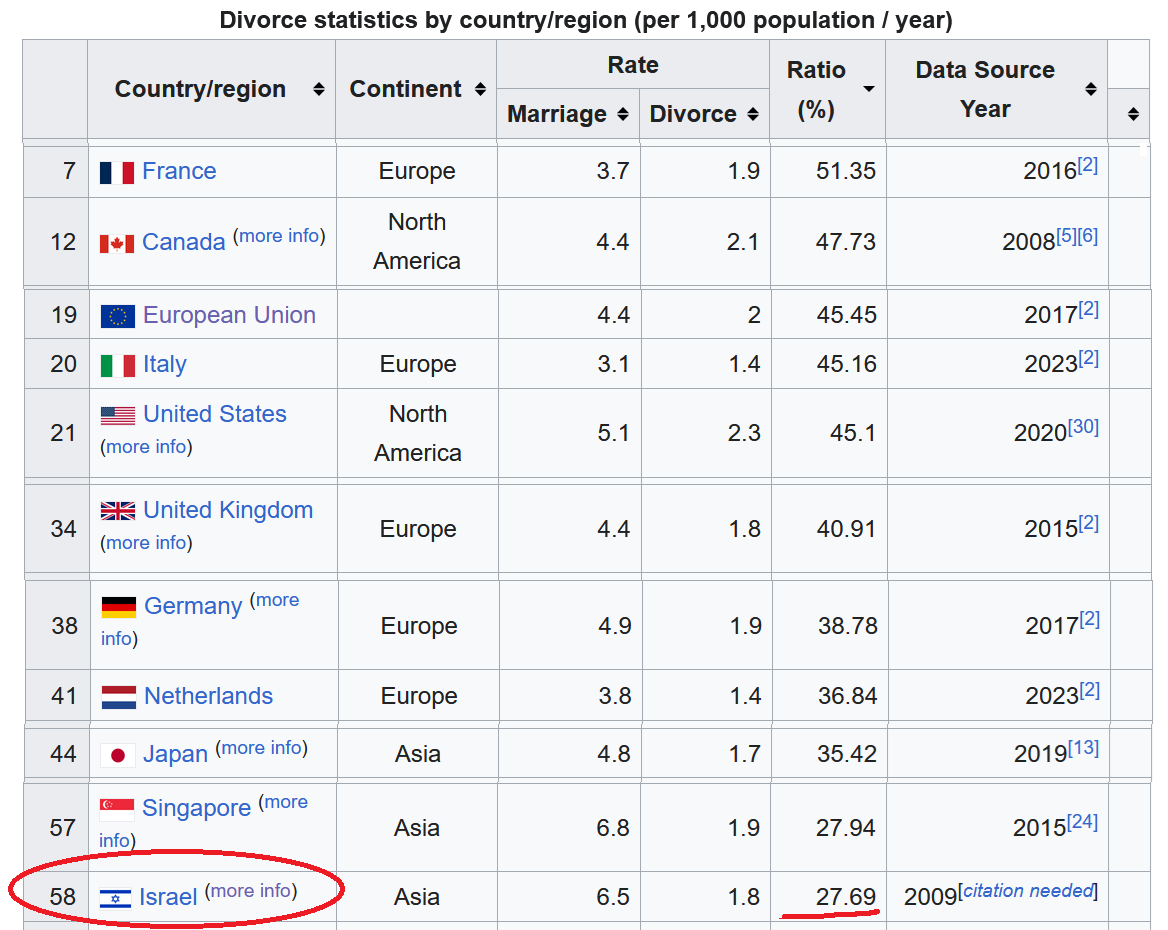
In fact, second lowest in the world, according to Wikipedia. Here’s a theory:
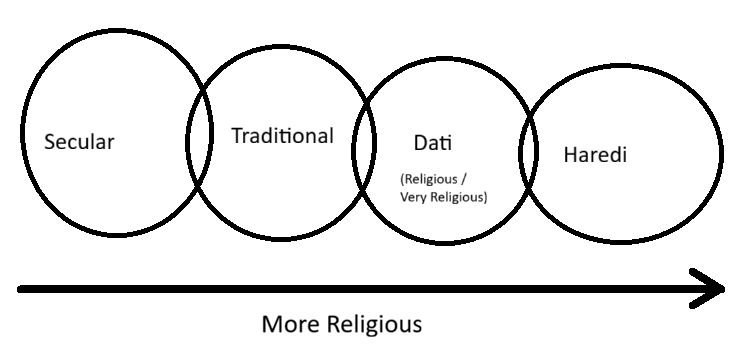
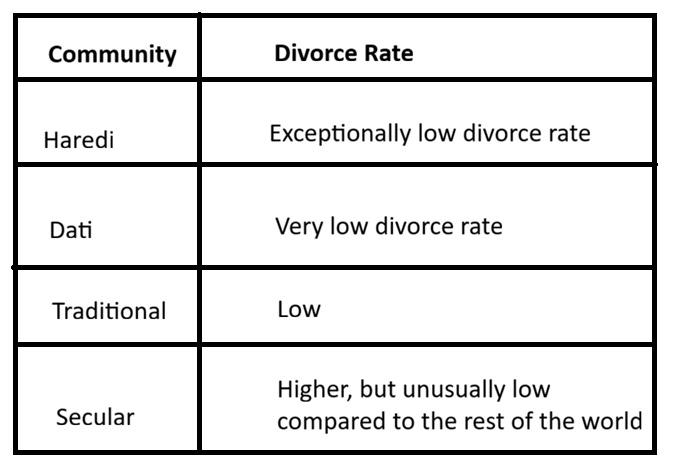
Haredi Jews (the ultra-orthodox) have exceptionally low divorce rates wherever they live. For any reason that a married couple might cite for divorce, Haredi society will counter it with a better reason to stay married. Thing is, in Israel, there are other religious communities - less religious than Haredi - who draw inspiration from the Haredi and are influenced by them. These communities, like the Dati, provide a one-way channel of influence between Israeli Haredi and the rest of Israeli society, a sort of valve in which Haredi marriage/divorce memes can spread outwards, without allowing pro-divorce memes inwards1.
This theory - let’s call it mimetic theory of Israeli divorce rates - explains not only Israel’s very low overall divorce rates, but also why even the most secular group in the country, Secular Jews, have lower divorce rates than those seen in other developed countries. Anti-divorce memes propagate step by step, from the Haredi community all the way down to the Secular community.
Now that we’ve got a theory, what should we do with it?
I now want to test the theory against the available data. If the theory successfully predicts what the data shows, that would strongly suggest it’s right. If it can’t predict correctly, that would make me doubt it’s validity.
But before we proceed, let me clarify that the old 27.69% divorce rate (year 2009) shown in the image above is very similar to the current rate. This rate is calculated as the number of divorces that took place in a given year, divided by the number of marriages2.
Once again, I will use data from Israel’s Central Bureau of Statistic (CBS) to estimate divorce rates, taking advantage of the very different distributions of religiosity groups across Israeli cities, just like I did in the last couple of posts. To arrive at the divorce rate of a city in a certain year (let’s say a Haredi city), I’ll just divide the number of divorces recorded that year by the number of marriages in the same year.
Actually, the CBS also publishes marriage and divorce numbers for local councils - an administrative unit for smaller towns - and regional councils (grouping several minor localities), allowing us to broaden our search for overwhelmingly Secular localities, overwhelmingly Dati localities, etc. This will enable us to examine a larger sample and calculate a rate for each locality in the sample, beginning with overwhelmingly Haredi localities.
So, is Haredi divorce as rare as the theory says?
These are the average divorce rates (years 2021, 2022) for the five Israeli cities and local councils where more than 80% of households are Haredi:

So, the Haredi divorce rate is somewhere around 11.6%3. That’s higher than Vietnam, yet far below the divorce rate of any developed country. So far, so good. Let’s move on to the Dati.
Since the Dati are (apparently) less averse to mixing with other Israelis than the Haredi, it’s harder to find localities that are overwhelmingly Dati. This means I had to relax the requirement for what constitutes “overwhelmingly”, and accept any locality with more than 70% Dati households. And here are the results, averaged across 2021 and 2022.

For comparison, North Macedonia and Ireland seem to be the only European countries which show divorce rates clearly lower than the Dati one. This is precisely what the mimetic theory predicts. The Dati community has a very low divorce rate, around 20%, but not as low as the Haredi community.
Ideally, we should now check the next step in the mimetic transmission chain: the Traditional religiosity group, constituted by those who are partially observant yet not secular. But, as I mentioned in my previous post, there are no overwhelmingly Traditional cities and I couldn’t even find local councils or regional councils that could be described as such. So, I’ll skip the Traditional group, and go straight to the least religious group, Secular Israelis.
One step forward, one step backwards
Let’s now see the table of divorce rates for overwhelmingly (more than 70% of households) Secular administrative units.
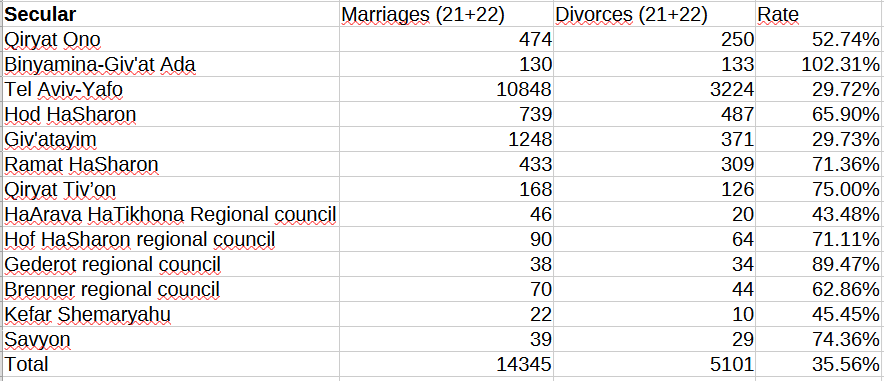
35.56% is certainly higher than the Dati rate, but still lower than almost every developed country, except Japan (divorce rate 35.42%). Japan is weird, right? That’s it. The mimetic effect of low-divorce Haredis, and Datis, is strong enough to produce a weirdly low divorce rate in Secular Israelis…
…yet, a few localities look suspiciously high-divorcy. In fact, most localities have a suspiciously high rate, and the average total rate is mostly a product of Tel Aviv-Yafo having the most population by far.
At this point I feel obliged to note that 2021 was not a normal year4. It was a Covid year. Maybe the large variation in rates across localities is driven by the disruptions that took place in 2021. Just to be on the safe side I decided to calculate the divorce rates again, expanding the time period to four years: 2019-2022. With the addition of 2019 and 2020, the average divorce rate now raises to 40.59% - you can see the table in this footnote5. But instead of gloating over the higher rate (which would be highly inappropriate; that’s a lot of divorces), I’ll try to do something more interesting.
While I was updating the divorce rates table with 2019-2020 data, I remembered that Tel Aviv-Yafo is, strictly speaking, a mixed city. Mixed cities are those with more than 10% of the population registered as “Arabs” and more than 10% of the population registered as “Jews”. And even though Tel Aviv’s current Arab population is no more than 5% of the total (higher historically), it has such a high concentration of “Others” (non-Arab, non-Jewish residents) that the Jewish population of the city is only 84.2% of the total. And while most of that 84.2% are Secular Jews, not all of them are, reducing the Secular Jewish share to maybe 60%-65%. Tel Aviv has a lot of non-Secular or non-Jewish population.
But rather than continue by excluding Tel Aviv from the sample, I decided to go one step back. Remember how we skipped the analysis for the Traditional group? I now wanted to estimate what the Traditional divorce rate might be, even if very roughly.
First, I calculated the divorce rate for cities6 where 90% or more of households are either Secular or Traditional, with a Traditional share below 24%, to ensure the sample is overwhelmingly Secular. Then I assembled a group of cities where 85% or more of households are either Secular or Traditional, with at least 26% Traditional. This second sample is shifted towards Traditional Israelis and therefore allows us to see whether divorce rates differ from the Secular sample and, if so, how big is the difference.
And here are the tables for the first and second group of cities, with their computed divorce rates:


There’s a gap between average divorce rates for the Secular-shifted and Traditional-shifted samples, yet it’s a small one.Admitting the limitations of this approach to estimate divorce rates, I believe the Traditional rate does not fall below 40%. And as for Secular, it’s almost certainly above 50%.
Conclusion
As you probably know by now, this post is not truly about Israeli divorce rates, but about Israeli fertility rates. I made up the “mimetic theory of Israeli divorce” as a parallel to the mimetic theory of Israeli fertility. The feature of family life this theory addresses is different - divorce as measured by the divorce rate instead of fertility as measured by TFR - but the proposed mimetic mechanism remains the same, emerging naturally from the structure of Israeli society and the interactions among its religiosity groups.
I want to know if the mimetic mechanism is real, and after examining how much interaction there is between religiosity groups in my last post, I’ve now tried to see the outcome the mechanism should produce in family life, focusing on a metric other than TFR. And I can’t see it.
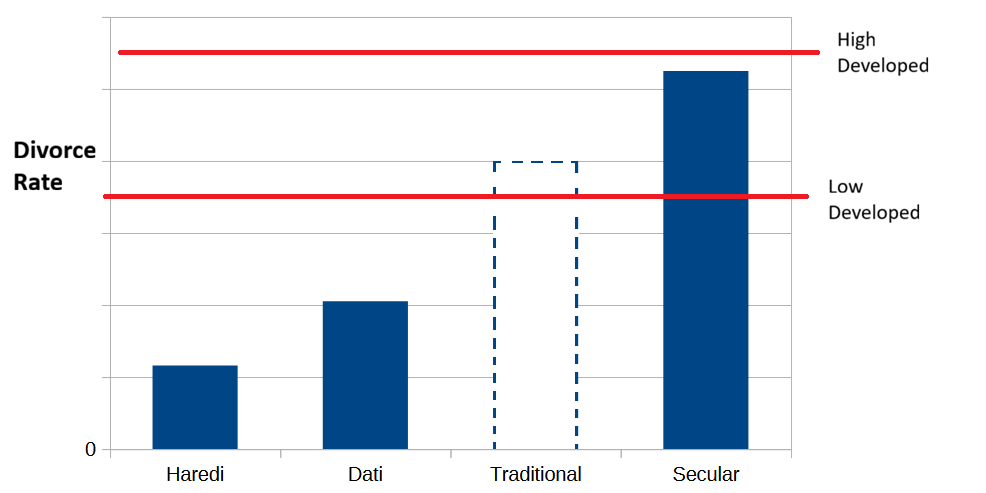
Haredi and Dati divorce rates are as low as you would expect them to be, but not the Secular one, and likely not the Traditional one either. If the mimetic mechanism truly exists, it has no effect on Secular divorces even though it raises fertility. It’s as if divorce outcomes are divorced from family fertility outcomes.
Of course, this isn’t a final refutation of the mimetic theory of Israeli fertility. It could be that some features of family life are affected by it while others aren’t. And it could be that the mimetic effect reaches down to the Dati and Traditional communities, but isn’t strong enough to influence Secular Israelis.
As of now, I’m less confident of the veracity of the mimetic theory of fertility than I was before. And I’ll keep digging into the data.
Yes, I’m unabashedly plagiarizing Nonzionism in this paragraph. Nonzionism, if you are reading this, I’m sorry I butchered your prose this way.
This of course doesn’t take into account temporal effects. Those who divorce in a given year do not hail from the group of those married in that year. Divorce rates for the last two years with available data (from tables 5 and 15 of the CBS) are 31.87% (2021) and 29.74% (2022).
This confirms “wherever they live“. American Haredis appear to have a divorce rate of around 10%.
Why did I choose it? Because the CBS does not have marriage and divorce data for the years 2023 and 2024.
Average divorce rates of Secular cities, local councils and regional councils (2019-2022):

Regional councils and and local councils have small populations and would not alter the results of this analysis. Percentage Jewish for some of the cities in the samples: Nes Ziyyona 97.1%, Giv’atayim 94.8%, Qiryat Tiv’on 95.4%, Qiryat Bialik 89.2%, Hod HaSharon 96.3%, Ramat HaSharon 96.2%, Rishon LeZiyyon 89.3%, Holon 90.1%, Nahariyya 83.4% (excluded from sample), Qiryat Yam 81.1% (excluded from sample), Tirat Karmel 91.4%, Herzliyya 93%, Qiryat Ono 95.3%, Even Yehuda 97.1%, Azor 91.4%, Kefar Yona 96.6%,
I don't think divorce is mimetic in the way fertility is. Obviously, it's somewhat mimetic, because basically any form of behaviour is mimetic, but it's not characteristically mimetic, or at least I haven't seen anyone claim it is.