

In my last post I examined one measurable aspect of family life in Israel, divorce rates, under the premise that, if the memetic theory of Israeli fertility is correct then the theory’s mechanism should influence divorce patterns just like it influences fertility - the only difference being that instead of raising the Secular Israeli fertility rate, it should lower the Secular Israeli divorce rate.
Well, the data on divorce rates shows no evidence of the proposed mimetic influence.
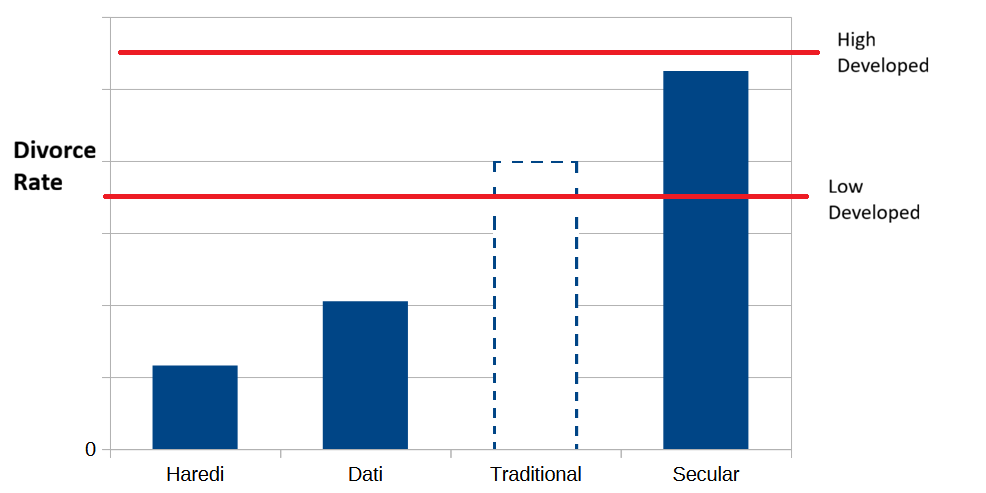
However, that’s just one aspect of Israeli family life that I’ve examined. I’m not saying that divorce is a minor feature, but it’s just one among several measurable aspects of family life that could (or should) be impacted by the theory’s mechanism.
If we want to take a look at aspects more closely related to fertility, then choosing divorce as the first one to analyze was a mistake. Before divorce comes marriage; in fact, before having children, most couples marry. Perhaps I should have looked at marriage data before reviewing the data on divorce rates. So, let’s do that now.
But before I continue, a caveat: the rest of this post assumes you are familiar with the four religiosity groups in Israel’s Jewish population. If you are, you can safely skip the following note. If not:
(Note: The four Jewish Israeli religiosity groups are, from most religious to least: Haredi, Dati, Traditionals and Seculars.
The Haredi - also known as Ultra-Orthodox - usually live in close-knit communities, devote much of their lives to the study of the Torah and generally follow a very conservative lifestyle. They constitute roughly 8%-9% of the adult population of Israel, but around 13% of its total population due to their exceptionally high fertility.
The Dati, also know as Religious Zionists (classified as Religious / Very Religious by the CBS), practice their Jewish faith rigorously yet do mix and mingle with other groups far more than Haredis. Approximately 10% of Israel’s population is Dati.
Traditional Israelis are neither strictly religious nor secular, following Jewish religious precepts to varying degrees. They are predominantly of a Mizrahi (Middle Eastern) origin rather than an Ashkenazi origin.
Finally, Secular Jews are, as their name implies, non-religious, and comprise the largest group among Jewish Israelis.)
Haredi and Dati marriage
Haredis (Ultra-Orthodox) Israelis give huge importance to marriage. In fact, the emphasis they put on marriage seems to be increasing over time, to the point where the proportion of women who have never married is higher in older age cohorts than in younger ones.
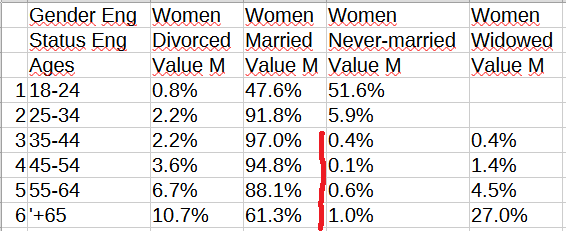
It’s very rare for a Haredi woman to reach old age without having married, and it appears to be getting rarer. On average, in overwhelmingly Haredi localities, the percentage of women and men 65 and older who have never married is close to 1%. Not zero, but pretty low.
I won’t show you the table with never-married percentages of 65+ women in overwhelmingly Haredi localities because it adds little of value. But I will show you the corresponding Dati table.
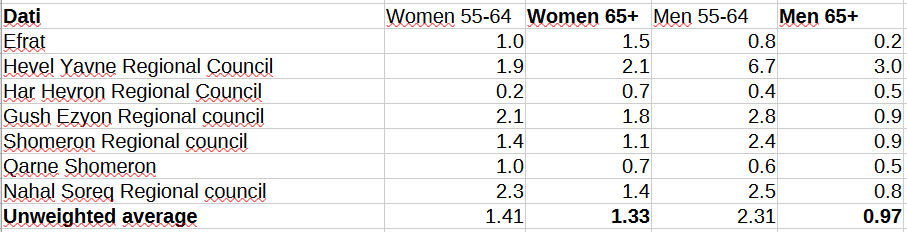
A caveat: data on never-married Israelis aged 65 and older in local councils is much harder to find than divorce statistics, forcing me to drop local councils from the Dati sample1. To compensate for this I had to lower the “overwhelmingly Dati” threshold (again), so take these percentages with a big grain of salt. The new threshold is 60% of households or more.
That being said, the above table suggests large variation across localities in the number of never-married 65+ Datis, while implying that unmarried men and women in the oldest cohorts are rare (1.33% for 65+ women), though not as rare as among Haredis. It appears that marriage is almost as important for Datis as it is for Haredis.
Yet, I haven’t explicitly stated what is the yardstick against which I’m measuring Haredi and Dati marriage. Is a 1% or 1.33% never-married rate truly low? And compared to what?
To answer those questions, let’s move on to the next two religiosity groups in Israeli society: Traditional and Secular. As in my previous post, I won’t be able to estimate the Traditional never-married rate directly, but we should get a rough idea of its magnitude, along with a more precise estimate of the Secular rate.
Traditional is marriage
Just like I did in my analysis of divorce rates, I assembled two samples of localities that are overwhelmingly Secular and Traditional2; one of them is more Traditional-shifted, with a larger share of Traditional households (28% or more)3, while the other is more Secular. However, as I’ve already mentioned, the localities for which Israel’s Central Bureau of Statistics (CBS) publishes marital status data are not the same as those for which it publishes divorce data4. As a result, both samples are larger than the ones I used in the divorce post.
First, let’s see how the Traditional-shifted sample does, and please note that the average never-married percentage shown below is unweighted (not adjusted for population sizes).
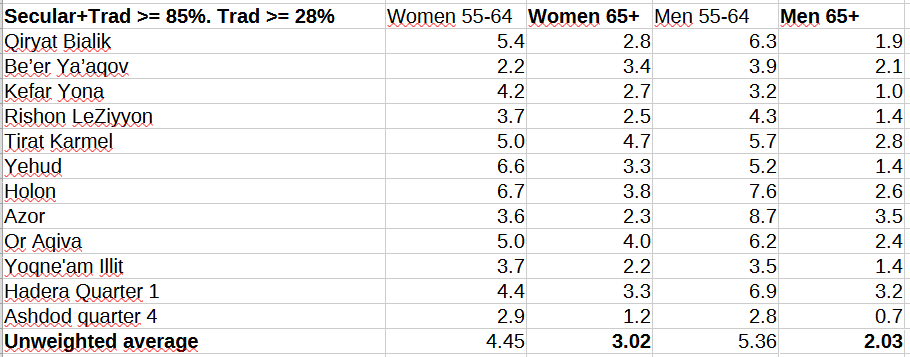
These percentages of never-married 65+ women and men are significantly higher, often double or more, than the percentages for the Haredi and Dati communities. But are they as high as those seen in most developed countries?
Here are a few never-married rates for selected countries:
United States: 6.4% of women aged 65+ and 6.9% of men aged 65+ have never married. Source is 2022 American Community Survey, and it’s corroborated by the census’ Current Population Survey (see Table A1 “Marital Status of People 15 Years and Over, by Age and Sex: 2022“).
Germany: I can’t find the exact numbers, but according to the Federal Office of Statistics it appears to be between 5% and 6% for both sexes.
England and Wales: Roughly 5.1% of women aged 65 and older and 7.8% of men. Source is 2021 census (see Figure 2 and accompanying Excel file).
Japan: 4%-6% of 65+ women and 6%-8% of men. Source: Grok. [UPDATE: Japan’s rate is 5.2% for both sexes.]
Canada: 7.9% for women and 8.5% for both sexes according to Statistics Canada data.
The answer is no. The never-married rates in the Traditional-shifted localities sample are substantially lower than rates in developed countries. And of course, the Dati and Haredi rates are extremely low compared to developed country rates.
Regarding divorce rates, I didn’t see any evidence for mimetic influence on the Traditional community, but now I tentatively do for never-married rates. Since there are no overwhelmingly Traditional localities whose marriage data I can examine, I must rely on the mostly Secular yet Traditional-shifted localities in the sample above to get a sense of what the Traditional rate might be. And it’s almost certainly lower than the average rates of developed countries, which aligns with the predictions of the mimetic theory.
So, one point for the mimetic theory.
Now, let’s check the second sample, comprised of Secular-shifted localities.
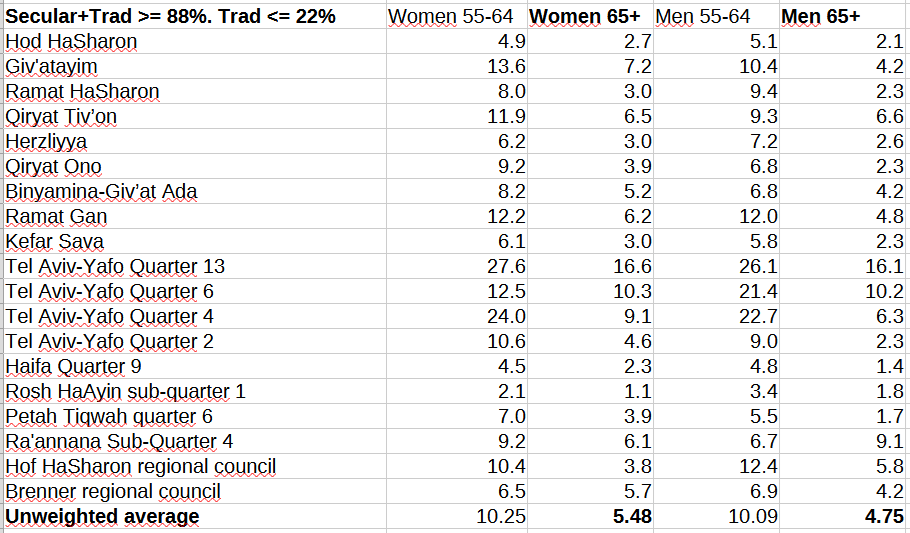
Well, that’s certainly higher. My very rough estimate puts the never-married rate for 65+ women in overwhelmingly Secular localities at 5.48%, well within the developed country range. Though the men’s rate appears to be lower than the typical percentage of never-married men in developed countries.
There’s a couple of points I want to make about these numbers. First, these “overwhelmingly” Secular localities are not 90% Secular; not even 80% Secular. The true Secular never-married rates are likely higher than these. Also, the gap between the >= 28% Trad sample and the <= 22% Trad sample is substantial, two and a half percentage points, which suggests that the Traditional rate is quite low, but also that a hypothetical 100% Secular population (0% Trad) would show a never-married rate significantly higher than 5.48%.
Second, the Secular rate for men is clearly lower than for women5, contrary to what appears to be the case in most developed countries. I’m not sure what to make of this, and I hesitate to link it to the mimetic theory, partly because if the true male rate is actually higher, it might very well fall within the developed country range.
So maybe the Secular men’s never-married rate lends some support to the theory; but maybe not.
Did you happen to notice that each of the three never-married rate tables (Dati, Traditional-shifted, Secular-shifted) includes two additional columns besides the ones for 65+ women and 65+ men?
These additional columns show the percentages of never-married women and men between the ages of 55 and 64. By comparing them to the values in the 65+ columns we can try to determine whether never-married rates are increasing or decreasing over time in the Dati and Secular communities.
In contrast to what I observed for the Haredi, Dati never-married rates appear to be slightly increasing in younger generations, though that’s far from certain. But in the case of Secular Israelis the trend is very clear: men and women in the younger cohort (55-64) are substantially more likely to have never married than those in the 65+ group6.
This also challenges the mimetic theory, since never-married rates in developed countries appear to be increasing, just like Secular Israeli rates, rather than decreasing like the Haredi ones.
From no marriage to yes marriage
Since we are already on the subject of marriage, let’s look at another marriage index: median or mean age at first marriage7. I apologize in advance for switching between mean ages and median ages; international data on first marriage is not as standardized (or abundant) as I would like it to be.
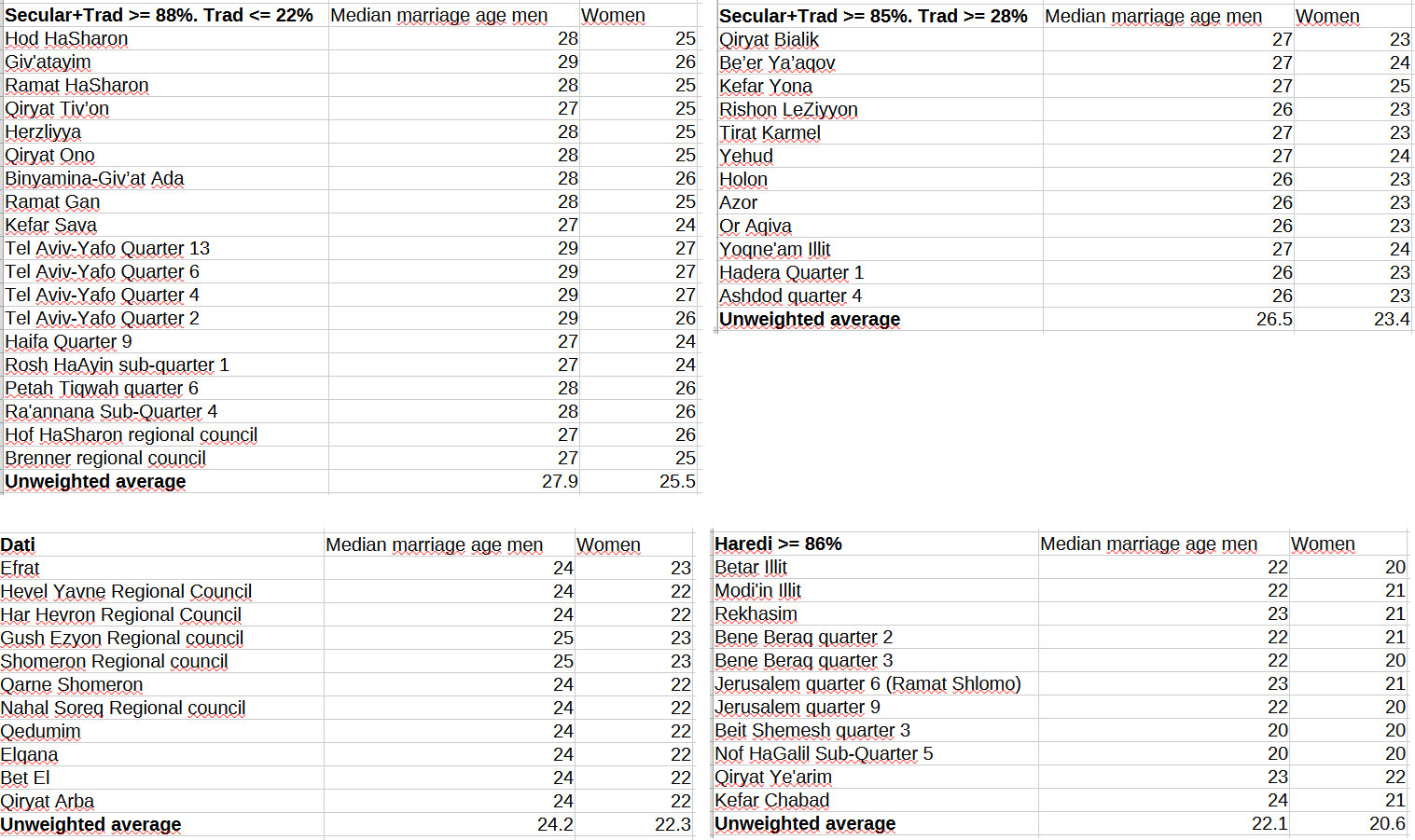
To estimate the median age at first marriage for each Jewish Israeli religiosity group, I used the same methodology as before, calculating the average age over a sample of localities where the overwhelming majority of households belong to that group. I’ll skip the tables (you can find them in the footnotes8) and go straight to the results.
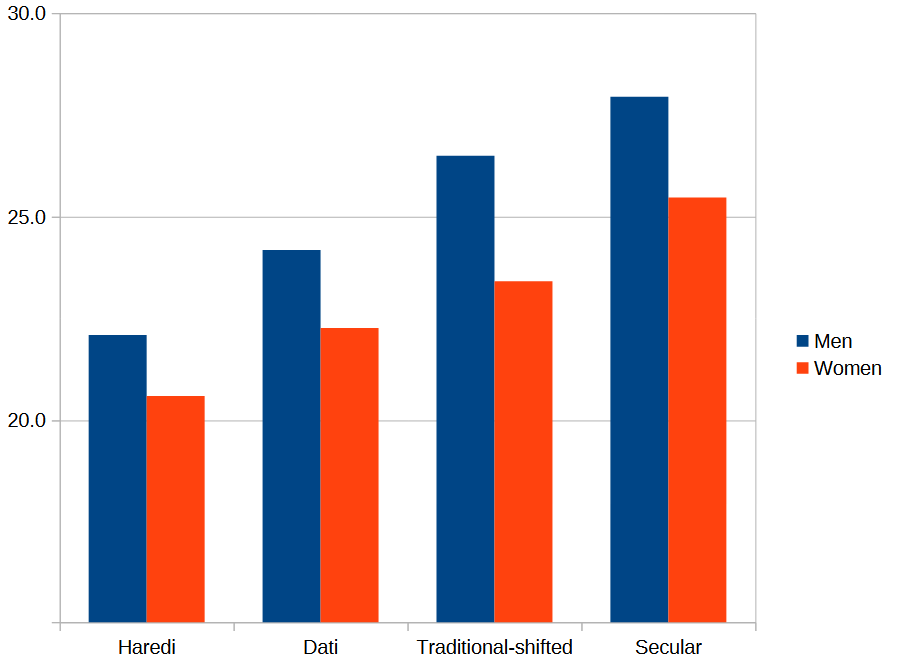
If you are familiar with marriage ages in developed countries, you are probably thinking now that Secular Israeli men and women marry very young (27.9 and 25.5) based on the above chart. There are two problems with that conclusion though. The first is that, same as before, the “Secular sample” is not 100% Secular, and therefore the true Secular median ages are higher than 27.9 and 25.5 (notice the sizeable age gaps between Traditional-shifted and Secular-shifted samples: 1.4 for men and 2.1 years for women).
The second issue is that the CBS reports the median age at marriage for the whole population, not just those who married during the census year (2022). Since marriage ages in most developed countries (including Israel) were lower in previous decades, these figures are biased downward by the earlier marriages of older people.
So, what is the true mean age at first marriage of Secular Israelis? The United Nations Economic Commission for Europe (UNECE) publishes age at first marriage data for Israel and several other developed countries, allowing us to treat the Israeli figure as a weighted average across all four religiosity groups9, and compare it with other countries.
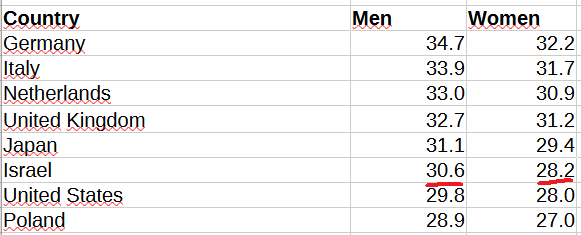
The national Israeli mean is slightly below average, but well within the developed country range. And we’ve already seen that Secular Israelis marry substantially later than Haredi and Dati (and very likely Traditionals), so we can safely estimate their mean age at first marriage as higher than 30.6 years for men and 28.2 for women.
To summarize, Haredi men and women marry very early, much earlier than the typical marriage age in developed countries; Dati also marry early, though not quite as young as Haredi; Traditional Israelis appear to marry somewhat early by developed country standards (though I can’t be 100% certain); and finally, Secular Jews do not marry early at all. The Secular do not differ from populations in other developed countries when it comes to marriage age.
Three makes a crowd?
I’ve now documented three measurable aspects of family life where the data on Secular Israeli Jews does not appear to support the mimetic theory of Israeli fertility: divorce rates, never-married rates, and age at first marriage.
In all three cases the data could support Haredi and Dati influence over Traditional Jews, but Secular Jews show no such influence when their marriage and divorce rates are compared to those in other developed countries. This can be interpreted as evidence that the mimetic theory is correct when applied to Traditional Israelis, but that was not the main motivation to put forward the theory. The main motivation was to explain the exceptionally high Secular Israeli fertility rate.
Maybe fertility is a unique aspect of family life, and Secular Jews are influenced by religious Israelis in that particular aspect and no other. Perhaps the three aspects I’ve examined are not the most relevant ones, and I should take a look at another one(s) (suggestions are welcome).
I don’t know whether this analysis will persuade anyone for or against the mimetic theory, but I do hope it will move the discussion forward.
The local councils, which I included in the Dati divorce table, are: Bet El, Elqana, Qedumim and Qiryat Arba.
In this case I did not lower the “overwhelmingly” threshold for the Traditional-shifted sample, while I did slighly lower it for the Secular-shifted sample (from 90% to 88%).
This slightly differs from what I did for the divorce analysis. The Traditional-shifted sample is now more heavily Traditional, and the Secular-shifted sample is more Secular.
This might be connected to the fact that marriage and divorce are not strictly civil law affairs in Israel.
There are only five localities in the sample where the reverse is true.
The only two Secular localities that show a lower never-married rate among 55-64 than among 65+ are Be’er Ya’aqov (only women) and Ra’annana Sub-Quarter 4 (only men).
Why did I choose to write about these two marriage indexes? Because they are the only two marriage indexes for which the CBS publishes detailed data.
Tables of median marriage age for the four samples:
This average also includes Arab Israelis, who tend to marry earlier than Secular Jews.