

Two years ago, I wrote a post comparing the fertility of billionaires across several countries, South Korea among them, and examining what the results of that comparison reveal about South Korea’s remarkably low fertility.

At the time, I wasn’t particularly interested in Israeli fertility, so I chose France and Germany as comparison countries1. They both have a large number of billionaires, which made it easier to gather a sufficiently large sample of billionaires with publicly available information on their number of children. Their fertility rates also provided a contrast to South Korea’s: France has relatively high fertility for a developed country, while Germany has an average rate for a developed country.
The conclusion I reached from that comparison was:
…Korean billionaires have a significantly lower fertility than their French and German peers.
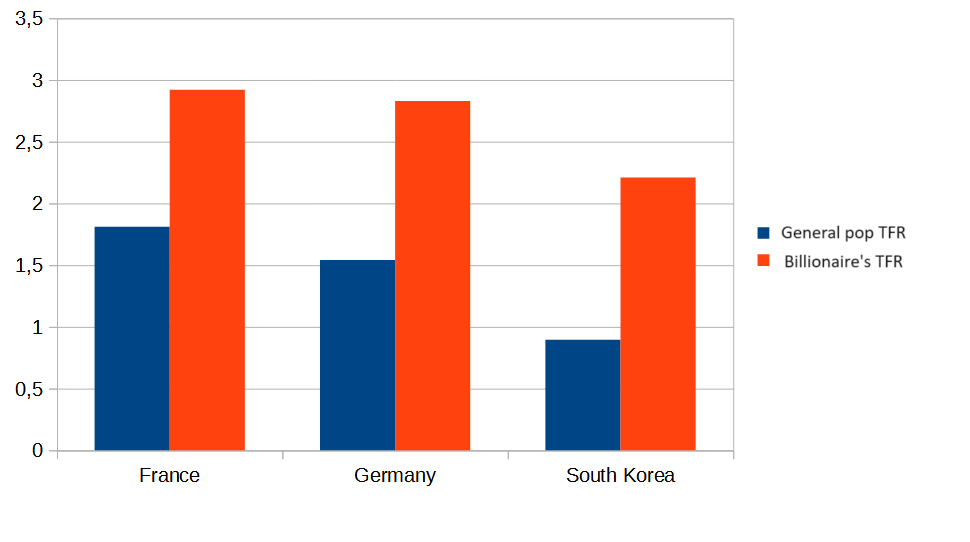
The values of the fertility gaps between South Korean billionaires and French or German billionaires are 0.71 and 0.62 respectively2. Those same values for the general population are 0.92 and 0.64, a wider but similar range.
This suggests the existence of a factor, specific to South Korea, a non-economic issue that lowers fertility for both Korean billionaires and the general population.
Assuming that billionaires are largely unaffected by economic pressures, and that fertility is primarily affected by economic and cultural factors, the cross-country comparison of billionaires and general population fertility suggests that culture’s effect on fertility is substantial, as you can see in the following chart.
Now that I’ve become particularly interested in Israeli fertility, I decided to take another look at billionaire fertility, this time including Israeli billionaires. Israel has a large number of billionaires for such a small country (in case you are not aware of the stereotype, Jews make lots of money), which not only allows me to calculate a credible billionaire fertility rate but also to restrict this analysis to Secular billionaires, given that Secular Israeli fertility has been the focus of my recent fertility posts.
Among other things, I want to check whether the Israeli billionaire fertility rate can tell us anything about the Mimetic theory of Israeli fertility: the theory that Secular Israelis have a higher fertility rate than the (secular) population of any other developed country due to the memetic influence of high-fertility religious Israelis:
What these groups do is provide a one-way channel of influence between Israeli Charedim and the rest of Charedi society, a sort of valve in which Charedi fertility memes can spread outwards, without allowing fertility decreasing memes inwards….
Around 25% of the Religious Zionist [Dati] community is actually barely religious at all and very comfortable freely mixing with ‘traditional’ Israelis who don’t keep the Sabbath, but ‘respect’ it…Finally, these traditional Jews mingle with secular Jews, who pick up the last scraps of the Charedi fertility meme, enough to keep their demographic head above water.
The basic model here is that, unlike anywhere else in the world, there is no hard cultural barrier (at least in one direction) between Charedim and the rest of society, and enough mimetic stepping stones that almost everyone is influenced to some degree.
The billionaire samples
Before I continue, let me remind you of how I constructed the billionaire samples used in these comparisons:
All living individuals listed as billionaires in the respective Wikipedia entries for each of the three countries are considered for inclusion (in the case of Israel, which has less billionaires than France and Germany, I also used two other sources3).
Many billionaires place a high value on their privacy for understandable reasons, so those for whom no information on the number of children could be found were not included in the sample (this time, I also used Grok to help me with this task).
Didn’t include anyone bellow the age of 43 because younger people have probably not reached their completed fertility (the youngest Israeli billionaires I could find were 49 years old).
Didn’t include billionaires who hold the nationality of a country yet have spent the majority of their lives, particularly their formative years, outside that country. The sample is supposed to be a good representation of the general population of the country in terms of culture.
Did not include widowers of billionaires, but did include children of billionaires even if they themselves do not appear in a billionaire’s list.
I also included billionaire families, whose individual members do not necessarily meet the billionaire threshold on their own. These are families (meaning siblings, cousins) who collectively own billions (e.g. the Hériard-Dubreuil family, majority owners of Rémy Cointreau group, valued at more than 9 billion euros).
The purpose of including close family of billionaires and billionaire families is to have a larger sample of very rich people, especially people under 70 years old, who were raised in the same families as billionaires and experienced the same absence of economic hardship. Billionaires tend to be old for obvious reasons, and I wanted to have as many younger people on the sample as possible.
Also, billionaire families include individuals whose net worth is not billions, but only hundreds of millions. They are in the same category as billionaires from the point of view of not having economic constraints when deciding to have children.
The results
To reduce the effect of decreasing fertility over recent decades on the billionaire sample, I chose a maximum age threshold of 70 years. This ensures the fertility comparison is between the general population and “younger“ billionaires, rather than “older” billionaires. In the case of Israel, I raised the threshold to 72 years of age so its billionaires would be comparable to the billionaires I examined in 2024. And I also excluded Israeli billionaires from Mizrahi or Sephardic backgrounds, because I suspect most of them are Traditional rather than Secular4.
And now, let’s take a look at the estimated fertility rate for under-72 Israeli billionaires and how it compares to the Secular Israeli fertility rate of 1.96 2.00 children per woman.
(UPDATE: I should have used the 2019-2021 Secular Israeli fertility rate (2.00) instead of the one for 2021-2023 (1.96). This doesn’t change the results though. The value of M for Israel drops from 1.72 to 1.69)
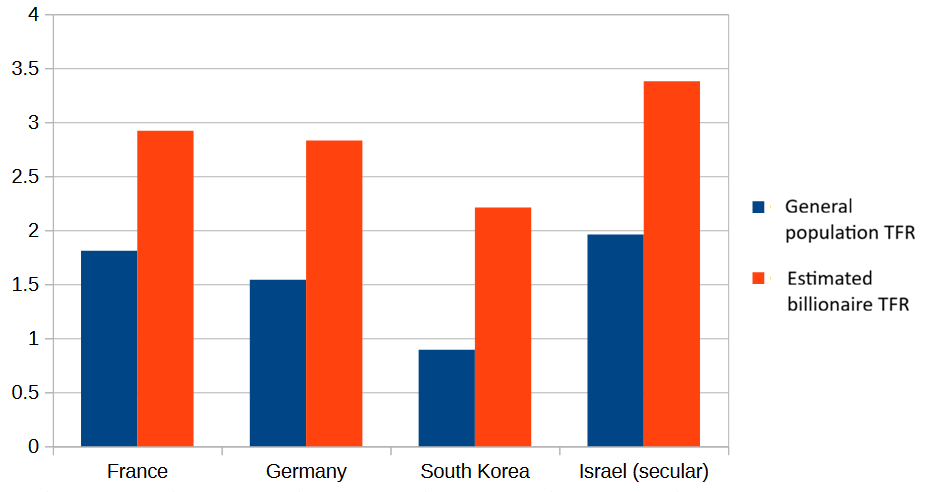
Just as Secular Israelis have higher fertility rates than the populations of other countries, Secular Israeli billionaires have higher fertility (3.38) than billionaires from other nations. I guess this isn’t surprising, and it could be interpreted as supporting evidence for the Mimetic theory: once economic constraints are removed, Secular Israeli fertility climbs even higher, reducing the gap with the fertility rates of religious Israelis (Haredi and Dati). But let’s leave the Mimetic theory aside for a moment.
While comparing the fertility gaps between general population and billionaires across countries, I noticed the Israeli gap did not appear to align with those of other countries. But the ratio of billionaire fertility rate to general population fertility rate in Israel did fall within the range of the other countries (except South Korea).
(To give an example, if the billionaire fertility rate were 3.0 children per woman and the general population fertility rate were 1.5, the ratio would be 2.0)
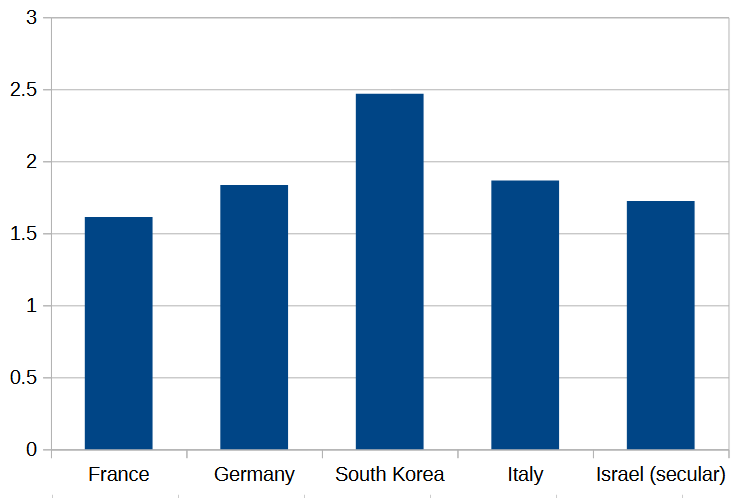
Setting aside South Korea, the fact that countries with fertility rates as low as Italy’s5 (1.28 children) and as high as Israel’s show similar ratios suggests that the same fertility-raising mechanism (removing economic constraints) acts over the baseline fertility rates of different countries, multiplying fertility in roughly the same proportion.
This is very much speculative, so don’t quote me saying the ratio of billionaire fertility rate to general population rate is roughly similar across most developed countries. I’m not completely sure that the pattern is real. An obvious way to settle this would be to calculate billionaire rates for additional countries (I actually mentioned Italy, Japan and Spain in my previous billionaire fertility post), and I might just do that in the near future.
Going back to the Memetic mixing theory of Israeli fertility, the fertility gap between Secular Israelis and (non-billionaire) religious Israelis narrows among billionaires; but is that what the theory would predict? In a trivial sense, yes. Secular Israeli billionaires have higher fertility than other billionaires.
Let’s call the factor that raises Secular Israeli fertility M. This factor supposedly multiplies (maybe 1.2X, 1.4X) a baseline Secular Israeli fertility rate (R), which otherwise wouldn’t be much different from the rates of other developed countries. Similarly, let’s call the factor that raises billionaire fertility above the general population baseline factor B (which falls roughly in the 1.6 to 1.9 range, as you can see in the chart above). Under the Memetic theory, the Secular Israeli fertility rate results from multiplying the baseline rate by M, while the Secular Israeli billionaire fertility rate is the result of multiplying the same baseline rate R by M and then by B:
Secular Israeli rate = RxM ~= 1.96
Secular Israeli billionaire rate = RxMxB ~= 1.96xM ~= 3.38
This implies that Secular Israelis in general, and Israeli billionaires in particular, are mimetically influenced by religious Israelis (factor M). But if so, why would Secular Israeli billionaires be influenced by religious Israelis? Or, more narrowly, why would they be influenced even by relatively more religious Traditional Israelis?
In terms of status, billionaires rank among the highest-status groups in every developed country I can think of. They are literally at the very top of one of the main measures of status recognized in every society. They have no reason to imitate non-billionaire religious Israelis, whether in aspects of their family life or any other area of life.
If Israeli billionaires are not influenced by religious Israelis, that leaves us with two possibilities: either Israeli billionaires do not follow the pattern followed by billionaires in other countries (factor B), or perhaps factor M is not connected to Secular Israelis imitating religious Israelis’ family life (maybe it’s More-analysis-is-needed factor??).
I’m not certain the former explanation is true; I would need to calculate the billionaire fertility rates for more countries to be more confident that factor B is real and applies to Israeli billionaires. And even then, South Korea already provides a clear counterexample. That said, I’m definitely skeptical about the latter, and the more I look at Israeli fertility data, the more convinced I become that “factor M” has little to do with mimetic mixing.
(Credit for this post’s thumbnail goes to the Berlusconi Flying Circus blog. If you think Silvio Berlusconi’s life is one of the most entertaining recent counterexamples to Noblesse oblige, you might enjoy reading Berlusconi Flying Circus’ article on the late Italian billionaire’s family life. Berlusconi and German billionaire Ferdinand Piëch might end up inspiring a future post on fertility.)
In fact, I also gathered data on Japanese billionaires at the time, but I never published it because I wasn’t happy with the sample size. The Japanese are as private as the stereotype says.
While looking at the German billionaires data, I realized I had inadvertently duplicated the entry for Georg Friedrich Wilhelm Schaeffler (Georg F. W. Schaeffler). The corrected estimated fertility rate for German billionaires is now 2.79 children per woman, down from the 2.83 I reported in the previous post.
The additional sources are: Globes (an Israeli financial newspaper) list of Israel’s high-tech billionaires; and Forbes Israel 100 Rich List (though I included only the first 80).
My very rough estimated fertility rate for Mizrahi/Sephardic billionaires is 3.79 children per woman.