

When one mentions throngs of middle- and upper-class Cubans fleeing their homeland, the image that usually comes to mind is that of the early 1960s, the first years of the Cuban Revolution, when hundreds of thousands left the island. Most of those departing made it to the United States. The confiscation of their lands and businesses, nationalization of the companies they worked for, and rapid erosion of their economic and political freedoms drove them to leave all of their material possessions behind1 and move abroad.
However, the title of this post could also refer to the recent migration wave that has driven over a million Cubans to leave in the last few years, sparked by the severe economic crisis on the island. Yet this latest wave, with its “last one out, please turn off the lights“ feel, does not look like an exodus of the upper classes. It should remind us, though, that economic crises are often the root cause of major political upheavals and migration waves.
Let’s take a closer look at the sixties wave then, but perhaps a different century.
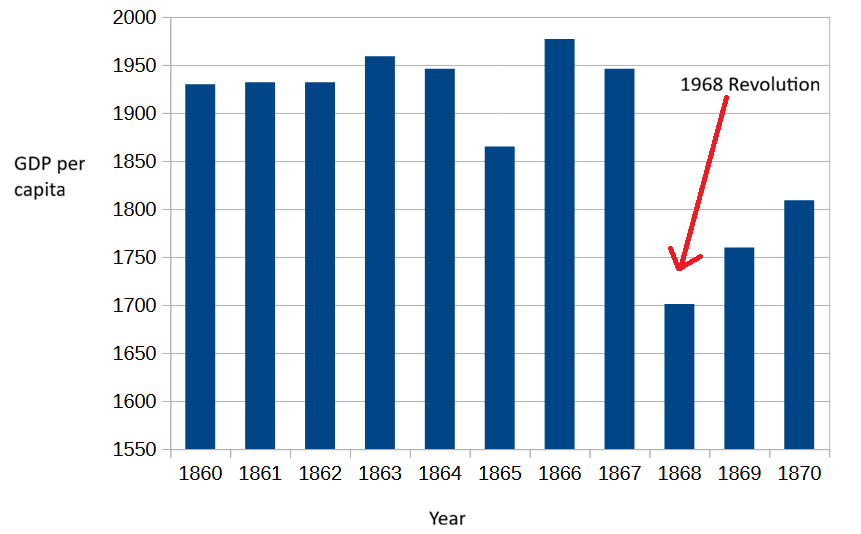
During the reign of Queen Isabella II, between the years 1866 and 1868, the Kingdom of Spain suffered a severe economic crisis that prepared the ground for the major political shift that followed2:
…the trigger for the 1866 financial crisis was the losses suffered by railway companies, which dragged down banks and credit societies with them… The financial crisis of 1866 was compounded by a severe subsistence crisis in 1867 and 1868, caused by poor harvests during those years. Those affected were not businessmen or politicians, as in the financial crisis, but the working classes, due to the scarcity and high cost of basic goods such as bread. Popular riots broke out … The subsistence crisis was exacerbated by the rise in unemployment caused by the economic crisis triggered by the financial crisis
At the time, the Spanish Kingdom was organized as a constitutional monarchy with a functioning parliament and regular elections, although electoral practices were a far cry from what we now consider democratic standards. In the years leading up to 1868, this already imperfect parliamentary monarchy had become increasingly authoritarian, persuading even the monarchist opposition leaders that maybe Spain should remain a monarchy, but with a different monarch.
On September 18, the Spanish Navy fleet in Cádiz revolted. This was hardly surprising given that the Spanish military had been regularly intervening in politics since the end of the Napoleonic Wars. Soon, revolutionary councils were formed in most major cities across Spain, reflecting the popular support for the insurrection, and after the loyalist army suffered a cleat but indecisive defeat on September 28, Queen Isabella went into exile, clearing the way for opposition leaders (and generals) to seize power and organize a new government.
News of the successful uprising soon reached Cuba, Spain’s sugar-producing colony on the other side of the Atlantic, where independence-minded members of the Cuban elite had already been plotting rebellion against Spain for some time.
With Spanish leaders busy organizing a new political system and dealing with the demands of a restless population, this was the perfect time to revolt. One of the loudest and most often repeated demands of the Spanish lower classes was the end of forced conscription (quintas). If approved - as Cuban rebels probably hoped - it would have drastically reduced Spain’s chances of suppressing the Cuban rebellion by severely limiting the number of troops that could be sent to the island. Encouraged by the events taking place in Spain, the Cuban conspirators launched their own uprising on October 10, 1868, near the town of Manzanillo in eastern Cuba3, followed by a second uprising on November 4 near Camagüey in central Cuba.
The rebels published a Manifesto of the Revolutionary Council of the Island of Cuba and convened a constitutional assembly in the town of Guáimaro with the goal of giving their revolutionary republic a formal organizational framework, while simultaneously facing the Spanish army in a series of skirmishes. Soon, large areas of eastern Cuba began to suffer the effects of the guerrilla tactics employed by the rebels, including the burning of many sugar mills and other economic infrastructure4:
[General Fernández-Cavada Howard] spawned the idea of the burning torch to destroy the properties of landowners who supported Spain, and he systematically applied this method to economically weaken the forces opposed to the freedom of Cuba, which led to him being known by the nickname “General Fire” (General Candela).
The Spanish successfully contained the rebellion to the eastern half of the island by building a fortified defensive line across its center, blocking the highly mobile rebel forces from invading the prosperous western half of Cuba, where Havana is located. Yet the huge amount of resources committed to the building of this barrier, and the vast additional human and material resources devoted to suppressing the rebellion, couldn’t prevent the widespread devastation that eastern Cuba would suffer during the appropriately named Ten Years’ War (1868-1878). When rebel forces couldn’t hold the cities they captured (liberated from their point of view), they sometimes burned them to the ground5:
Three days after the event, the embers were still smoldering. The Spaniards couldn’t believe it, even though they had already seen the gigantic fire, which foretold the terrible outcome: they would find nothing in Bayamo, only ashes…Why did they decide to set fire to such a beautiful city? Since October 20, 1868, Bayamo had been experiencing the fever of a nascent Revolution, the same one that ignited a hymn, a plaza, a City Hall… after more than 80 days without foreign tutelage, [the city] the concept of freedom ingrained in their hearts.
After burning down Bayamo in 1868, the rebels went on to burn the town of Guáimaro (1869) and the city of Las Tunas (1876).
All this burning and destruction eventually persuaded many Cubans to leave the island in search of greener, more peaceful pastures; many others left to escape reprisals by the Spanish authorities against those who supported the rebellion, with the majority heading to Jamaica, the United States, and the Dominican Republic. A large share of these migrants belonged to the upper classes of Cuban society, as recorded by a contemporaneous Jamaican newspaper6:
The French Transatlantic Steamer ‘Tampico,’ in one day from Santiago de Cuba, arrived here yesterday with upwards of one hundred passengers, among them many ladies and gentlemen, who are fleeing to a place of safety ere the worst comes about in a serious crisis which appears to be looming up, if indeed, it has not already begun, in the island of Cuba.
Many others did not7:
The schooner Almogabar in six days from Manzanillo de Cuba, arrived here [at Kingston, Jamaica] on Tuesday evening with thirty passengers, chiefly small farmers, who have been compelled to abandon their country in consequence of the insecurity of life and property.
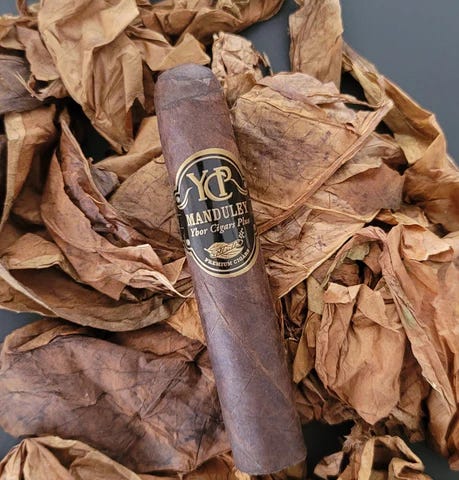
The social background of Cuban migrants depended partly on the economic opportunities available at each destination. For example, the picturesque American city of Key West, Florida, attracted many tobacco workers, drawn by the establishment of several cigar factories in the island city. It would be inaccurate to describe these workers as unskilled though; cigar makers were among the best paid laborers in Cuba and the U.S.8 at the time (and likely still are today). And most founders of these cigar factories were also Cuban migrants, who took advantage of Key West’s favorable conditions: they imported high-quality tobacco leaf from nearby Cuba, and then produced cigars for sale tariff-free in the American market.
So Florida got Cuban human capital, financial capital, Cuban know-how, and an entire new industry, while Cuba got a revolution. Sounds familiar.
Key West was not the only major destination of Cubans fleeing to the United States. The 1870 U.S. census, taken before the peak of Cuban migration, records around 12,000 Cuban-born residents: 4,500 in New York, 3,000 in New Orleans, and 2,000 in Key West. I’ll come back to these numbers later.
Meanwhile, in the Dominican Republic, a small Cuban community of no more than 1,200 immigrants9 had settled in the northern port of Puerto Plata by 1875. As I mentioned in my post on Haiti and the Dominican Republic, the Dominican sugar industry was in its infancy at the time, and these Cuban refugees played an important role in launching Dominican sugar production. They did not limit themselves to sugar, though, becoming involved in many other enterprises10.
There were several Cuban establishments [in Puerto Plata]: the sugar mills of Carlos F. Loynaz11; the Camagüeyan Pastry Shop, owned by Cirilo Recio; the La Habana Restaurant, owned by Lino Castro; the Dominican-Cuban Hotel Unión de Cuba, later Las dos Repúblicas, owned by Francisco Moroní; the saddlery shop of Juan Anido; the photographic gallery of Narciso Arteaga; the tailor shop of Manuel Miranda; the bookstore, an agency of the one Néstor Ponce de León had in New York, was managed by Fernando Cisneros y Correa.
In Jamaica, highly skilled12 Cuban emigrants fleeing from the Ten Years’ War also gave a big push to certain economic areas of the smaller island. Just like in Florida, they revolutionized Jamaica’s tobacco industry, while also dominating less capital-intensive trades such as tailoring and barbering13. And just as they did in the U.S. and the Dominican Republic, many (though not the majority) remained in Jaimaica after the war in Cuba had ended14.
That these Cuban refugees were not a random sample of the Cuban population seems to be confirmed by their names. Howard Johnson, whose “Cuban Immigrants in Jamaica, 1868–1898“ is one of the main sources for this post, identifies by name just over 40 Cuban migrants. Among them, six had French surnames, one was of Scottish origin, and another (Englishman) of Jewish origin. Most Cubans of French origin descended from white French colonists who had left Haiti after the Haitian Revolution and found refuge in Cuba, where they generally prospered and integrated into the upper classes of Cuban society. Their overrepresentation in Johnson’s sample further confirms the upper-class skew of Cuban emigrants.
The Cuban community in Jamaica was somewhat larger than the one in the Dominican Republic, reaching around 1,500-2,000 at its peak15. Combining this number with the ones recorded for the U.S., we can estimate that the total number of Cuban emigrants was 14,000 at the very least. This minimum does not include emigrants to other countries and makes no adjustment for the increase in U.S. residents between the 1870 census and the peak of migration in 1872-1873.
The true number is substantially higher than the 14,000 minimum, but far lower than the unsubstantiated 100,000 figure cited by some historians16. We should also consider one estimate for the number of Cubans outside the island on the eve of the 1895 Independence War17, which puts the figure at 40,000-50,000, and the number of Cubans residing in the United States according to the 1880 census18 (after the peak). Taking everything into account, my best guess for the peak of emigration during the Ten Years’ War would be 20,000 to 30,000 refugees, or about 1.4% to 2% of Cuba’s population at the time. And given what we have seen about their background, these emigrants accounted for a far higher share of Cuba’s most skilled population.
Although the 1868-1878 Cuban exodus involved only a small share of the island’s total population, it was not an insignificant brain drain. It deprived Cuba of many of its most talented and enterprising people and, more importantly, it was the first of many brain drains.
Literally. All property of those leaving was confiscated.
Puerto Rican rebels acted even faster than their Cuban peers by launching the Lares revolt on September 23. Telegraphic service had not yet reached Puerto Rico in 1868, but it only took 3 to 5 more days for the news from Spain to travel from Havana to San Juan.
See “El General Candela, un hombre de leyenda“ in CubaNet.org, and “1871- Es fusilado el General del Ejército Libertador Federico Fernández Cavada“ in Radio Cadena Agramonte.
See “The burning that glorified us“ (“Quema que nos glorificó“).
From “Cuban Immigrants in Jamaica, 1868 –1898”, Howard Johnson, 2011, as reported in Jamaican newspaper The Gleaner.
From “Cuban Immigrants in Jamaica, 1868 –1898”, Howard Johnson, 2011, as reported in September 1873 by Jamaican newspaper The Gleaner. Did you know that The Gleaner is the oldest continuously published newspaper in the Western Hemisphere, operating since 1834? Wikipedia says that “Gleaner” has become synonymous “newspaper” in Jamaica.
According to Antonio Rafael de la Cova in “Cuban Exiles in Key West during the Ten Years’ War, 1868-1878”, the average weekly wage of Key West cigar rollers and packers ranged from 40 dollars to 60 dollars, two to three times what a skilled worker typically earned in the U.S. at the time.
From the Cuba Research Project: “The 1871 census shows 197 people whose nationality is listed as ‘Cuban.’ For the year 1875, the number increases dramatically to 1167 individuals. And lastly, the year 1879 shows a decrease to only 300 individuals, potentially suggesting that many Cubans returned to Cuba after the war.“
From “Puerto Plata a la llegada de Maceo“, Diario Libre, September 8, 2018.
Other source (Familia Bateyera) names additional Cuban founders of Dominican sugar mills: Joaquín M. Delgado, Evaristo de Lamar (1876), and Juan Amechazurra.
From Howard Johnson’s “Cuban Immigrants in Jamaica, 1868–1898” (2011), we can glean that Cuban immigrants in Jamaica developed a reputation as skilled: “Native Jamaicans responded defensively to an advertisement placed by De Cordova soliciting employment for ‘several intelligent Cubans’ qualified to serve as planters, accountants, general clerks, teachers, surveyors, and ‘telegraphists’.“
See “Cuban Immigrants in Jamaica, 1868–1898”, Howard Johnson, 2011.
From “Cuban Immigrants in Jamaica, 1868–1898”: “It is not surprising that the Kingston business directory for 1891 listed many of the cigar and cigarette manufacturers who had established themselves in business since the 1870s“.
See “Cuban Immigrants in Jamaica, 1868–1898”, Howard Johnson, 2011.
See “Cuban Exiles in Key West during the Ten Years’ War, 1868-1878”, Antonio Rafael de la Cova, 2010.
See “El papel de la emigración patriótica en las guerras de independencia de Cuba (1868-1898)”, Paul Estrade.
2,388 in Florida according to Antonio Rafael de la Cova, and 6,917 across the entire United States.