

Andalusian towns with a higher share of non-Andalusian ancestry showed higher rates of literacy in 19th-century Spain. At least that’s what I tried to prove in my last post. But how does that work?
As I mentioned then:
The most straightforward way to increase literacy was to expand primary schooling, and in small Spanish towns this depended mainly on the town’s financial capacity (and willingness) to pay for a primary school teacher.
The most plausible way for towns with a large share of non-Andalusian population, such as San Sebastián de los Ballesteros, to raise literacy was by expanding schooling. Was that indeed the case, or was there another mechanism at work?
Luckily, we can examine a certain dataset that might help us to clarify the role of primary schooling.
Madoz’s dictionary
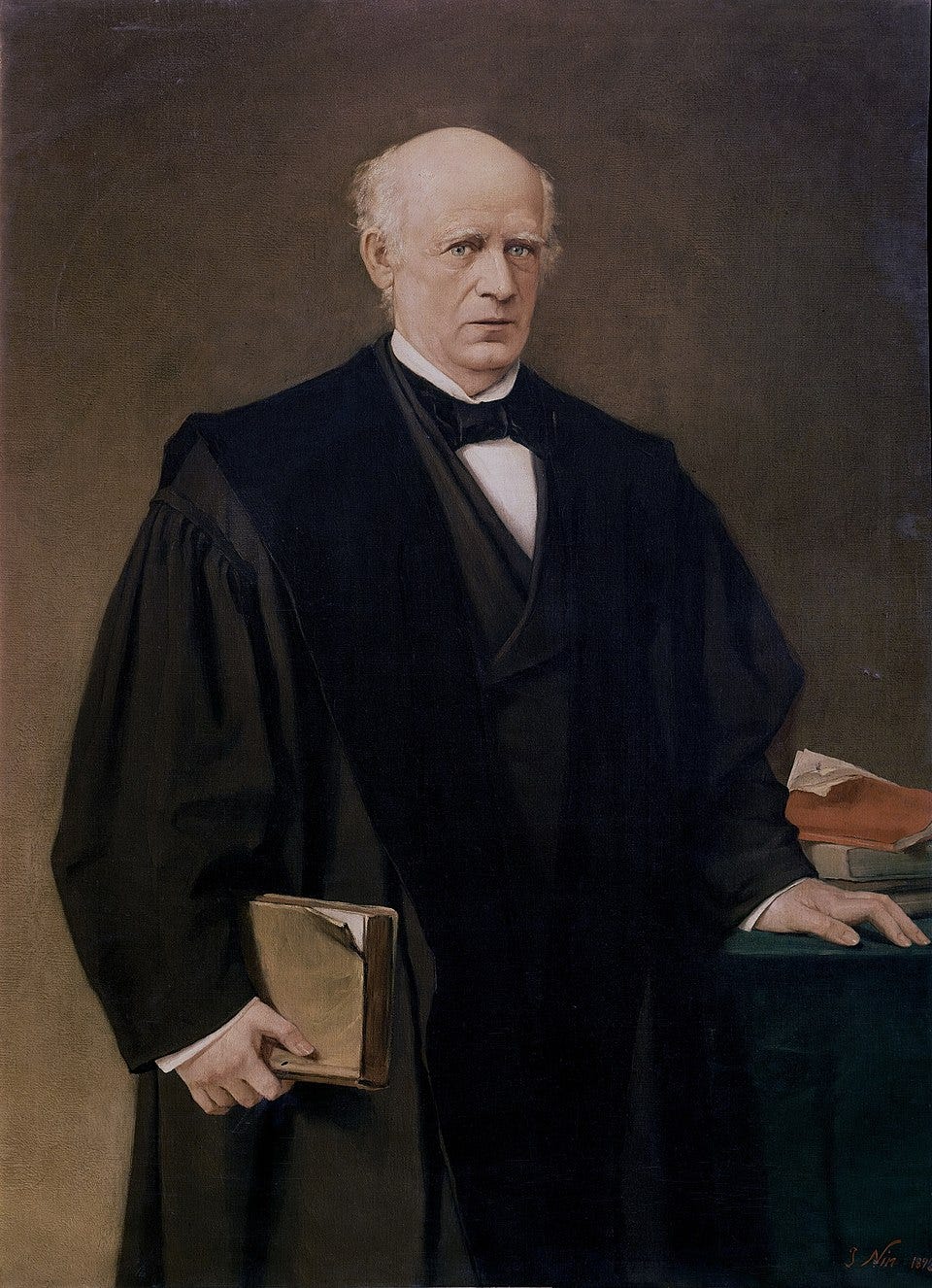
Pascual Madoz e Ibáñez was born in 1806 in Pamplona, the capital of Navarre in northern Spain. The very liberal-minded Pascual studied law, got into trouble with the very illiberal authorities of the time, and was forced to go into exile in France. Only after the political winds shifted in a more liberal direction did he come back and settle in Barcelona, where he devoted himself to publishing and politics, two fields that were often intertwined in 19th-century Spain.
,_Congreso_de_los_Diputados_(2).jpg)
By the early 19th century, tens of thousands of encyclopedias had already been printed and sold across Europe (Britannica, Diderot’s, etc.). Compiling and publishing these summaries of available knowledge, either general or specific to a field, was becoming increasingly common with each passing decade. In Spain, a Geographic Dictionary of Spain and Portugal had already been published by Sebastián Miñano in the 1820s, including detailed information on the population, economy, and geography of thousands of Spanish cities and towns.
Madoz, who probably distrusted the accuracy of Miñano’s informants - mostly parish priests -, decided to produce his own geographic dictionary, one more accurate and complete than Miñano’s. It was certainly more laborious: compiling and editing the vast amounts of information required for his Geographical-Statistical-Historical Dictionary of Spain and its overseas possessions took him fifteen years of his life.
Madoz’s dictionary was a major milestone in Spanish geographical literature. Even after regular censuses made population data more widely accessible, it continued to provide a wealth of information that was hard to find in any other source. Almost two centuries after its publication, it’s still one of the best resources available on Spain in the 1830s and 1840s.
The Madoz dictionary includes data on the number of schools and students attending them for most Spanish municipalities (Miñano’s dictionary didn’t). And although it’s not always well-structured data, it’s useful data nonetheless1. So let’s take a look at it.
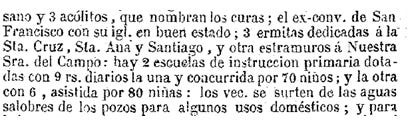
Be aware that not all municipality entries in the dictionary mention a primary school. Since the average population of municipalities for which no school is mentioned was just 471 people, we can assume these were too small to support their own school. The sample for this analysis is comprised of all municipalities in Córdoba province and the northern and northwestern parts of Jaén2 province for which the dictionary provides data on primary school enrollment (some entries mention one or more schools but don’t provide the number of students who attend them).
To measure how widespread primary schooling was in each municipality, I calculated the ratio of primary school students per 100 residents, based on 1860 population data3. And, as usual, I created a choropleth map showing these ratios.
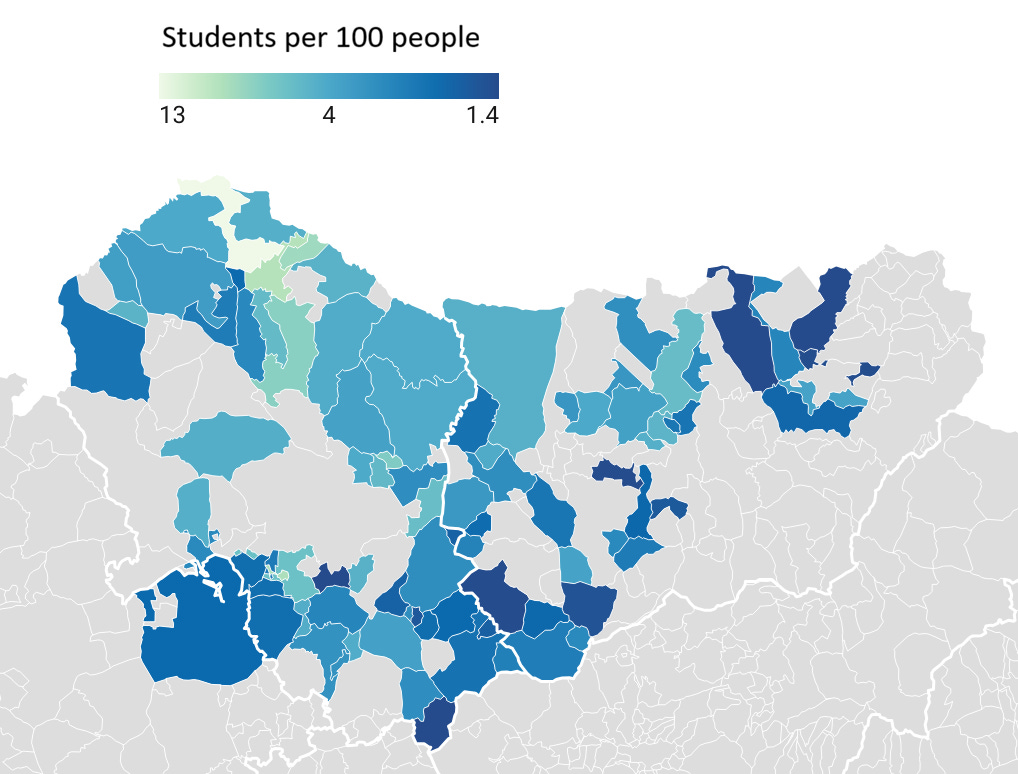
The map is far from perfect. About one in four municipalities is shown in gray because they lack student data4, which makes it difficult to discern any geographic pattern.
Maybe placing the 1900 illiteracy map side by side with this one will make any geographic patterns easier to discern.
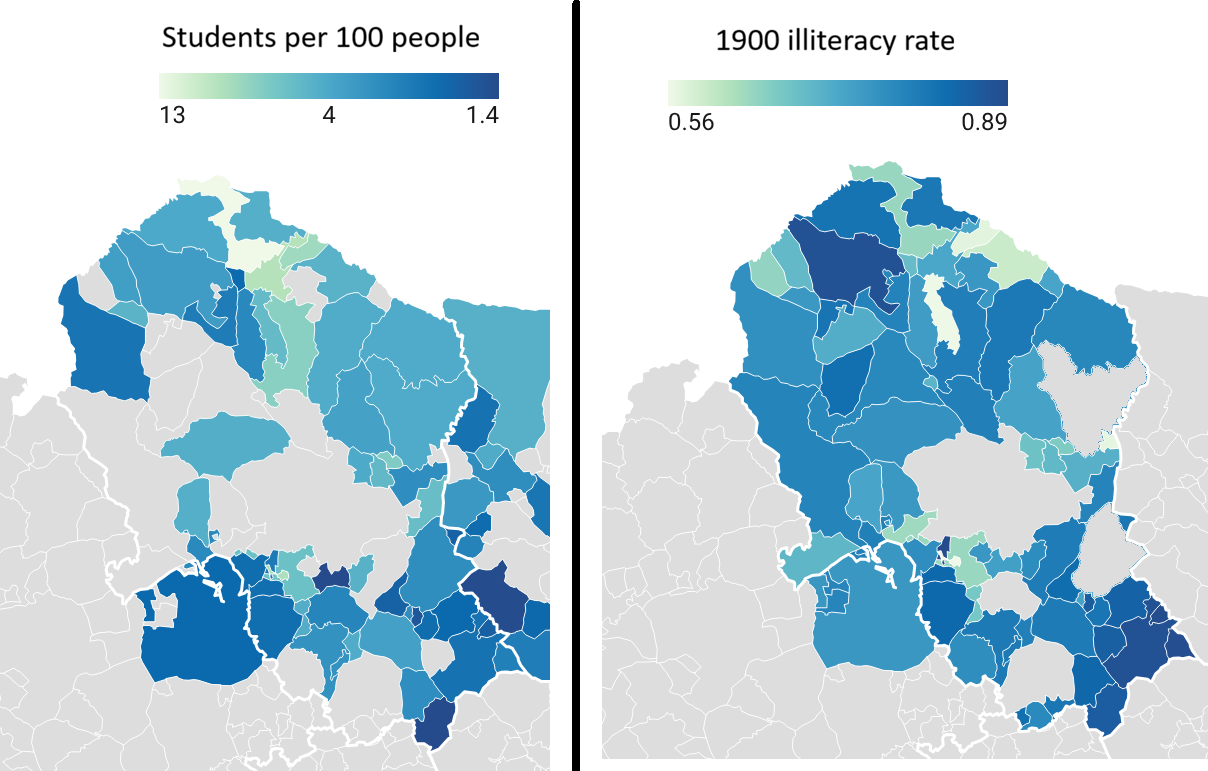
That’s a bit better. Good enough to see that the three areas of higher literacy in Córdoba province, which I remarked on in the previous post, also had higher ratios of students per population: the area immediately east of Córdoba city, the northern part of the province, and the New Settlements of Andalusia area around San Sebastián de los Ballesteros.
(If you are feeling a bit lost a this point, it might be a good idea to quickly skim through the previous post to better understand the characteristics of these three geographic areas)
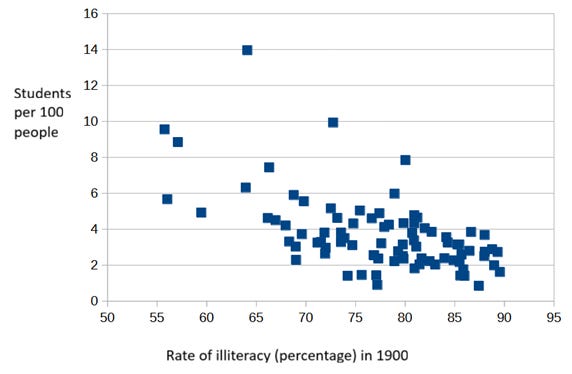
Beyond what a visual inspection tells us, we should also measure the strength of the relationship between the two datasets. The correlation coefficient between student-to-population ratios and 1900 illiteracy rates is -0.585, which is a moderately strong correlation (higher student-to-pop ratios → lower illiteracy). That said, the correlation with 1860 illiteracy rates is substantially weaker, at only -0.34.
There are several reasons why I didn’t expect the correlation to be very strong:
Madoz’s data is a single snapshot, taken sometime in the 1830s or early 1840s. It does not comprehensively represent the state of primary education in a Spanish municipality during the entire first half of the 19th century, much less the second half.
The process of collecting the data must have been far from perfect, leading to some errors in the figures recorded in the dictionary6.
Not all municipalities had the same population structure.
There is, of course, a large time gap between the 1830s and 1900. Most of the children who learned to read and write in the 1830s would still have been alive in 1860, yet would have died by 1900. The factors that influenced student-to-population ratios in the 1830s may have persisted for the next decades, but they could also have faded over time. This raises the question of why is the correlation with 1900 illiteracy rates stronger than with 1860 rates. I don’t have a good answer to that.
Despite that last point, I think these correlation coefficients strongly imply that broader access to primary schooling produced higher literacy, which should surprise no one.
Among New Settlements colonies, San Sebastián de los Ballesteros had the third-highest ratio of students per 100 people out of more than 80 municipalities (it was also one of the few towns where girl students outnumbered boys). Two other former colonies I’ve mentioned before, La Carolina and Aldeaquemada, don’t show particularly high student-to-population ratios.
In the case of La Carolina this is likely an artifact of my methodology: I assumed zero female students when the dictionary mentions a school for girls but provides no number of students7.
Aldeaquemada, on the other hand, doesn’t rank high or low; its entry doesn’t give the number of students attending its primary school, so I couldn’t calculate a ratio for it. Maybe because Aldeaquemada was so small (population 425), it was harder to obtain an exact number of students. So instead of comparing ratios, we’ll make a qualitative comparison between Aldeaquemada and other small towns (less than 1,000 population).
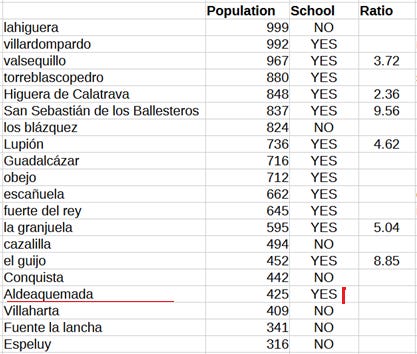
As you can see, many small towns lacked a school8, and Aldeaquemada was one of only two municipalities with fewer than 500 residents that actually had one. This suggests at least a greater concern with schooling than its peers.
Mining or no mining?
Examining the relationship between primary schooling and literacy might seem like a pointless endeavor, a futile way to confirm the obvious: wider access to primary schooling increased literacy.
But that would be unfair. One of the three areas of higher literacy I mentioned above, east of Córdoba city, presents no clear causal factor that might explain its literacy level. But we can now say this was very likely due to wider access to education, even if we still don’t know what caused that wider access. Another potential causal factor I put forward in my last post, the 19th-century mining boom in northern Jaén province, now needs reevaluation:
Mining made the region’s towns prosperous and attracted many new residents to work in the mines. The resulting wealth meant more funds for primary schooling, which was probably the main driver of rising literacy,
I particularly singled out the town of Vilches:
An illustrative example of the effect of mining wealth would be the municipality of Vilches,… its literacy rate was almost as high as those of La Carolina and Aldeaquemada
Yet Vilches had the highest ratio of students to population of all the Jaén municipalities I included in the analysis, before the mining boom began. In fact, the entry for Vilches doesn’t mention any mines operating in its territory. This makes me doubt the hypothesis that the mining boom was the cause of increased literacy in northern Jaén. More generally, I should update downwards the likelihood that economic booms increase literacy9.
So, we did get some insights out of this analysis.
While the average student-to-population ratio of Córdoba and Jaén municipalities was around 3.5 students per 100 residents, towns in northern provinces with intermediate literacy levels (e.g. Barcelona10) generally had ratios in the 4 to 6 range. Furthermore, consistent with the correlation between broader access to schooling in the 1830s/1840s and higher literacy, some of Spain’s highest-literacy provinces, such as Burgos11, had student-to-population ratios in the 7 to 13 range.
I hesitate to conclude that Andalusian municipalities with a higher share of non-Andalusian population - like those in the New Settlements of Sierra Morena and Andalusia areas - had high student-to-population ratios, given the factors I discussed above regarding La Carolina and Aldeaquemada.
I should probably spend some time researching this more thoroughly.
(Here’s the data on schools and number of students by municipality that I transcribed from Madoz’s Dictionary)
When the dictionary provides a range for the number of students (“á la que asisten de 40 á 50 discípulas”), I used the midpoint of that range.
I didn’t include the whole of Jaén province because I’m lazy.
I didn’t use Madoz’s own population figures because it was just too much work to transcribe them, and I already had the 1860 census figures available.
I also excluded the cities of Lucena and Córdoba, and the town of Torredonjimeno because its number of girl students was implausible.
Remember that a correlation coefficient (Pearson’s r) measures the strength and direction of the linear relationship between two variables. Its magnitude (absolute value) ranges from 0 (no correlation) to 1 (strongest), and its sign indicates the direction of the relationship.
Also, schools for girls are mentioned in the towns of Belalcázar, La Carolina, Valenzuela, Santaella and Iznájar, yet no student numbers are given for them (those sexist bastards!).
Assuming that the number of female students is around half the number of boys, La Carolina would rank in the top 20% of municipalities by student-to-population ratio.
One of those was Espeluy (population 316), a town I highlighted in the previous post for its exceptionally high literacy.
Maybe they only increase literacy when they don’t alter the population’s structure by attracting workers?
Based on a limited sample of Barcelona municipalities that I examined.
Based on a limited sample of Burgos municipalities that I examined.