

A recurrent subject on this blog is Spanish migration to the Americas, along with the occasional post on recent reverse migration from Latin America to Spain1. Yet I haven’t previously written about historical reverse migration to Spain.
Since I recently spent a ridiculous amount of time manually transcribing data from old Spanish censuses2, I took the opportunity to also collect data on foreign-born residents in 19th-century Spain, especially those born in Latin America. Why do I care about those Latin American nationals living in 19th-century Spain? Because their presence in Spain is a reflection of the migration flow going in the opposite direction. For the most part, these were either Spaniards returning home after years or decades abroad, or the (sometimes American-born) spouses and children of those returnees.
The data for this analysis come from the 1877, 1887 and 1900 Spanish censuses. The first one recorded the country of birth of foreign-born residents, while the 1887 and 1900 censuses recorded only the nationality of foreigners3. Therefore, the 1877 census would not have recorded a Spanish-born returnee, even if he had renounced his Spanish nationality while living in the Americas4. On the other hand, the 1887 and 1900 censuses would not have recorded American-born spouses and children of returnees who had acquired Spanish nationality before the census took place5.
These census recording rules, combined with Spanish nationality law, produced a surprising gender ratio among Latin American foreigners (or foreign-born) living in Spain. Although Spanish emigration to Latin America was strongly male-skewed, the gender ratio of Latin Americans living in 19th-century Spain was usually more balanced, and in some cases even female-skewed. The obvious explanation for this is the presence of many Latin American spouses, mostly wives, and children.
While the 1877 census did not record the gender of foreign-born residents6, women comprised around 55% of Latin American nationals in the 1887 census7 and roughly half in the 1900 census8. I will show the gender ratios by country only after we’ve examined the total number of nationals from each Latin American country living in Spain, as the variation in ratios becomes more interesting when viewed in context.
So here are the total numbers of residents by Latin American country of origin:
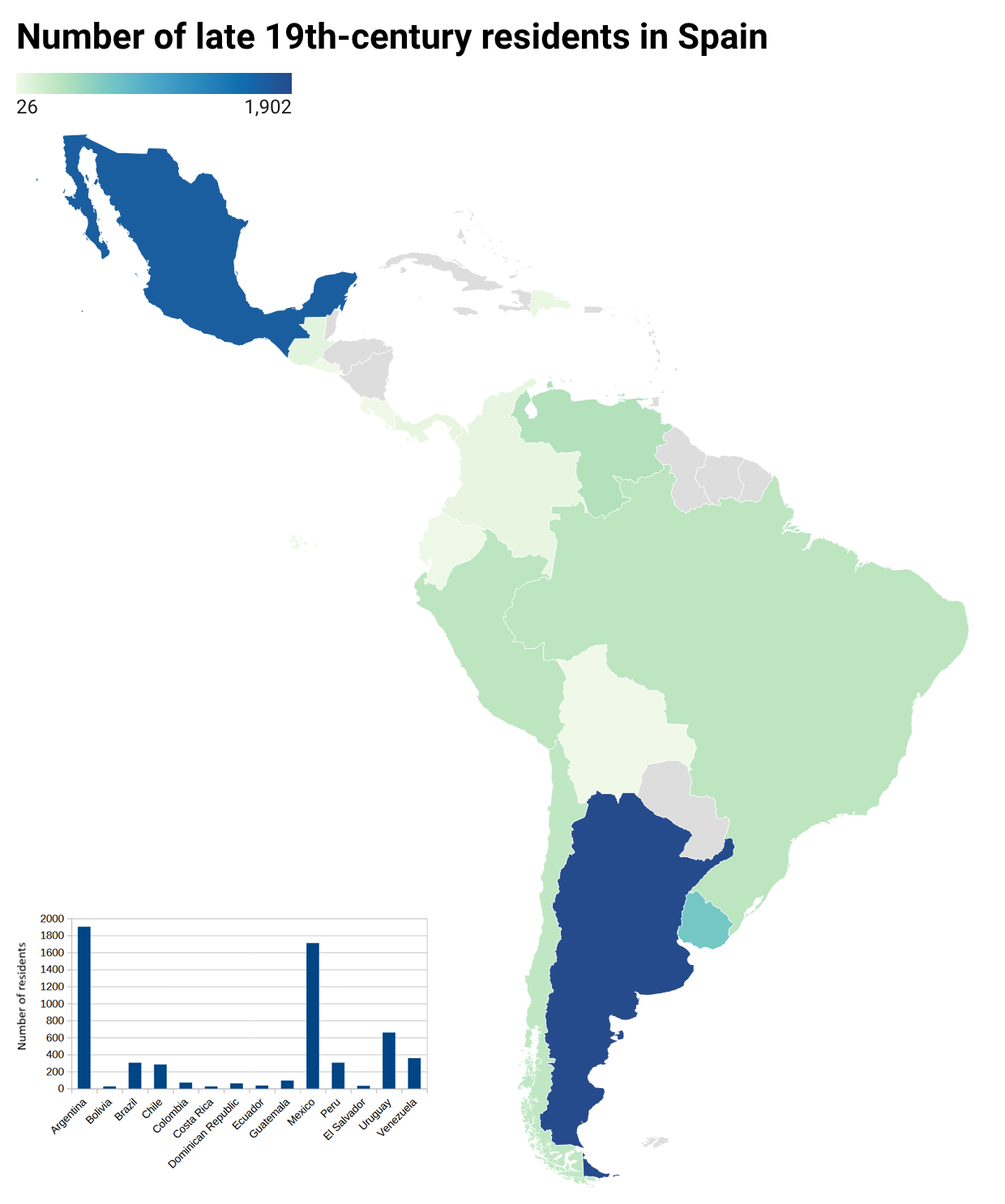
A few caveats about these numbers:
Since Cuba and Puerto Rico were still Spanish territories during this period, their natives were not classified as foreigners. Therefore, I have no Cuba or Puerto Rico numbers. Cuba only shows up as an independent country in the 1900 census.
Panama was not yet an independent country either. Panamanian-born residents were classified as Colombian.
I omitted countries with very few residents in Spain: Honduras, Nicaragua and Paraguay.
The numbers in the map and chart above are the sum of the 1877, 1887 and 1900 census figures for each country. As I’ve already noted, these figures measure similar but not identical things (foreign-born vs nationality).
At first sight, the numbers shouldn’t surprise us. Argentina accounts for the largest number of residents, reflecting its status as the main destination of Spanish migrants in the 19th century. Assuming Spanish emigrants were similarly inclined to return from one Latin American country than from another, the number of residents from each Latin American country - mostly spouses and children of the emigrants - should be roughly proportional to the number of Spaniards who emigrated to each country.
This assumption also aligns with the numbers for other countries: Uruguay, a small but highly favored country, sent the third-highest number of returnees to Spain, while Colombia, the least favored destination among major Latin American countries, has a relatively small number of nationals residing in Spain.
In fact, adjusting for population size, Brazil shows slightly more residents in Spain than Colombia, even though Brazil is not a former Spanish colony.
Mexico’s oddity
The country that clearly breaks this correlation between number of immigrants from Spain and number of returnees back in Spain is Mexico. If the pattern held for Mexico, it would have received fewer Spanish migrants than Argentina (with around 1.5 million) but far more than Brazil or Uruguay, which received somewhere between 300,000-600,000.
This number - at least hundreds of thousands - is nowhere near the estimated tens of thousands of Spaniards living in Mexico in the late 19th century9. Either the general pattern does not apply to Mexico, or there is some other factor(s) affecting the number of Mexican residents in Spain.
One possible factor is the presence of Mexican-born individuals in Spain, such as businessmen or students, with no family ties to any Spanish emigrant. Yet this number was likely small, as shown by the extremely low numbers of nationals from Latin American countries like Nicaragua or Paraguay10. If these Mexican nationals were living in Spain for business or academic reasons, their gender ratio must have been strongly male-skewed, given how male-dominated those occupations were at the time.
Were these non-returnee Mexicans numerous enough to make the overall gender ratio of Mexican residents in Spain male-skewed? Or were they only a small fraction of the total? I cannot answer these questions definitively, but we can take a look at the gender ratios for Mexican nationals, and those of other countries, to try to understand why Mexico does not follow the pattern.
The following scatter plot shows the estimated number of Spanish migrants (logarithmic scale) versus female ratio for each of the eight main countries11.
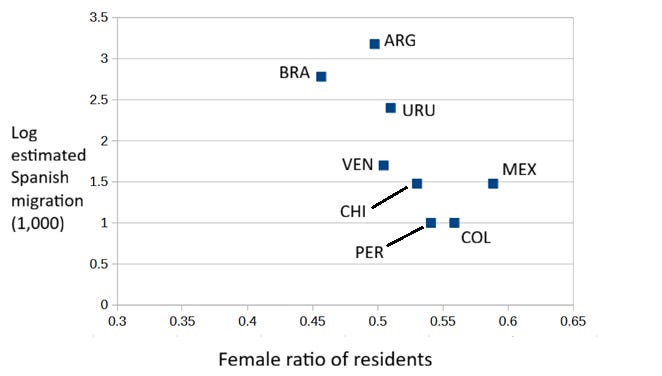
The apparent correlation between the two variables is pretty strong (Pearson’s r = -0.74), yet I honestly don’t believe there’s a genuine linear correlation here. What I think the plot shows is simply a separation of Latin American countries into two groups: a high-migration group consisting of Argentina, Brazil and Uruguay, and a low-migration group comprising Chile, Colombia, Mexico and Peru, with Venezuela falling in between.
Countries in the high-migration group present a fairly balanced female ratio (close to 0.5), whereas countries in the low-migration group, including Mexico, show a female-skewed gender ratio. Returnee Spaniards and their relatives were likely a larger share of residents from high-migration countries, while low-migration countries had a higher share of non-returnees (businessmen, students, etc). If this is the case, why do low-migration countries show a female-skewed ratio instead of the male-skewed ratio that their more non-returnee profile would suggest?
As some famous person whose name I can’t be bothered to look up once put it: the answer is love.
Many (perhaps most) returnees brought children and spouses back with them to Spain, and we can assume that the gender ratio among these children was roughly balanced. But that’s not necessarily the case with spouses.
First, because Spanish emigrants were predominantly male, returning spouses were more likely to be wives12. Second, in the male-dominated world of the 19th century, it would be more common for migrant men to bring back the wives they married in Latin America than for migrant women to bring their husbands back to Spain13. Thus, we have good reason to believe that the gender ratio of returnees and their families would have been somewhat female-skewed, if marriages to Latin American women were common.
This last point, the frequency of marriages to Latin American women, clearly differs between high-migration countries and low-migration countries. In high-migration countries, the large community of Spanish migrants increased the probability of marrying a Spanish-born spouse. By contrast, in low-migration countries the smaller migrant population lowered the chances of marrying a Spanish-born wife, correspondingly increasing the probability of marrying a Latin American wife.
This is the most likely explanation for the higher female ratio of low-migration countries relative to high-migration ones. It also happens to fit with the temporal trend of almost every country. As Spanish migration to Latin America increased, one would expect a decline in the female ratio for most Latin American countries, which is precisely what we see:
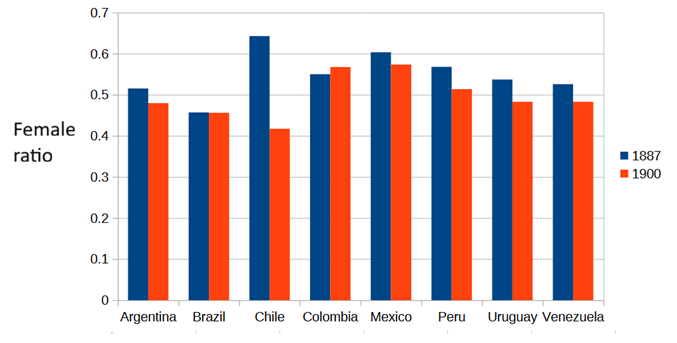
With one exception (Colombia), all countries show a decrease in their ratio, with the steepest drop happening in Chile, where the Spanish-born population grew sevenfold between 1885 and 190714.
So that is what the gender ratios of 19th-century Latin American residents in 19th-century Spain can tell us.
To be honest, my main motivation for writing this post was not so much to analyze gender ratios, but to show you some cool regional maps displaying the very different distributions of Latin American residents in Spain.
Let’s start by the total Latin American residents by province15 (darker colors indicate higher numbers of residents).
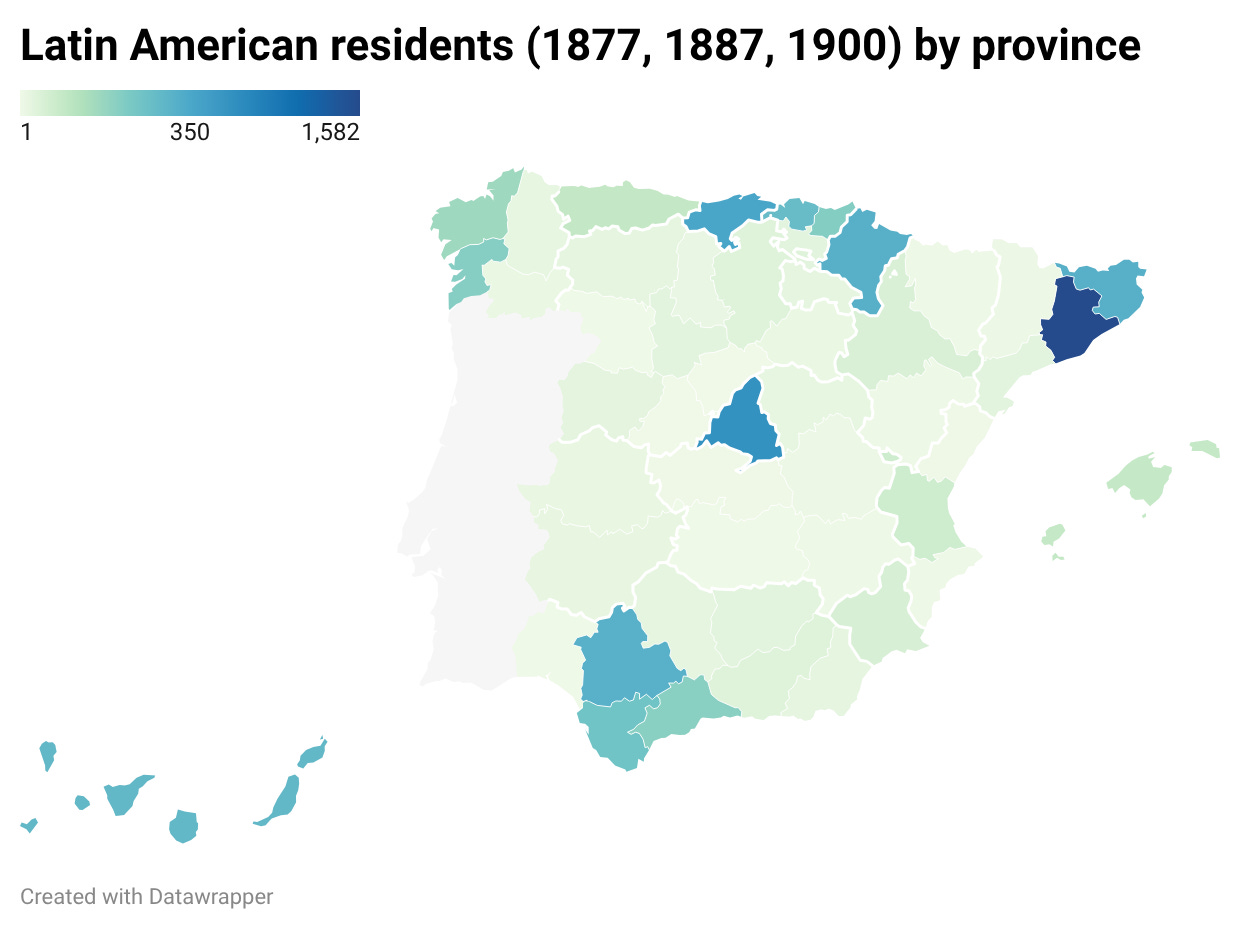
A few patterns we can discern from the map above:
Madrid and Barcelona, the two main cities, each host more residents than any other province. Barcelona in particular accounts for roughly one-fourth of the total. It seems many returnees did not go back to their province or region of origin, but rather to cities where economic opportunities were more plentiful16.
The Andalusian ports of Cádiz, Málaga and Seville were among the ten largest cities in Spain and accounted for a large share of maritime traffic between Spain and the Americas. Unsurprisingly, the provinces where these three ports are located show high numbers of residents.
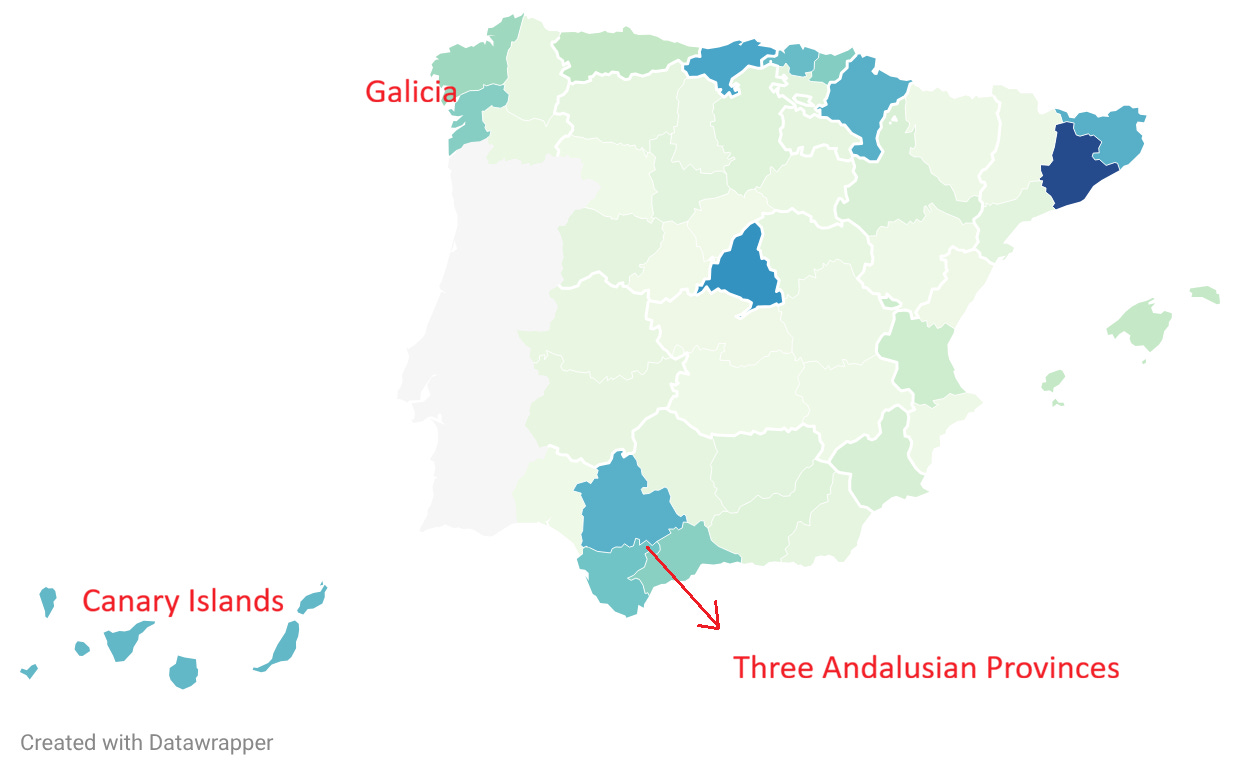
The two main regions of origin of Spanish migrants, Galicia and the Canary Islands, are clearly visible because of their darker color (as you can see in this footnote17).
There’s a general pattern of Latin Americans settling along the coasts, perhaps mirroring the 19th- and 20th-century Spanish trend of internal migration from the interior of the peninsula towards the coasts. Not all coasts attracted residents with the same intensity though. The northern coast stands out as a focus of attraction, while the eastern coast - excluding Barcelona - shows very low numbers.
In contrast to the coasts, the provinces surrounding Madrid show particularly low numbers of residents, probably due to the capital’s pull.
Now that we’ve seen the overall Latin American geographic distribution, let’s examine the distribution of Argentine and Uruguayan residents side by side.
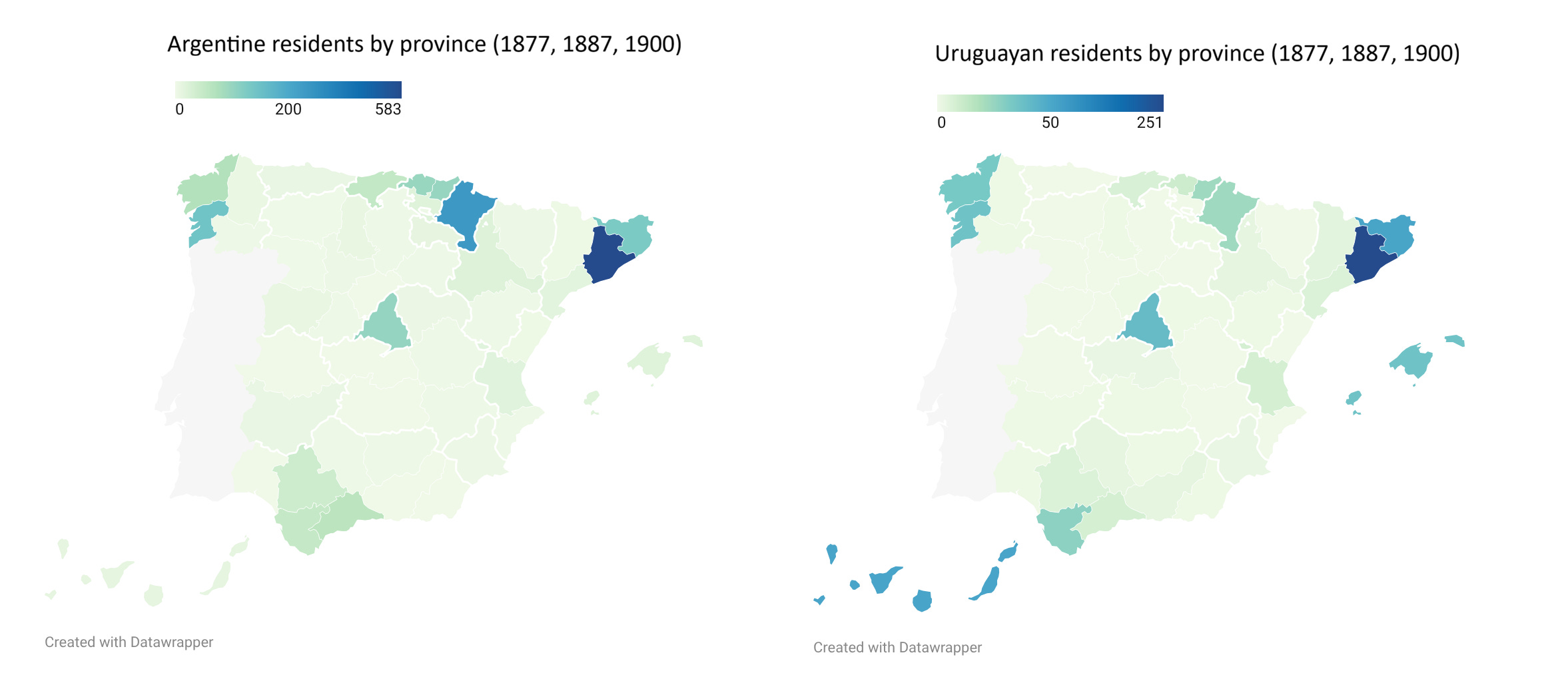
The geographic patterns of Argentine and Uruguayan residents are fairly similar to each other and for the most part follow the general Latin American pattern, including a northern belt of four darker colored provinces along Spain’s northern coast. The main difference between Argentina and Uruguay is the large number of Uruguayans present in both Spanish archipelagos: the Canary Islands and Balearic Islands.
The two archipelagos also explain the main differences from the general pattern. Argentina has very few residents in the Canaries compared to Latin America as a whole, while Uruguay shows an unexpected18 high concentration of residents in the Balearic Islands.
An obvious next step is to compare these two countries with their neighbor, Brazil.
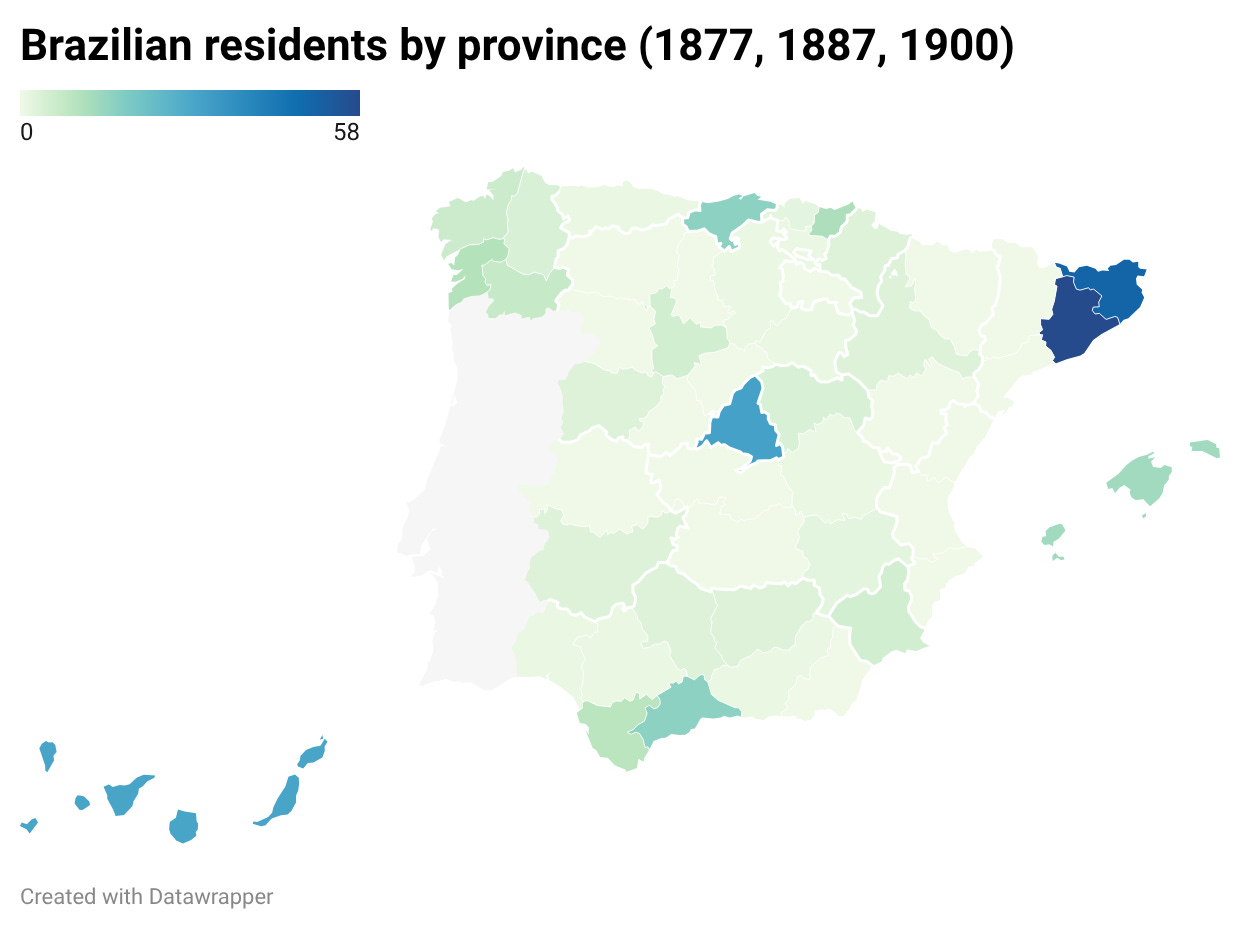
Brazil looks very similar to Uruguay. Even down to the high number of residents in the Canaries and Balearic Islands.
I’m not sure this similarity between Brazil and Uruguay holds after 1900, when a large wave of migration from Andalusia to Brazil took place (perhaps an interesting subject for a future post). I interpret the high numbers of residents in some Andalusian provinces as a consequence of the major ports located there (Cádiz, Málaga, and Seville), which probably attracted many returnees and businessmen.
Of the remaining countries, Venezuela has the closest profile to the three we have already examined (although I hesitate to call it a high-migration country), yet it also presents some major differences.
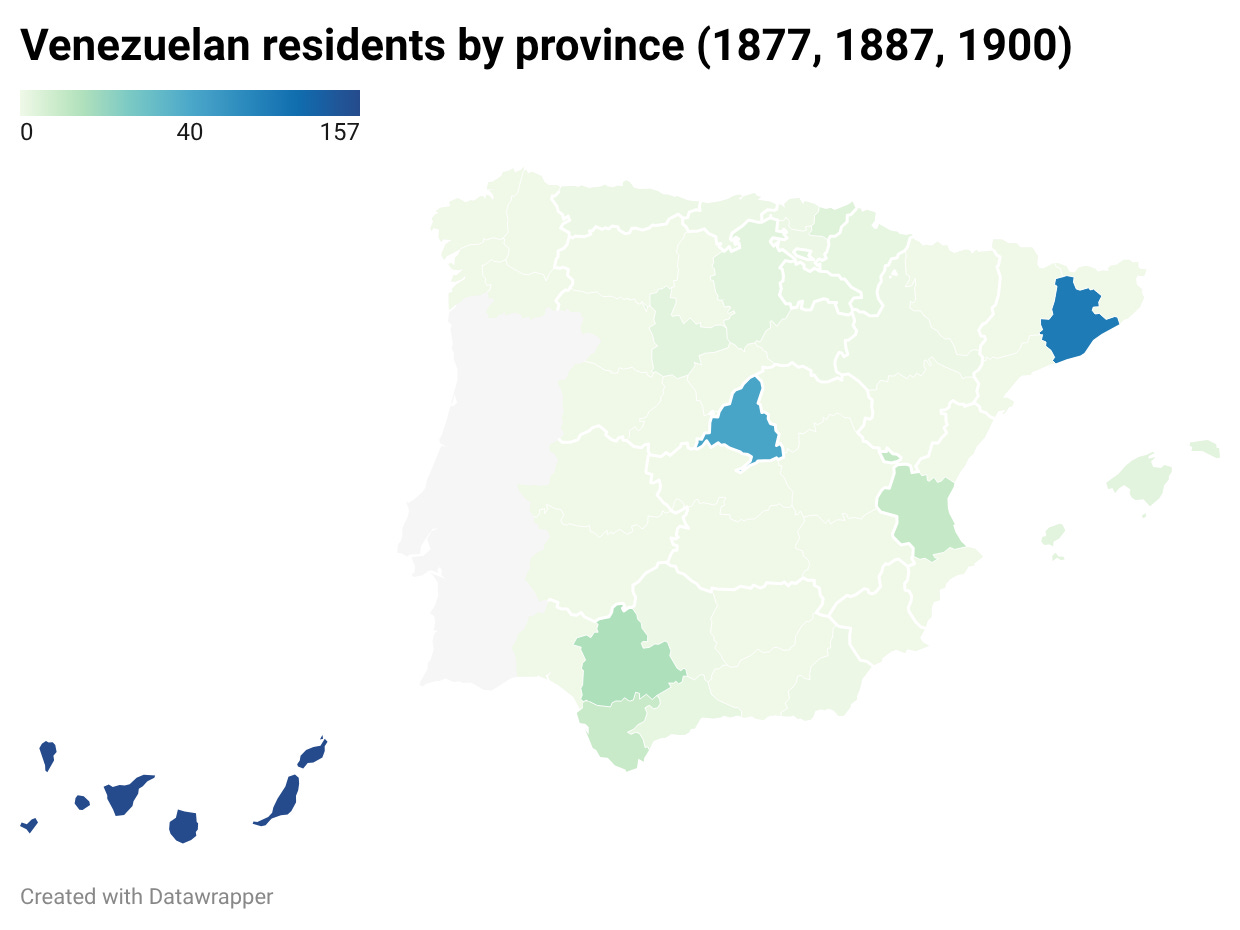
Those differences consist of an increased presence in the Canary Islands and a reduced presence almost everywhere else. Venezuela’s map reflects a point I’ve made in previous posts: Spanish emigration to Venezuela in the 19th and 20th centuries was mainly Canarian emigration.
The low-migration countries
Let’s start our examination of the low-migration countries with Mexico.
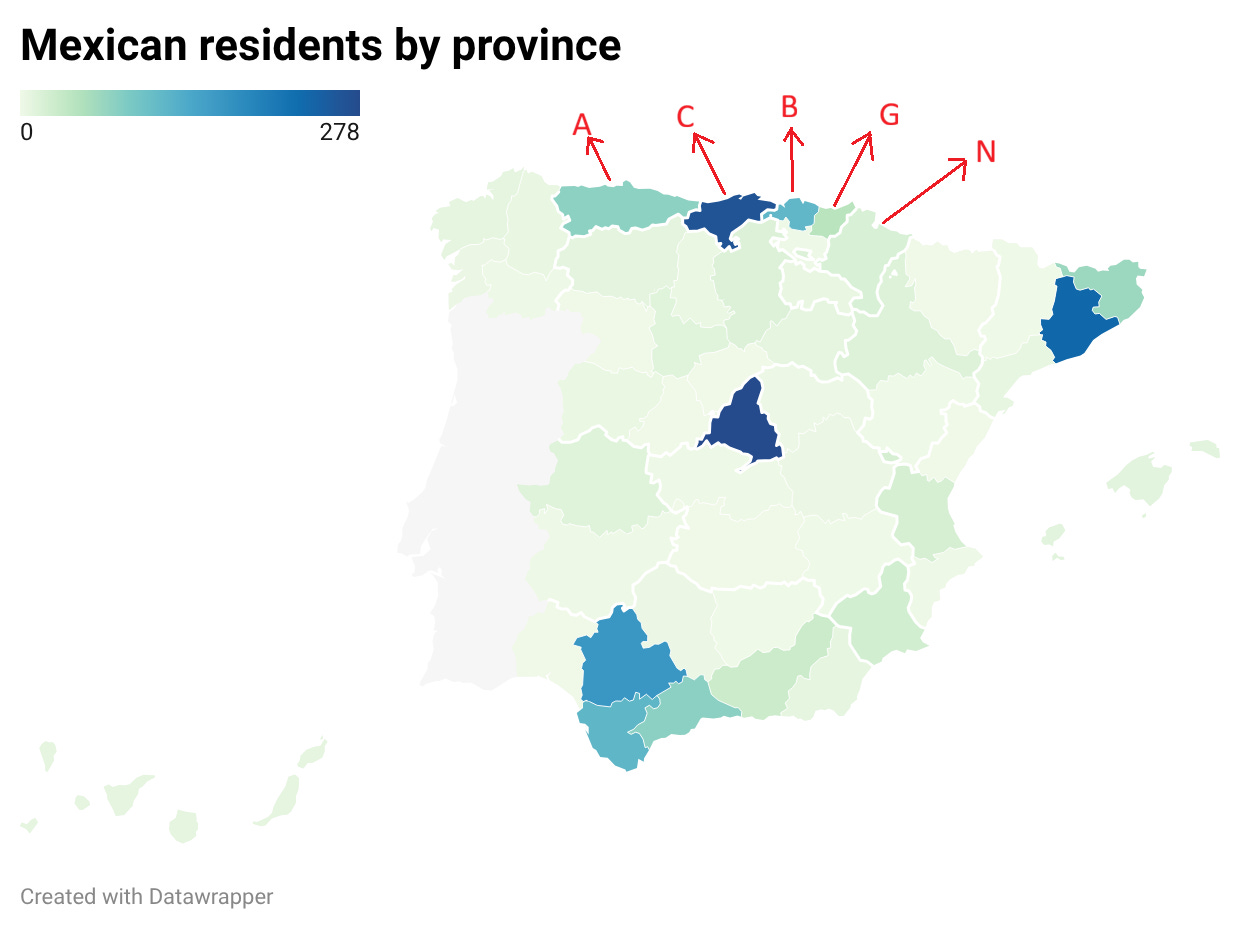
The Mexican distribution of residents differs from that of high-migration countries in the low numbers it shows in Galicia and the Canaries, the main regions of origin of Spanish migrants. This is exactly what we should have expected given the distinct profile of the smaller migration flow to Mexico.
This profile, characterized by a large share of northern Spaniards - Cantabrians, Basques, Navarrese - who were drawn not only by higher wages but often by commercial opportunities, produces a concentration of residents along Spain’s northern coast similar to that of Argentina and Uruguay, though the pattern is more pronounced in the case of Mexico.
Mexico’s northern Spanish belt peaks in Cantabria (labeled “C” on the map), a region strongly associated with 19th-century Spanish migration to Mexico. It also includes Asturias (labeled “A”), but arguably not Navarre (“N”), while the corresponding belt for Argentina and Uruguay substitutes Navarre for Asturias.
Finally, Chile and Peru19 display a distribution of residents intermediate between Mexico and Argentina.
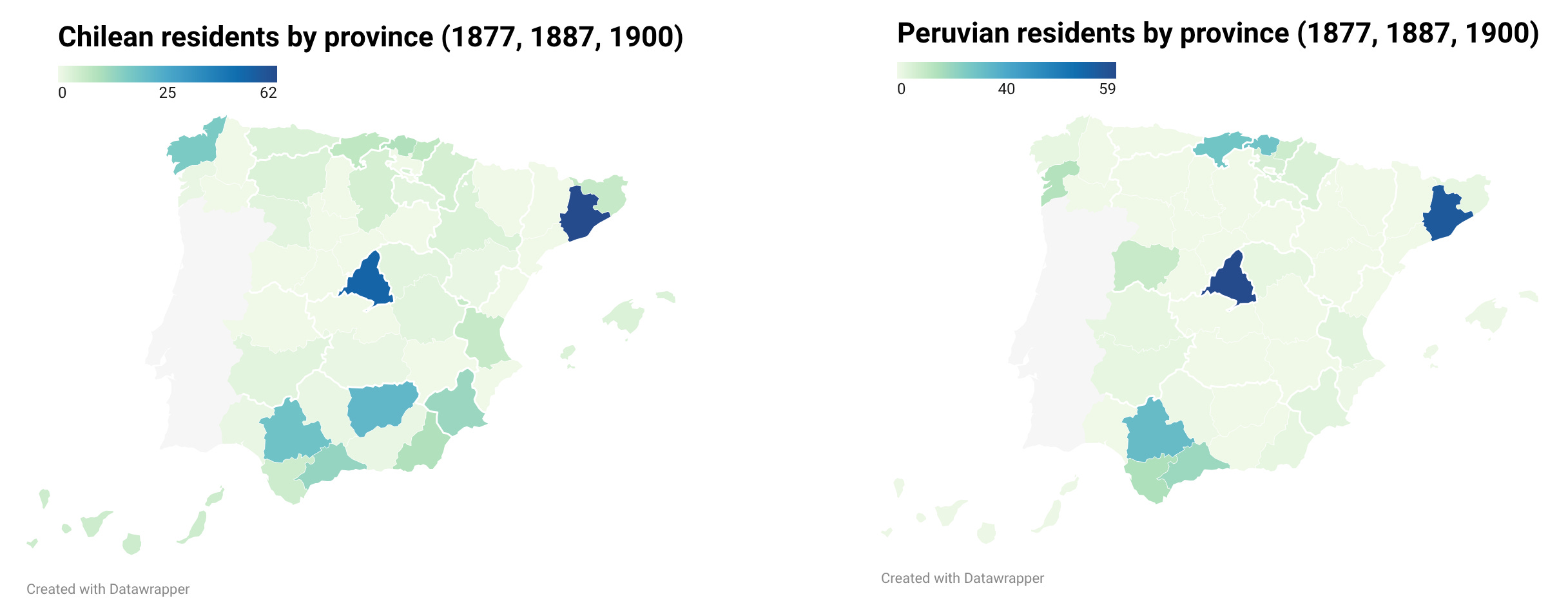
Both show a higher number of residents in Galicia than Mexico does, together with low numbers in the Canary Islands.
Peru’s northern belt appears more clearly defined than Chile’s, and the same is true of the usual cluster of main Andalusian provinces, which in the case of Chile looks more like a concentration in Andalusia as a whole (plus Murcia).
These maps raise as many questions as they answer. Returnees clearly concentrate in major cities - see Barcelona and Madrid -, but is their strong presence in major Andalusian ports only an effect of those port’s size?
They do confirm what we already knew about the regional origins of 19th-century Spanish migrants to various Latin American countries, but there’s not much else that can be concluded with certainty from these results.
The link between Spanish businessmen in Mexico and Spain’s northern belt is well documented20, yet I hesitate to claim the same for Chile and Peru. I also doubt there’s any direct connection between the female-skewed gender ratios seen for low-migration countries and the more business-oriented profile that Spanish migrants to those countries apparently had. For the time being, I would tentatively ascribe their female ratios to the smaller size of their migrant communities, pending further research on this topic.
I guess I should do more research.
(Credit for this post’s thumbnail goes to the Centro Asturiano de México, the association of Asturian descendants in Mexico. It pictures the football team founded by Asturian immigrants in Mexico)
Would “partial reverse migration” be more accurate?
My personal “I’m in awe of AI” moment will come true the day I can feed an imperfectly scanned old document containing numeric tables to an AI assistant and get back a perfectly formatted, 100% accurate table. And this is what I mean by imperfectly:

Place of birth was not broken down by country in 1900.
The Spanish 1889 Civil Code did not allow dual nationality. See articles 20, 21, 25 and 26.
See article 24 of the Spanish 1889 Civil Code.
Given what we know about gender ratios of emigrants, I suspect it would have shown a more female-skewed ratio among Latin Americans than the 1887 and 1900 censuses. Also, the 1877 census grouped all South Americans together for the provinces of Valladolid (26), Tarragona (3), and La Coruña (143). And it also combined all Latin Americans together for the provinces of Huelva (4), Huesca (1) and Jaén (7). For Valencia (1877), the census reports 34 people born in North America, but no Latin Americans.
Estimated from a sample of provinces: Madrid, Barcelona, Seville, Bizkaia, La Coruña, Cantabria, Navarre, Pontevedra, The Canaries and Cádiz.
1900 data comes from “Tomo II. Clasificación de la población de Hecho por sexo, estado civil e instrucción elemental“.
The 1900 Mexican census recorded 16,278 Spaniards living in Mexico. This may be a lower bound estimate, given that many Spanish-born individuals had likely acquired Mexican nationality.
According to the 1887 census, there were only two Paraguayan citizens living in Spain at the time (6 in 1900), and only one Nicaraguan citizen (4 in 1900). The combined population of both countries was close to a million people in 1900, compared to Mexico’s 13.5 million. Assuming that all Nicaraguan and Paraguayan nationals in Spain had no family connections to Spanish emigrants, we can estimate an equivalent non-returnee share of residents for Mexico.
The eight main countries, together with the estimated number of Spanish migrants each received, are: Argentina: 1,500k; Brazil: 600k; Chile: ~ 30k; Colombia: < 10k; Mexico: 30k; Peru: ~ 10k; Uruguay: 200k-300k; Venezuela: ~50k.
See “La otra orilla del mundo. Cántabros, vascos y asturianos en el occidente de México durante el siglo XIX“, by Sergio Valerio Ulloa. “At the beginning of the 1880s, 21 people resided in the [Mexican] city of Guadalajara who declared to the Jalisco authorities that they held Spanish nationality, of whom only two were women. Fourteen of them stated that they were primarily engaged in commerce, two were farmers, and there was a cook, a musician, a hatter, a singer, and a housewife. Most of these Spaniards were married, mainly to Mexican women, so their children had been born in Mexican territory.“
In the case of Spanish returnee couples who had married before emigrating and changed their nationality while abroad, their return would have had no effect on the gender ratio of Latin American residents in Spain.
From 2,508 in 1885 to 8,494 in 1895, and reaching 18,755 in 1907. See Cuadro II in “Los canarios en la colonización del sur de Chile, 1900-1912”, by Concepción Navarro and Baldomero Estrada.
At the time, the Canary Islands constituted a single province, rather than the modern-day two provinces. Numbers of residents are given for the one single province.
Or maybe to the same ports of departure from which they had sailed to the Americas.
Labeled version of the Latin American residents by province map:
Unexpected to me at least.
Colombia doesn’t show any interesting pattern. 73% of its 71 nationals resided in Barcelona, Madrid or Seville.
See “La otra orilla del mundo. Cántabros, vascos y asturianos en el occidente de México durante el siglo XIX“, by Sergio Valerio Ulloa.
I'm persuaded that some of my cousins (and thus their father, my uncle-in-law) must have Mexican ancestry. Notably the elder cousin of my age is very unusually dark in skin tone and has extremely black ("bluish") straight hair (in contrast native European black hair is typically very dark brown in fact: different types of eumelanin acting here), her youngest brother also has some milder Native American look, looking much like a brunet version of Brad Pitt.
My uncle is from Madrid and comes from a military family (although he's a mathematician).
Nevertheless the presence of Native American ancestry should be apparent in mtDNA surveys and yet I'm unaware of any presence of haplogroups A, B, C or D in modern Spaniards. They should show up at least occasionally but nope.