

Among modern Latin American populations with partial African ancestry there seems to be no general pattern in the ratio of African maternal descent to African paternal descent. A study on uniparental markers of the Brazilian population, for example, found that around 55% of Black Brazilian’s maternally inherited mtDNA is of African origin, while only around 20% of their paternally inherited Y chromosomes belong to African haplogroups1.
Argentina shows a similar pattern to Brazil, with African maternal lineages between two and five times as common as African paternal lineages2. Mexico, on the other hand, has much more even African paternal and African maternal shares; possibly even a slightly higher paternal share3. If anything, the only regularity appears to be that African paternal lineages are never substantially more frequent than African maternal lineages.
What are these uniparental markers and why should we care about them?
Uniparental markers are pieces of DNA inherited from only one parent and thus from only one ancestral line. Mitochondrial DNA is passed only from mothers to their children, while the Y chromosome is passed exclusively from father to son. In an admixed population with Indigenous, European and African ancestry - like Brazil or Mexico - these markers can reveal the sex bias among the population’s founders several generations ago. If African maternal mtDNA is more frequent in an admixed population than African Y chromosomes are, that tells us more African women than African men contributed to founding that population.
If the number of African women who contributed to founding Latin American populations was either similar or higher than the African men who did so, does that mean African women outnumbered African men in colonial Latin America?
Well, no. Significantly more male slaves than female slaves were imported from Africa to Latin America over the three centuries of Spanish colonial rule. In Mexico, the male slave population outnumbered females around 3 to 14. African women were simply much more likely to leave descendants in Mexico than African men. But not if they were slaves.
A very rough estimate, based on the age and sex figures that Colin Palmer gives in his book “Slaves of the White God: Blacks in Mexico, 1570-1650“ for slaves living in several Mexican plantations, suggests that each enslaved woman had an average of one child5. Even accounting for the continued importation of new slaves from Africa, this very low fertility meant that Mexico’s enslaved population could not maintain its numbers.
This might seem hard to square with the roughly 3%-5% African ancestry in Mexico’s population today, given that the slave population on the eve of independence (1821) was less than 2% of the total. It’s hard to see, given its gender imbalance and its concentration in low-fertility cities, how this small population of around 10,0006 could have produced the not insignificant share of African ancestry in today’s population. Luckily we don’t have to answer that question, because another colonial population group is a more plausible source of most of Mexico’s African ancestry: Mexican Pardos.
Remember the riddle I mentioned in my last post?
Chief among them is the question of why the Spanish community, comprised of those descended mainly from Iberian colonists, did not grow fast enough to transform Mexico into a mostly European country instead of a mostly Mestizo country.
The riddle derives from the observation that non immunological naive populations, like Afrikaners and French Canadians, who enjoyed abundant land and resources during the late 17th century to the late 19th century, grew extraordinarily fast over that period.
There’s something of a link between that riddle and Mexico’s Pardo population.
Even though we don’t know the exact mix of ancestries that produced Mexico’s Pardo population - the literal meaning of pardo is “brown” - we do know that Africans, Indigenous and Europeans all contributed significantly to it. Already in 1576-1577, a few decades after the Spanish conquest, freed former slaves in Mexico City were classified as 86% Mulato and only 14% Black7, showing the high degree of mixing that would later characterize the free Pardo community.
Describing this community as “mulato” (a word that would eventually give way to the use of Pardo) might imply that most freed men and women were the children of European and African parents, yet we know that already in the 16th century unions between Black men and Indigenous women - formal marriages and otherwise - were common8.
We can get a sense of the likely ancestry mix of colonial Mexican Pardos by looking at Brazilian Pardos today. The Pardo ethnic identity (same word in Portuguese as in Spanish) has persisted in Brazil for much longer than in most Latin American countries, where slavery was abolished in the wake of the Independence Wars. According to DNA studies, Brazilian Pardos have roughly around 20%-30% African, 50%-60% European and 10%-15% Indigenous ancestry.
Despite the two centuries and half a continent that separate colonial Mexican Pardos and modern Brazilian Pardos, this estimate should be good enough to shed light on a couple of things about them, and how they interacted with the rest of Mexican society:
Although they were described as “brown”, Pardos almost certainly had more European than African ancestry9. Conservatively twice as much, but perhaps close to three times as much. Their Indigenous ancestry, though not insignificant, was the smallest of the three.
Even though African ancestry was not their main ancestry, Pardos were defined by it. I was their most salient ancestry from the point of view of a society that discriminated against them and looked down on them.
Pardos did not have it easy. From the late 16th and early 17th century, when they appear as a small but recognizable group, they were subject to a discriminatory legal framework10 that only ended with Mexican independence.
During its early years the community appears to have grown quickly, from around 1,400 in 1570 to about 8,000 in 159211. This was surely due more to the relatively large inflow of manumitted slaves into the free community (Black slaves numbered 18,567 in 157012), than to the natural growth produced by births (minus deaths). Once the Pardo community became larger than the enslaved population, growth through the incorporation of former slaves must have slowed, and natural growth became the main driver13.
It’s hard to say exactly when Pardos overtook the slaves, but I would hazard a guess that it was around 1650, when Colin Palmer estimates their number at between 15,000 and 20,00014. In fact, the rapid growth of the Pardo population likely helped to limit the number of slaves imported into Mexico after 1650 by providing an increasingly abundant, and comparably cheap, labor force15. That figure of 15,000-20,000 will be our initial population.
The final population for the analysis I now want to make is the estimated half a million Pardos living in Mexico around the year 1800. We have no numbers for the Pardo population after 1821 because Mexican censuses stopped recording race, and the gradual mixing of the Mexican population would have made racial categorization increasingly absurd.
But before doing the analysis I want to perform a simple test: take the half a million 1800 population (around 10% of the total), assume a faster than average Pardo rate of growth between 1800 and 1900, and then assume that African ancestry in 1900 Mexico was more or less the same as it is now.
Applying a 4X increase16 (Mexican average was 3X) to the 1800 population results in a hypothetical Pardo population of 2 million in 1900, or 14.8% of the total. And if that Pardo population was 25% African, then the 1900 Mexican population - well on its way to mixing the previously separate groups (Pardos, Mestizos, etc) - should have had at least 3.7% African ancestry. Allowing for a little additional African ancestry in the non-Pardo population, that 3.7% is well within the 3%-5% range measured by genetic studies.
Thus, this test appears to confirm the plausibility of the Mexican Pardo population having 20%-30% African ancestry.
Analyzing Pardo growth
Let’s now analyze what happened between 1650 and 1800. We know the Pardo population grew a lot, from 20,000 to approximately 500,000, but how does that compare to the growth rates we’ve seen previously?
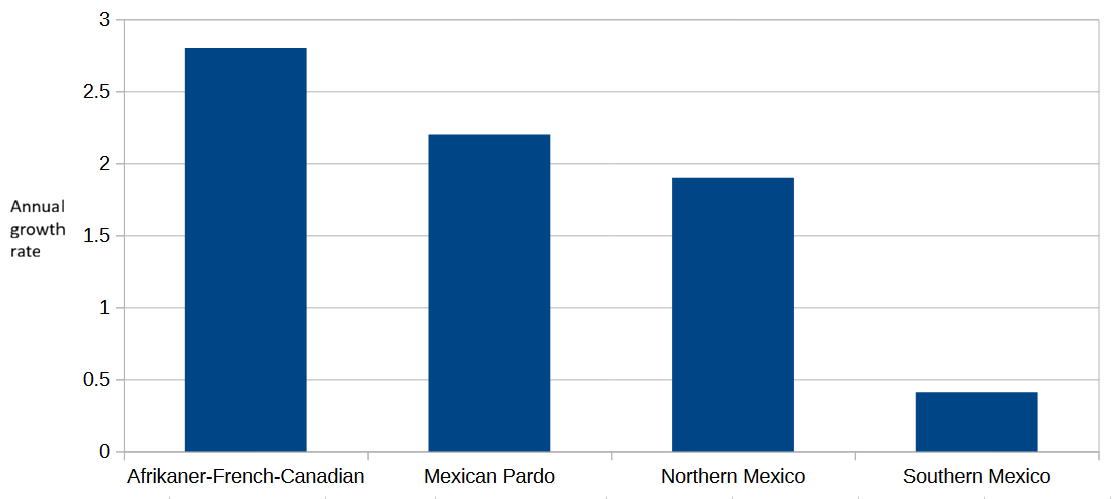
That increase translates to an annual growth rate of 2.2%17, below the extraordinarily high historical Afrikaner rate of 2.6%-3.0% per year, but higher than the rapidly growing regions of northern Mexico between 1742 and 1790 (Beware: the following chart shows rates calculated over different time periods).
Part of the explanation for the rapid growth of Pardos is, as usual, that they had many children. Population padrones (registries) for several Mexican jurisdictions recorded the number of children and women in 1791 and 1792, so we can calculate a ratio of children per woman for Pardos18. And since these registries categorized people by race, we can also compare the Pardo ratio to the Mestizo, “Spaniard” and Castizo ratios.
A note on Spanish colonial racial categories: the main division of free Spanish subjects in the American colonies was between Indians and Spaniards. Indians had some local autonomy and enjoyed some protections from Spanish authorities, while also suffering from legal discrimination, forced labor and a discriminatory tax regime. Everyone else was considered a Spaniard. Well, not everyone. As we’ve already seen, Pardos were classified as a different casta (race) and were subject to legal discrimination, even in the 18th century when Mestizos for all practical purposes weren’t19.
This explains the four castas recorded in the 1791-1792 padrones20: “Spaniard” and Pardo were clearly distinct legal categories; Mestizo and Castizo categories largely reflected the racism prevalent in colonial Mexican society21. A Mestizo was a Spaniard who, usually visibly, had more Indigenous ancestry than most Spaniards, while a Castizo was a “purer” Spaniard22 who probably looked indistinguishable from one born of European parents.
Now let’s see how the Pardo ratio of children per woman compared to the ratios of the other three castas in the late 18th century23.
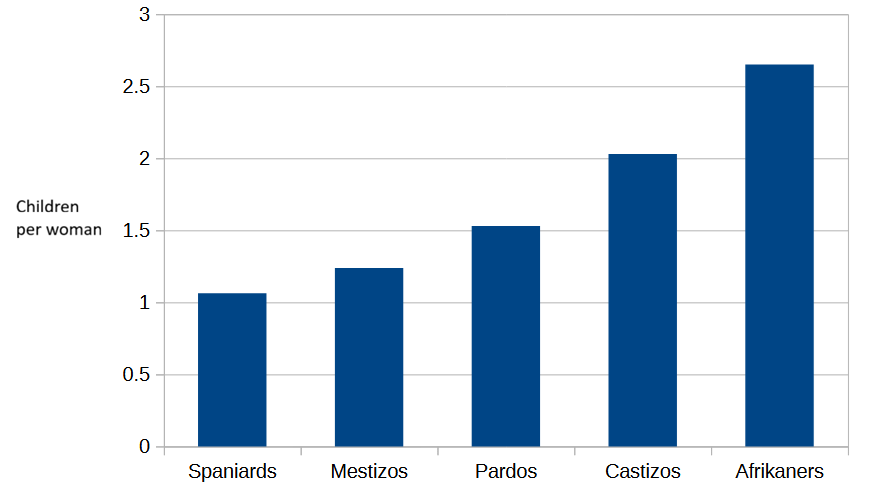
Notice that the denominator of these ratios is the total number of women, not only women of fertile age. If the ratios seem too low for a population that was definitely growing at the time, it’s because numerator and denominator are not the best suited to estimate a proper fertility rate. But they are good enough to compare fertility across population groups.
I also included the Afrikaner ratio for comparison, and as you can see, it is the highest of the five, followed by the Castizo ratio and then the Pardo ratio24.
The high Castizo ratio at least partly clarifies the riddle, even if it doesn’t entirely solve it. Castizos were most likely the least immunologically naive of the four 18th-century non-Indigenous Mexican populations on average, being mostly Spanish in ancestry, and they appear to have had the highest fertility.
Beware that only around 6%-8% of non-Indigenous individuals in the padrones were classified as Castizos (Mestizos were around 26%-29%), so who could or chose to identify as Castizo in a given jurisdiction may have affected their children-per-woman ratio25. It’s very likely that self-selection and social norms - what is the “social threshold” for someone to be considered as Castizo - played a role in this, and that this threshold varied from town to town26.
If a lower threshold meant that a larger share of the non-Indigenous identified as Castizo rather than as the default category of Spaniard, then a higher percentage of Castizos in a given town should mean that the group was less European in that town. That is assuming the town’s Castizo percentage was mostly an effect of the threshold, not of differences in ancestry between towns.
Is that a fair assumption? Well, let’s compare the Castizo children-per-woman ratio of jurisdictions with a high Castizo population share to that of jurisdictions with a low Castizo share. Very roughly, the comparison is between groups with less European ancestry (thus, supposedly, more immunologically naive) and groups with more European ancestry.
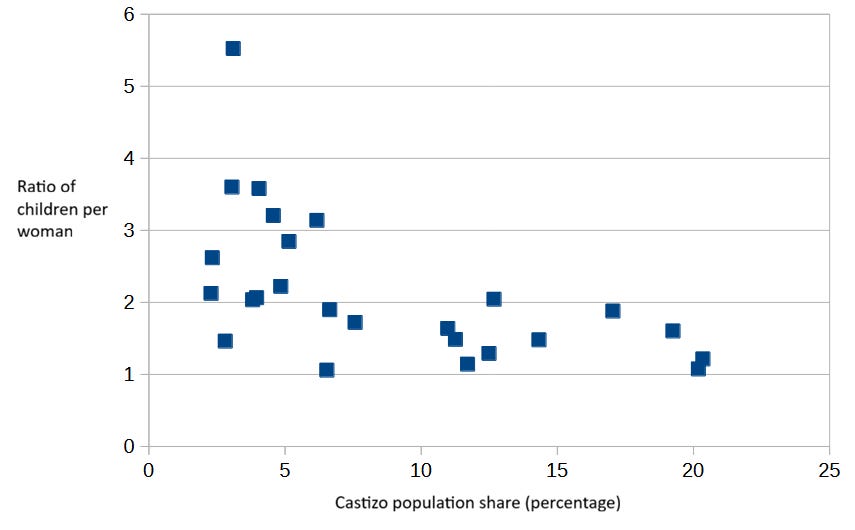
Please ignore the very high ratio (5.5) for San Felipe in the upper left corner of the plot, which may be a registry error. What the plot above seems to suggest is that Castizo groups which were more European (less immunologically naive) had higher ratios of children per woman. The correlation coefficient between Castizo share and children-per-woman ratio is -0.5627. There might be some confounding factor that explains this correlation28, but I am moderately confident it is not spurious.
When it comes to Pardos, who were around 22%-24% of the non-Indigenous population, their ratios show a much weaker correlation (Pearson’s r = -0.2929). A town with a “stricter” social threshold for being considered Pardo (for example, more visible African features), would have had a lower Pardo population share, all else equal, and assuming most people preferred to avoid the discrimination attached to the Pardo casta. But that smaller population could have had less European ancestry, less (immuno naive) Indigenous ancestry, or both. In other words, a smaller Pardo population was not necessarily less immunologically naive, and so it’s unsurprising that the correlation is weak for Pardos.
Given the Indigenous and European ancestry shares in the Mexican population today, it’s highly likely that Mexico’s 18th-century Mestizo population - including many people who self-identified as Spaniard, not Mestizo - was at least 50% Indigenous, and thus more immunologically naive and slower-growing than the Pardos. The Pardo community, by contrast, grew relatively fast because of both its European and African ancestry.
To summarize, the huge growth of Mexico’s Pardo community partly explains the enormous drop in Indigenous ancestry over the colonial period and also the country’s not insignificant share of African ancestry.
In a certain way, the rise in Mexico’s African share was due to the relatively high European ancestry of Pardos, which likely helped them reach their high ratio of children per woman. But conversely, the substantial African ancestry of Pardos - also not immunologically naive - helped raise the European share of Mexico beyond what Mestizo growth alone did, because Pardos possessed more European ancestry than the Indigenous and many Mestizos.
(This post’s thumbnail depicts Vicente Guerrero, one of Mexico’s founding fathers, whose paternal grandparents were Pardos. Credit: Wikipedia)

See “Uniparental markers reveal new insights on subcontinental ancestry and sex‑biased admixture in Brazil” (2022), by Joerin et al.
See “Genetic variation in populations from central Argentina based on mitochondrial and Y chromosome DNA evidence“ (2018), by García, Pauro et al., and “Inferring Continental Ancestry of Argentineans from Autosomal, Y-Chromosomal and Mitochondrial DNA“ (2009), by Corach et al., which finds 2.0% African mtDNA and 0.9% African Y.
See “Admixture and population structure in Mexican-Mestizos based on paternal lineages“ (2012), by Martínez-Cortés, Salazar-Flores, Fernández-Rodríguez et al.
One reason for that imbalance is that Spanish authorities favored the importation of male slaves over females, often stipulating a ratio of 2 to 1 when licensing slave traders. See “Slaves of the White God: Blacks in Mexico, 1570-1650“, by Colin Palmer, p. 11.
All of the plantations are described on pages 47, 48 and 67 of Palmer’s book, and they operated in the early colonial period (1570-1650), but I know of no reason why their age and sex structure wouldn’t apply to the late colonial period. One of the plantations described had an (exceptional?) average of 0.16 children per woman.
You can find the 10,000 figure on Wikipedia, probably sourced from Gonzalo Aguirre Beltrán’s book. I refuse to link Aguirre Beltrán’s book though, because it’s crap.
Table 16, “Slaves of the White God: Blacks in Mexico, 1570-1650“, by Colin Palmer.
Colin Palmer mentions these unions again and again: “The author found that male mulatto slaves had a decided preference for free women as marriage partners, probably owing to the fact that free women bore free children. Thus these slaves chose their wives principally from among mestizo, Indian, and free mulatto women“; “One indication comes from data derived from slaves working in the ingenio at Tuxtla in 1577. Of the twenty-seven black males who were married, thirteen chose black female slaves as their wives, and fourteen selected their spouses from among Indian and mulatto women.“; “[The viceroy] claimed that Indian women were ‘very weak and very attracted to the negroes and so they prefer them rather than the Indians, while the negroes marry them rather than those of their own kind in order to make their children free’”.
The 1791 registry for the corregimiento of Querétaro (Roncal calls it intendancy), summarized by Joaquín Roncal in The Negro race in Mexico (page 537), is unusual in that it records the Lobo casta separately from Mulattos: people of roughly half African ancestry, mostly paternal, and half Indigenous ancestry, mostly maternal. If Lobos were half Indigenous, the combined Mulatto (75.7%) and Lobo (24.2%) population of Querétaro was at least 12% Indigenous. Assuming Mulattos also had at least some Indigenous ancestry, the Indigenous ancestry of the combined Mulatto and Lobo populations (Querétaro Pardos) should have been a bit higher than the 10%-15% of Brazilian Pardos, but not far from it.
Discriminatory measures included the prohibition of bearing arms, certain occupational restrictions, and the payment of a poll tax, though irregularly collected
See Slaves of the White God: Blacks in Mexico, 1570-1650, by Colin Palmer, p. 178: “One viceroy estimated the total freedman population at 8,000 in 1592“.
See Table 11 (p. 40) of Slaves of the White God: Blacks in Mexico, 1570-1650.
In 1753, the free Black population of Mexico City was only around 2.5% of its Mulatto population. See Social Dimensions of Race: Mexico City, 1753, Patricia Seed.
Slaves of the White God: Blacks in Mexico, 1570-1650, page 178. See also the Black and Mulatto numbers for Mexico City parishes in Joaquín Roncal’s The Negro race in Mexico (page 535).
See “The Peopling of Mexico from Origins to Revolution”, by Robert McCaa.
The average Latin American country that was not heavily Indigenous grew around 3X-4X over the 19th century.
If we take into account the inflow of freed slaves into the Pardo community, the resulting rate should be slightly lower.
The jurisdictions of Igualapa/Ihualapam, Cuitzeo, Santiago de los Valles, Tamazunchale/Tamasunchale, Oaxaca city, and Tlapa used the term Mulato instead of Pardo.
A very narrow case was the use of racial categories, the broom or bride being a Mestizo or a Pardo for example, as grounds for the parents of someone under 25 to reject marriage. Low birth and poverty were also considered as legitimate reasons to oppose a marriage.
I found only two padrones (Huamelula and Oaxaca city) which exceptionally recorded an additional casta though with very few individuals and zero children.
Some padrones (Tehuacán, Orizaba, Xalapa and Chiapam) recorded Pardos separately and put everyone else (Spaniards) in a single category. Some padrones recorded other castas with visible African ancestry, like Lobo and Morisco, but rarely in a systematic manner (see footnote 9). As noted by Ben Vinson III in Bejore Mestizaje, Querétaro was an exception (beware that Vinson misinterprets some padrones data in his book): “In Xichú and Casas Viejas, in the jurisdiction of San Luis de la Paz, the emergence of lobos as a normative category seems tied to local demographic and economic conditions. Situated to the north of Querétaro… in contested frontier territory. Amidst a large indigenous majority, streams of mulattos and blacks found occupations and niche livelihoods. Inevitably, they fraternized with the local native population, bringing forth a mixed-race native/black population. The conditions were ripe for the emergence of lobos, who began to flourish.“
The literal meaning of the word “castizo” is purer.
I excluded jurisdictions in the current states of Mexico and Querétaro (Tezcuco/Texcoco, Toluca, Tetepango, Tacuba, etc). I also excluded any group with less than 30 women (usually Castizos or Pardos).
Beware that there was a clear motivation to record the children of a Pardo mother and a non-Pardo father (Spaniard or Mestizo) as not Pardo, therefore lowering the children-per-woman Pardo ratio.
Maybe those who identified as Castizo were more upwardly mobile and more upwardly mobile people had more children.
An interesting illustration of the social motivations and implications of identifying as one casta or another comes from Mexico City’s 1753 census, published by Eduardo Báez Macías, where only one of 45 lawyers declared a “quality” (or casta), as a Spaniard. We can assume that lawyers, at the top of Mexico City society, didn’t feel the need to identify as any casta. In contrast to lawyers, 88% of coppersmiths declared a quality or casta: 20% as Mestizo and 80% as Spaniards.
Excluding San Felipe (Guanajuato) actually rises the correlation coefficient to -0.59.
Hidalgo and Puebla states, which border each other, consistently show higher shares of Castizo population. But even there Castizos have the highest ratio of all the castas in most jurisdictions.
Including the 1777-1778 padrones recorded in Joaquín Roncal’s The Negro race in Mexico (pages 532,533), which did not include Castizos, lowers the correlation coefficient to -0.16.