

My last post’s description of the casta system in colonial Mexico might have surprised some of you, since I portrayed a quite simple classification system of four main castas for the free non-Indigenous population, rather than the byzantine system of more than forty categories that many sources, both on social media and scholarly works, have often presented.
A note on Spanish colonial racial categories: the main division of free Spanish subjects in the American colonies was between Indians and Spaniards. Indians had some local autonomy and enjoyed some protections from Spanish authorities, while also suffering from legal discrimination, forced labor and a discriminatory tax regime. Everyone else was considered a Spaniard. Well, not everyone. As we’ve already seen, Pardos were classified as a different casta (race) and were subject to legal discrimination, even in the 18th century when Mestizos for all practical purposes weren’t.
This explains the four castas recorded in the 1791-1792 padrones: “Spaniard” and Pardo were clearly distinct legal categories; Mestizo and Castizo categories largely reflected the racism prevalent in colonial Mexican society. A Mestizo was a Spaniard who, usually visibly, had more Indigenous ancestry than most Spaniards, while a Castizo was a “purer” Spaniard who probably looked indistinguishable from one born of European parents.
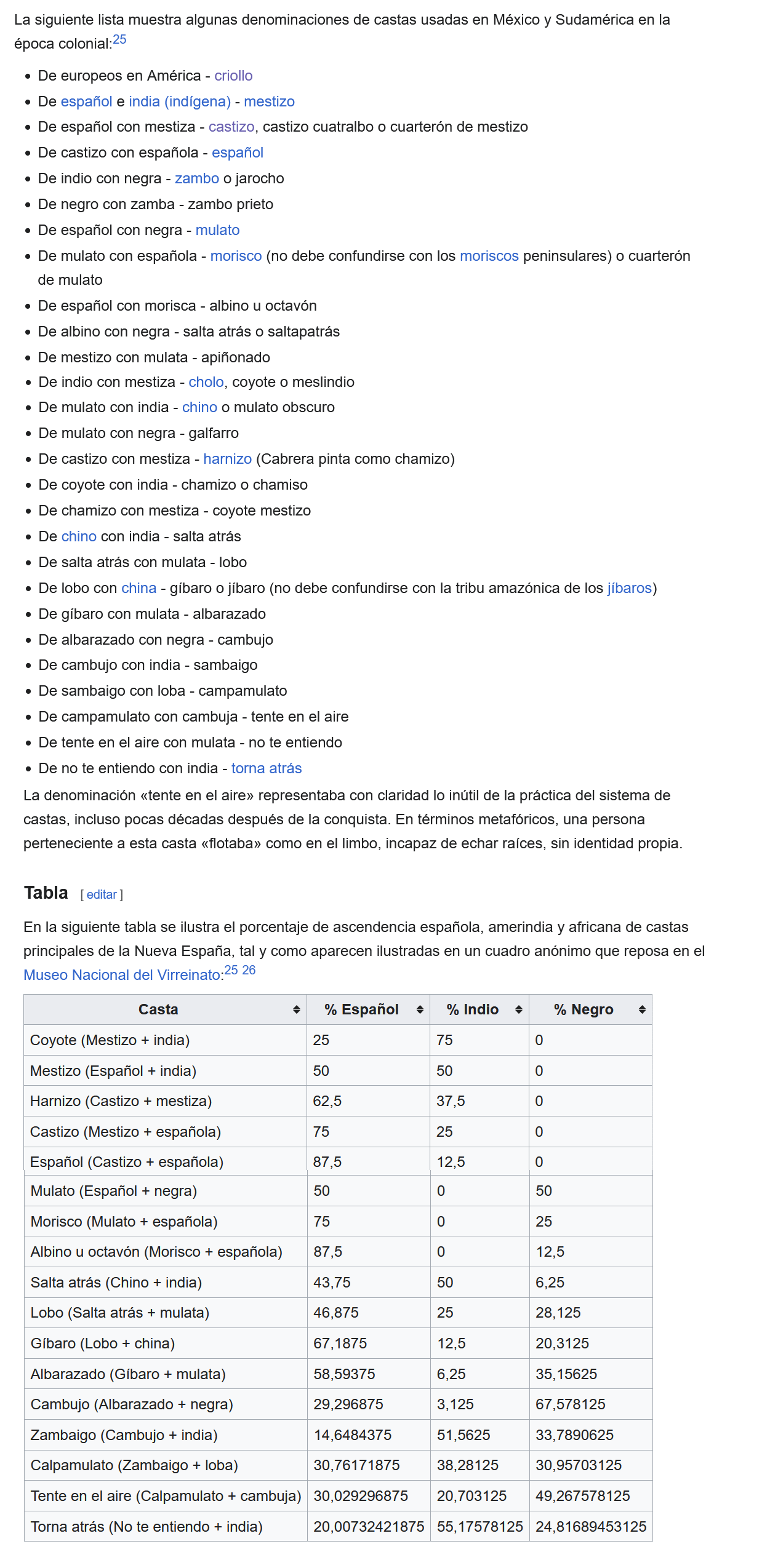
This contrasts with the very elaborate and widely disseminated casta system that many terminally woke and more than a few online racists favor as their preferred dystopian caricature of social relations in colonial Latin America. Even Wikipedia’s editors felt the need to reproduce the long lists and tables of categories; though, in its defense, Wikipedia lists only 27 castas rather than 46 or 47.
You would be forgiven for thinking that if even academic sources sometimes go for the byzantine casta system, there may be some truth to it. In fact, I even referenced an academic work in my last post which, while not endorsing the byzantine scheme, did partly contradict my interpretation of colonial castas. This work is Patricia Seed’s Social Dimensions of Race: Mexico City, 1753, published in 1982. Patricia Seed (PS) agrees that the elaborate scheme of dozens of castas is useless:
…In the eighteenth century a plethora of fanciful terms were created for successive generations of Black-Indian offspring, including ahí te estás (“there you are”) and tente en el aire (“hold yourself suspended in mid-air”), but these were never used in ordinary communication… The five basic terms in use in colonial Mexico by the middle of the eighteenth century were Spanish, Black, Indian, mestizo, and mulatto.
Yet she disagrees with my claim that Castizos were self-identified “purer” Spaniards, neither darker-skinned nor more Indigenous-looking than those recorded as Spaniards, though also not necessarily lighter-skinned or more European-looking than every Spaniard (castas were fussy). PS instead sees them as lighter-skinned Mestizos within a racial and social hierarchy in which they fall immediately below Spaniards1.
Castizo referred to a light-skinned mestizo… the continuum Indian-mestizo-castizo-Spaniard paralleled the progression Black-mulatto-morisco-Spaniard… The next racial group, the castizos, were unmistakably artisans, and by contrast with the creoles were far less frequently merchants or even owners of the artisan shops. Not only was a castizo more likely than a creole [Spaniard] to be an artisan, but he was far less likely to have owned the shop in which he worked. The greatest difference between creoles [Spaniards] and castizos lay in the absence of ownership of productive property by the latter.
Notice that Seed refers to Spaniards as Creoles because she distinguishes Peninsular Spaniards, born in Europe, from Creole Spaniards (criollos) born in Mexico. But the 1753 Mexico City census, which is her source, does not explicitly record residents as Peninsular or Creole2.
The census recorded the place of birth of persons born outside Mexico City (though I’m skeptical about how thorough the census takers were), who were less than 1% of the total, without stating their casta3. This is because the census’ goal was simply to record who lived where, and accompanied by whom4. Additional data such as casta (beyond Indigenous or Spaniard status), age, and marital status may have been desirable but were not mandatory.
Seed’s decision to split Spaniards into Peninsulars and Creoles on the basis of place of birth seems to derive from her belief that Peninsulars constituted a separate social rank above Creoles. On this point I partially, though not completely, disagree with her. In Seed’s social scheme of Mexico City there’s a clear Peninsular-Creole-Castizo hierarchy.
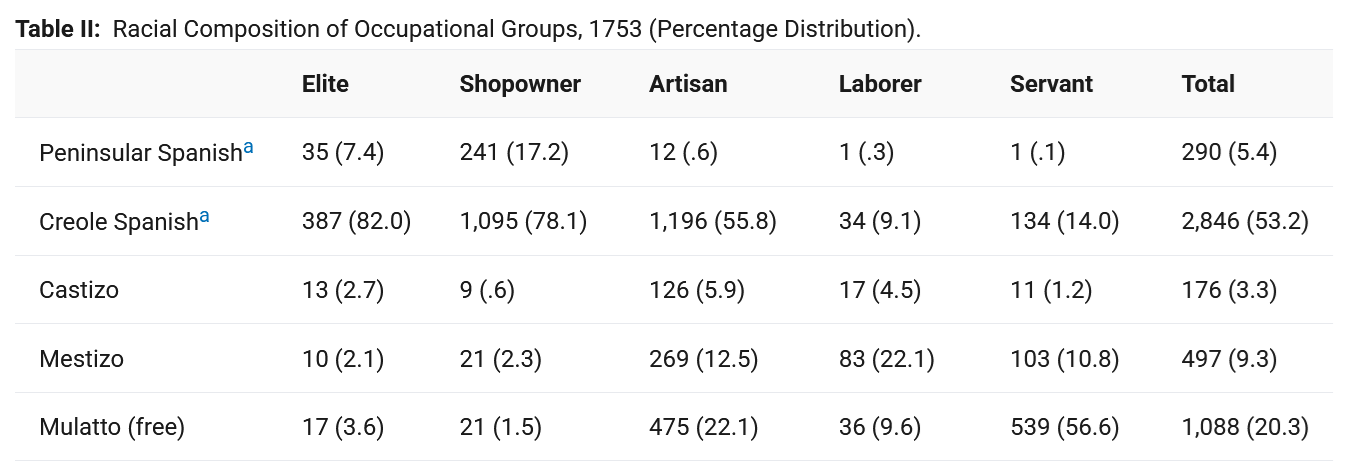
PS shows that Peninsulars and Creoles were much more likely than Castizos to be part of the elite (12%-13% vs 7%), much more likely to be at least “owners of the means of distribution” (her description of the second social rank), and less likely to belong to the artisanal class - Seed’s third social rank - to which the majority of Castizos belonged.
This supposed social hierarchy is defined by the occupations that Seed assigned to each of the three social classes5. Her elite class consists of employees and officials of the royal customs, the mint and the other main institutions of the viceregal government - which I agree should be considered the elite of colonial society - together with commercial brokers6 but not merchants.
The problem with classifying commercial brokers as part of the elite is that they don’t appear particularly prosperous, which calls into question their elite status, and yet they inflate the number of Pensinsulars within the “elite”. If brokers were excluded from the elite, only 21 Peninsulars would belong to that social class, making them just as likely (7%) to be elite as Castizos.
Also, at first sight, it may seem that Peninsulars were not significantly overrepresented in commerce as a whole, since they were 18% of brokers but only 9% of merchants. Yet many of the brokers and merchants recorded as Spaniards in the census were likely European-born, not Creoles as Seed assumes.
An example of this is Nicolás Ladro, who is recorded as a Spaniard and whose occupation is given as merchant. The surname Ladro is probably a deformation of the Valencian surname Lladró, of porcelain fame. Both Ladro and Lladró do not exist in Mexico today7, which given that the census records six children (two boys) for this merchant, strongly suggests Nicolás Ladro/Lladró returned to Spain after 1753. Otherwise we would probably see dozens, if not hundreds, of Mexicans surnamed Ladro or Lladró today. He could, of course, have been the son or grandson of a Peninsular migrant, but that would require that he and any brothers or cousins all left no descendants (the “return” to Spain of a son or grandson would have been highly unusual).
It’s not entirely certain that he was a Peninsular recorded as “Spaniard”, but it’s highly likely that he was. Together with the other cases of likely European-born merchants recorded as Spaniards in the census8, this suggests that the shares of Peninsulars among brokers and merchants were substantially higher than 18% and 9%.
The misrecording of Peninsulars as Spaniards (“Creoles”) also fits with the low number (300-400) of Peninsulars tallied in the census. Around 1753 the European-born population of Mexico City should have numbered at least 2,000 individuals9, significantly higher than the census total even after the addition of other household members.
It’s unsurprising that many brokers were Peninsulars given that the profession dealt largely with transatlantic commerce between Mexico and the Iberian peninsula, and especially with the ports of southwestern Spain10. Merchants, for their part - at least those living in Mexico City - were tightly integrated into the commercial networks of Spain, and tended to recruit employees (cajeros) from the old country, generating a chain of migration from the peninsula to Mexico.
And it’s also unsurprising that almost no broker or merchant described himself as Castizo, given that it was a Mexican term. One could say that Peninsulars were overrepresented in the upper classes largely because they were overrepresented in commerce.
It should also be noted that Castizos comprised around 3.8% of the non-Indigenous, non-Peninsular population of Mexico City according to the census. That is substantially lower than the Castizo share in other jurisdictions of the Valley of Mexico, which usually record more than 10% of Castizo individuals in 1790. Yet this low share can easily be explained by the misreporting of “Spaniards” as Peninsulars in the city (excluding a thousand misreported “Spaniards“ would raise the Castizo share to 5%).
What is elite?
If we redefine the elite so narrowly that it only comprises a few high officials of the viceregal government and exclude even highly specialized professionals such as lawyers, physicians and surgeons, then yes, Peninsulars are definitely overrepresented in the elite. But this definition of the elite would be so narrow as to be of little use for analyzing the structure of Mexican colonial society as a whole.
And a relatively broader definition that includes lawyers, physicians and surgeons does not really improve on this, because 70% of physicians (and surgeons) and almost every lawyer11 and clergyman did not declare a quality or casta. This, I think, is a more interesting characteristic of the elite. They do not seem to have cared much about their presumed casta. The lower one moves on the social hierarchy, the higher the concern with casta: surgeons declared a casta more often than physicians12, and at the opposite end of the social hierarchy from these professionals we find that only 23% of beggars and 13% of water carriers did not declare a casta.
The broadest definition of the elite (used by PS), comprising 8.8% of Mexico City’s population, I consider inadequate. There is a straightforward measure of socioeconomic status that shows brokers were less “elite” than the merchants who were excluded by Seed: the presence of servants in a household.
Since one goal of the census was to record how many people lived in each house, servants had to be recorded as members of the household, if only by their total number. And, as should be expected, wealthier households were more likely to include servants than poorer households, and to employ more of them. By this measure, the households of Mexico City merchants - roughly 60% of which included servants - were wealthier than the households of brokers, only 30% of which employed servants. And this relatively higher socioeconomic status of merchants is confirmed by Leonor Ludlow Wiechers in her book about the commercial brokers of Mexico City13:
John Kicza, in his study of business in Mexico City during the Bourbon period, states that their activity was restricted... to arranging sales between wholesalers and retailers, both in Mexico City and in the provinces, and to managing and carrying out many of the inventories required by commercial establishments... Although these agents led a comfortable life, none rose to the ranks of prominent merchants, nor did they acquire large tracts of agricultural land.
Patricia Seed’s definitions of the elite and shopowner classes are misleading. Merchants, who could have reasonably been included in a broad elite class, were instead included in the shopowner class, below commercial brokers. And cajeros, the employees of merchants I mentioned earlier, were also placed in the shopowner class.
This makes very little sense. The 396 cajeros in Mexico City were as numerous as merchants14 and were mostly Peninsulars: 67% of those who recorded a quality or casta were European-born15. They were also overwhelmingly not heads of households. Less than 3% are recorded as such, and therefore only for those few can we compare the presence of servants in their households with the rate of servant presence for others classified as part of the shopowner class.
A few of these rates were:
Among owners and managers of bakeries: 44%.
Owners of cantinas: 50%.
Owners of wineshops: 18%.
Owners of tobacco shops16: 16%.
For cajeros the rate was only 9%, low compared to other shopowners, and that is among the very few who were heads of households. Most didn’t have a house of their own, let alone servants. This suggests that among cajeros even the wealthiest cajeros - who lived in their own house - could barely reach the socioeconomic level of Seed’s shopowner class.
And given the concentration of Peninsulars in this occupation, the socioeconomic position of cajeros implies that Peninsulars were not simply concentrated in the upper social classes, but were spread over the upper and middle classes, much like Creole Spaniards were. Given their affinity for commerce, even poorer Peninsulars, such as many cajeros, had a fair chance of climbing into the upper classes, and many did.
There’s a second point I want to make about Peninsulars in 1753 Mexico City. In my earlier Latin American migration to Spain post I presented a map of late 19th-century Mexican residents in Spain as a proxy for the geographic origins of Spanish migrants to Mexico during that time period.
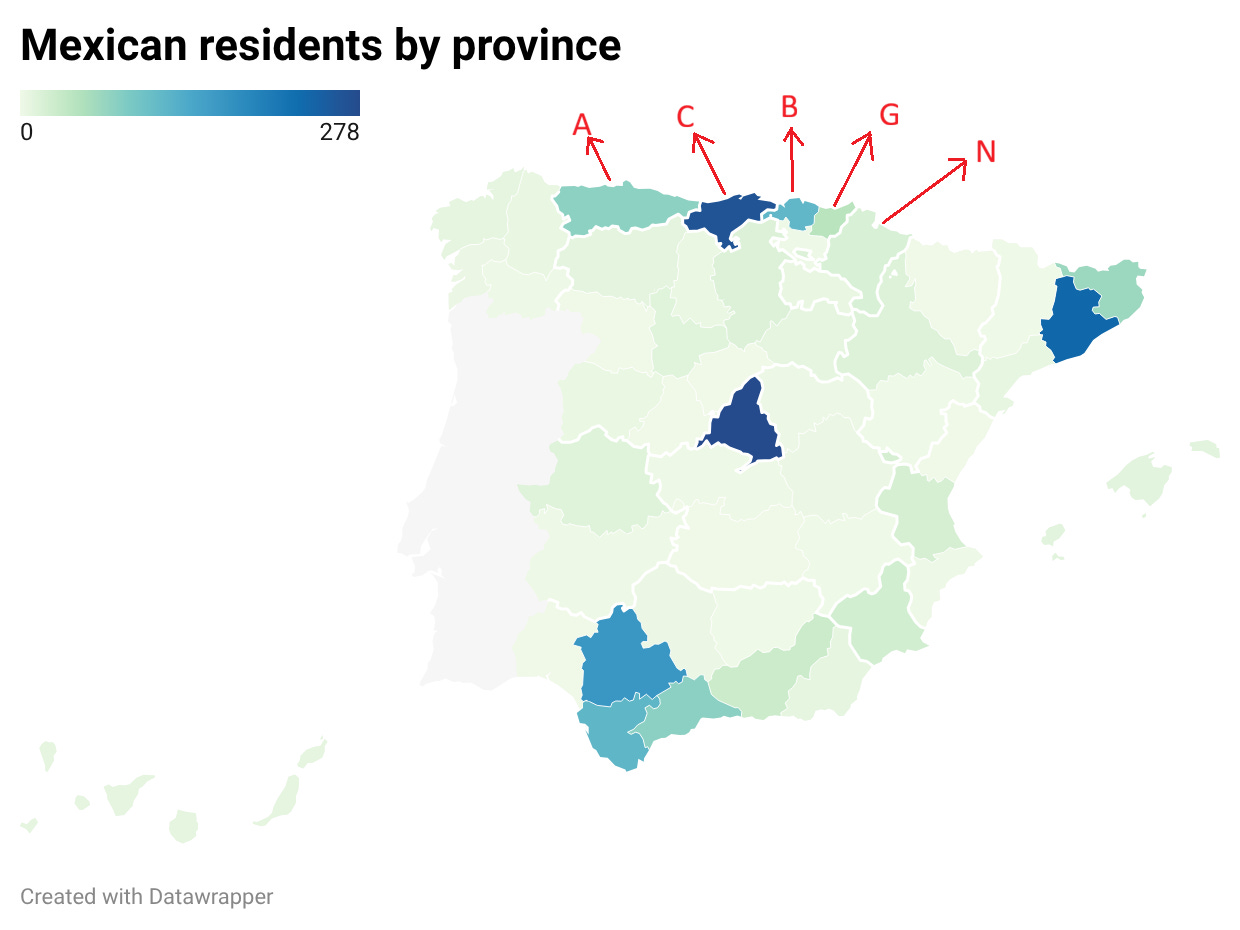
And I noted that Spanish migration to Mexico appeared to come mainly from two regions: southwestern Spain and a belt of provinces along the northern coast.
Mexico’s northern Spanish belt peaks in Cantabria (labeled “C” on the map), a region strongly associated with 19th-century Spanish migration to Mexico. It also includes Asturias (labeled “A”), but arguably not Navarre (“N”),
I can’t make a precise map of the regions and provinces of origin of 1753 Mexico City Peninsulars, because Spain had not yet gone through the whole post-French Revolution territorial rationalization process, and so the places of origin recorded for those born in Europe do not always correspond to modern Spanish provinces. But I can make a rough approximation17:
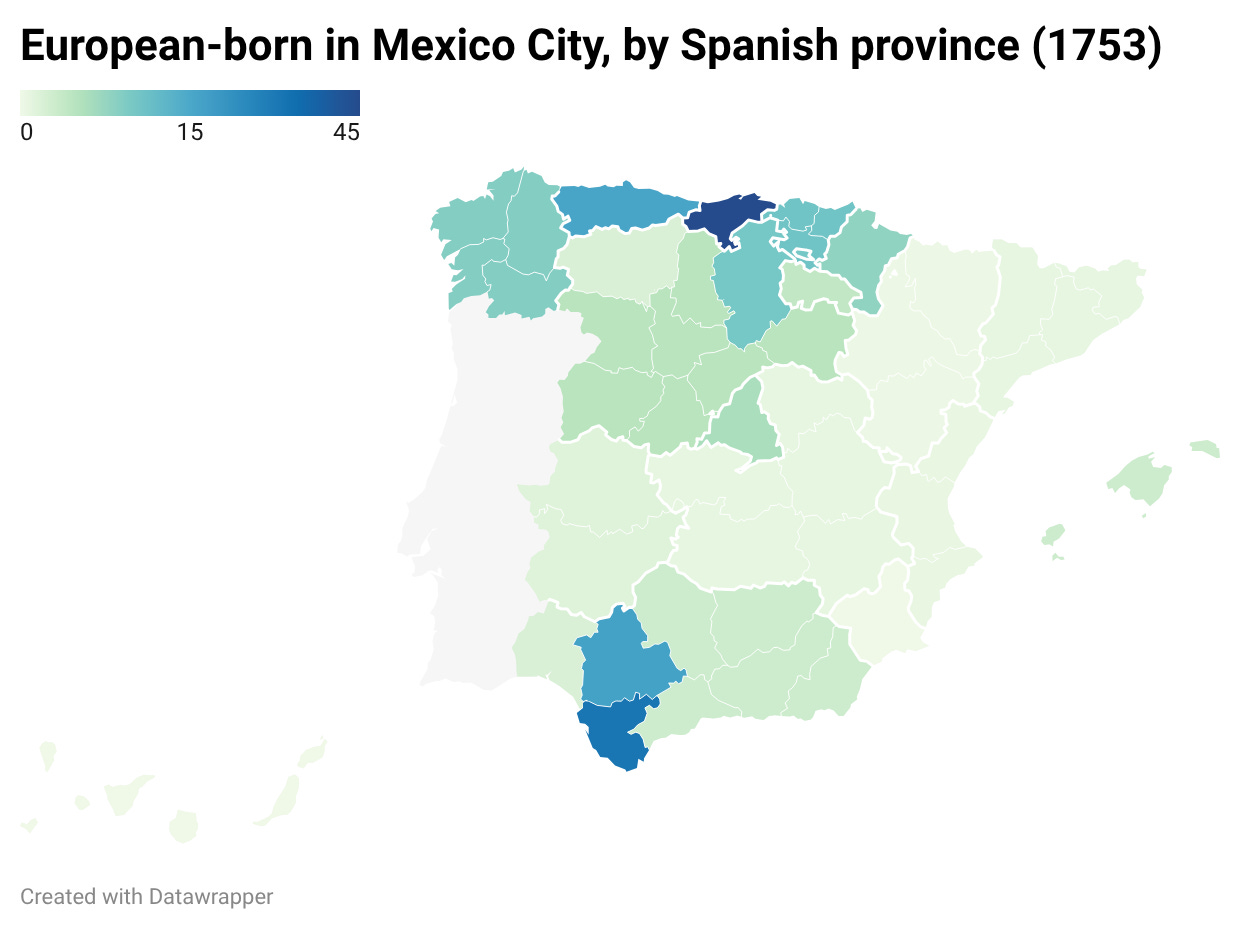
The differences between the two maps consist mainly of the late-19th century peaks in Madrid and Barcelona, and the high number of Galician-born residents in 1753 Mexico City. Here are the two maps side by side, with Madrid and Barcelona removed18, so you can compare them more easily.

As I mentioned in the Latin American migration to Spain post, Madrid and Barcelona likely had many Mexican returnees in 1887 and 1900 because migrants often did not go back to their province of origin, but rather to big cities where economic opportunities were more plentiful. Yet this doesn’t necessarily mean that many 19th-century Spanish migrants to Mexico came from Madrid and Barcelona.
Besides the clear difference in the ratios that the two main cities show between the first and second maps, there are other shifts I would like to highlight:
The aforementioned much higher share of Galicians among 1753 Spanish migrants. This may be related to the massive Galician migration to Argentina, and to a lesser degree Uruguay, that began in the 1870s. Maybe Mexico wasn’t as attractive for Galicians any more.
At the eastern end of what I called the northern belt, Navarre also saw a decline19, but milder than Galicia’s.
There is perhaps a decline in the importance of Castile, specially Burgos province. This could be part of a broader trend of diminished migration from central Spain, while the coasts remained as the major sources.
Despite these shifts, the general similarity between the two maps is remarkable and it implies strong continuity in Spanish migration to Mexico for over a century and a half.
This continuity also extended to the main occupation of the migrants: commerce20. It also forced me to correct an earlier notion. When I wrote the previous post, I was somewhat skeptical of Seville and Cadiz’s importance as sources of migrants to Mexico, but I’m almost certain now that they were a major source for over a century and a half.
Overrepresented or underrepresented?
Going back to Castizos, were they really underrepresented in the second social rank, that of shopowners, and more concentrated in the third rank (artisans) than Peninsulars were?
Well, yes, but only if we include commerce-related occupations in this class.
The overall ratio of Castizos to Spaniards in the census was 1 to 16 (or 1:14, see below), while the ratio among non-commerce-related shopowners (butchers, bakers and cantina owners) is 1 to 10. So Castizos were clearly underrepresented among commerce-related shopowners, but slightly overrepresented among non-commerce-related shopowners (remember Patricia Seed said: “[the Castizo] was far less likely to have owned the shop in which he worked“).
Let’s now move one rank down, to the artisan class. Each artisanal guild was organized as a hierarchy, with masters at the top, followed by officers and apprentices. The average officer was not very wealthy, but masters occupied a roughly intermediate position between shopowners and officers. 25% of master silversmiths21 and 9% of master blacksmiths had servants, with lower rates among master tailors and shoemakers.
Even if we assume that some 300-400 Mexico City “Spaniards” who worked in commerce were really Peninsulars22, thus shifting the overall ratio of Castizos to Spaniards to 1:14, Seed’s point that Castizos were more numerous among artisans than expected still stands.
But, this is not the case among master artisans. The ratio is 1 Castizo to 13.2 Spaniards among master artisans, very close to the (adjusted) overall ratio.
Moving on to the last two social classes defined by PS, laborers and servants, I have to take her figures for laborers on faith alone, since I cannot reproduce them23. So let’s accept that Castizos are overrepresented among laborers. And finally, regarding servants, the ratio is 1 Castizo to 12 Spaniards, again close to the adjusted overall ratio24.
Before summarizing the relation of Castizos to each social class, let me add an additional rank consisting of the heads of households who report no occupation25. PS ignored these residents in her Table II, focusing only on those with a recorded occupation, but I believe these 800-1,000 heads of households should also be taken into account when analyzing the socioeconomic status of Castizos.
Some of these residents may have been too old to work26, and many of them were widows, yet it seems implausible that a majority did not have an occupation providing them with a livelihood.
One possible explanation for this is that many of them did not have a steady occupation, and therefore no definitive occupation was recorded in the census. If that was the case, then this social rank should be placed near laborers and servants, toward the bottom of the socioeconomic scale. And the estimated Castizo to Spaniard ratio among these apparently non-employed residents is 1 to 22, or 1 to 18.4 if widows are excluded.
Another possible explanation is that the high ratios of Spaniards to Castizos (and Mestizos) resulted from the apathy of residents or census takers. If the lack of a recorded occupation was often connected to apathy, it would explain why apparently non-employed residents who should have been recorded as Castizos or Mestizos often appeared as “Spaniards” in the census, the default category27. This would provide further evidence that the Spaniard category was not the upper end of a racial continuum but simply a default category for the non-Indigenous.
Let’s now see a summary for all social classes, including the apparently non-employed and excluding those involved in commerce (as far as possible). I’ve also separated artisans into a masters class and an officers and apprentices class.
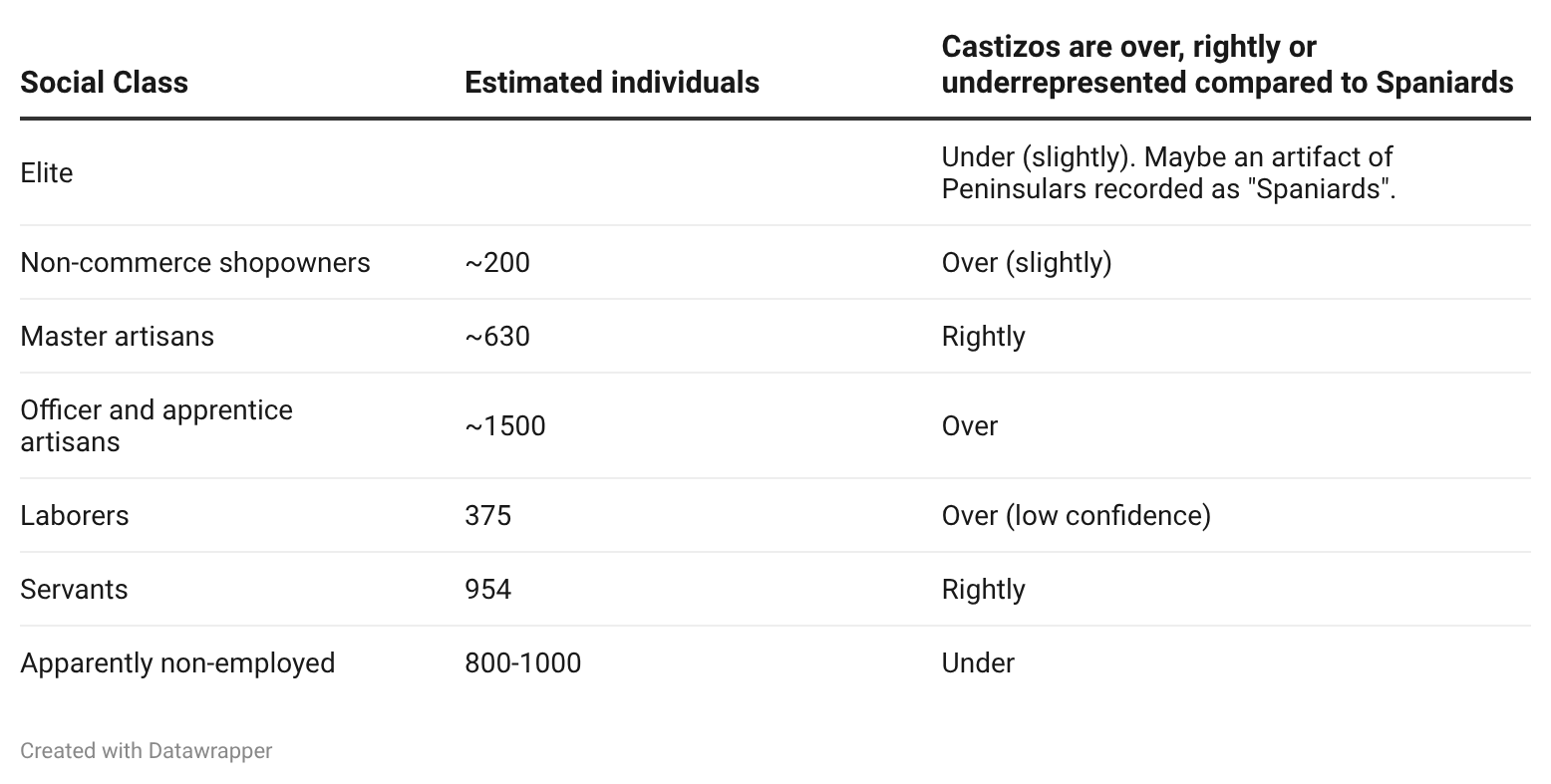
Notice that I kept Seed’s ordering of the laborer and servant classes, with laborers above, and added the apparently non-employed at the bottom, although I doubt there was any difference in average socioeconomic status between the three classes. I also kept the elite class, despite my objections28.
Based on these seven social classes, I find it very hard to conclude that Spaniards were above Castizos on Mexico City’s social hierarchy. And if I drop the elite class (and maybe fuse the three lower classes into one), I definitely see no difference between them. Castizos were not simply “light-skinned Mestizos“ as Patricia Seed characterizes them; Creoles were not synonymous with Spaniards; and eighteenth-century Spanish men were not “obsessed with classifying people”.


(This post’s thumbnail shows one of the casta paintings that are often presented as “evidence” of a byzantine Spanish colonial casta system. Paintings on subjects considered as exotic by the painter, or potential buyers, should not be regarded as reliable and accurate images of those subjects. Credit: Wikipedia)

See Patricia Seed’s Social Dimensions of Race: Mexico City, 1753 (1982), pages 573, 581.
The only mention of the word criollo (creole) in the census is to distinguish between two nephews of a priest, who lived in his household: “A gachupin [Peninsular] nephew and another one criollo“.
There was a resident born in Guatemala and four born in Havana. None of them was identified as Spaniard, Castizo or as belonging to any other casta.
Patricia Seed describes the census’ goal in more detail: “For better control of this unemployed or vagrant criminal element, whose numbers had been swelled by the influx of recent unemployed migrants from the countryside, the city council and royal government decided to improve the method of patrolling the streets. It was for this purpose that the city council members sought and received permission from the royal government to undertake a survey of the streets and the residents of the city“.
Despite my lengthy attempts to replicate Seed’s social classes, there were eleven Peninsulars whom, mainly because they were so few, I couldn’t place in any class: 3 pulque watchmen (yes, that was a thing), 1 musician, 1 clothes delivery man (merchant?), 1 “soquitero”, 1 doorman, 1 beggar, and 2 soldiers.
Also three rural property and mine owners. There may be some minor differences between the elite group that I reproduced and Seed’s group, since I counted 34 elite Peninsulares and 10 elite Castizos.
At least one source reports a couple of individuals with the surname Ladro in Mexico today, but other sources report zero. Thus, the most likely number is zero.
Other likely cases are: Pablo Baltasar Cameros, Juan Alonso de Curras, Manuel Díaz de la Serna, Nicolás de Iturri, Juan José Larizaga, Antonio “Hastarrica” (Bastarrica). Note that all of them have very unusual surnames because these are the easiest to notice, but it’s almost certain that many more Peninsulars with more common surnames were also recorded as Spaniards. There’s also one case of an European-born resident explicitly recorded as Spaniard: Tomás Vascelos. And a few cases of residents without a quality or casta description, but who are implicitly revealed to be Peninsulars by the date of their arrival in Mexico: Manuel García, Felipe de Hoyo, Luis Martínez and Antonio Folco.
In 1790, the European-born population was around 11,000 in all of Mexico and more than 2,000 in Mexico City.
The main ports were Seville and Cadiz. Of the eleven Peninsular brokers with a known province or city of origin, five came from within a 12 kilometer radius centered on those two ports.
44 of 45 Mexico City lawyers lack a quality or casta description. Intriguingly, the one lawyer described as a Spaniard was surnamed Montes de Oca, a typical Canarian surname. Maybe a sign of insecurity arising from a less European-looking physical appearance?
In contrast to physicians, surgeons received only practical training at the time, and their professional practice was under the jurisdiction of a physician’s supervisory body, the Protomedicato.
See Los corredores de lonja en la Ciudad de México, del período colonial al independiente, by Leonor Ludlow Wiechers, page 163.
The number of merchants was 405.
Among those who recorded a name, the share of Peninsulars rises to 77%, which suggests that if census takers had been more thorough (e.g. by not recording as “Spaniard” those born in Europe) the proportion would have been even higher.
A tobacco shop was one of the most humble categories of shop that a Mexico City shopowner could have. It was also frequently owned by women, many of them widows.
Toledo and Cuenca were merged into the Castilla-La Mancha region. I’m not 100% certain that what census takers regarded as León corresponded only to modern León province; it may also have included Zamora and Salamanca provinces. You can find some maps of the ancien regime territorial organization of Spain here.
I also removed the Catalonian province of Girona, which may have been a mistake.
Note that Alava province - next to Navarre - probably looks different because the 1753 map assumes an equal number of migrants from each of the three Basque provinces.
See La otra orilla del mundo. Cántabros, vascos y asturianos en el occidente de México durante el siglo XIX, by Sergio Valerio Ulloa: “At the beginning of the 1880s, 21 people resided in the [Mexican] city of Guadalajara who declared to the Jalisco authorities that they held Spanish nationality, of whom only two were women. Fourteen of them stated that they were primarily engaged in commerce, two were farmers, and there was a cook, a musician, a hatter, a singer, and a housewife.“
That is one of only four, so take it with a grain of salt.
Counting only merchants, brokers and cajeros, around 900 Mexico City residents worked in commerce.
I’m only certain that PS’s laborer class includes bakery workers. That is the only way to reach the number of Indian laborers she reports, since bakery workers were overwhelmingly Indigenous. The occupations most likely to be classified as laborers, besides bakery workers, would be water carriers, washerwomen, and carriers.
Among Castizo servants the share of those recorded only by first name ranges between 30% and 40% (an estimate), while among Spaniards around 30% were only recorded by their first name. In contrast, roughly 75% of Mestizo servants were recorded only by their first name. The very similar proportions for Castizos and Spaniards again suggest a similar socioeconomic level.
This class doesn’t include the 39 recorded beggars of Mexico City. The ratio of Castizos to Spaniards among them was 1:22.
I estimate that fewer than 10% were 60 years old or older.
As further evidence of the vagueness of the Spaniard category, we can look at the residents who carry the paternal or maternal surname Moctezuma. Of the eight Moctezumas for whom a casta is reported, two are recorded as Indigenous (one a cacique), one as Mulatta, and five as Spaniards.
I don’t understand how SP’s count of elite Spaniards reaches 372. Even including brokers, I can reach only about 200.