

Spain is renowned for its Merino sheep. This sheep breed, famous for its fine wool, is inextricably linked to the institution of the Mesta, an association of Spanish sheep owners founded in the 13th century. The Mesta regulated and protected large-scale sheep farming, mostly of Merinos, and was crucial to Spain’s thriving wool export trade and its prosperous wool-based textile industry.
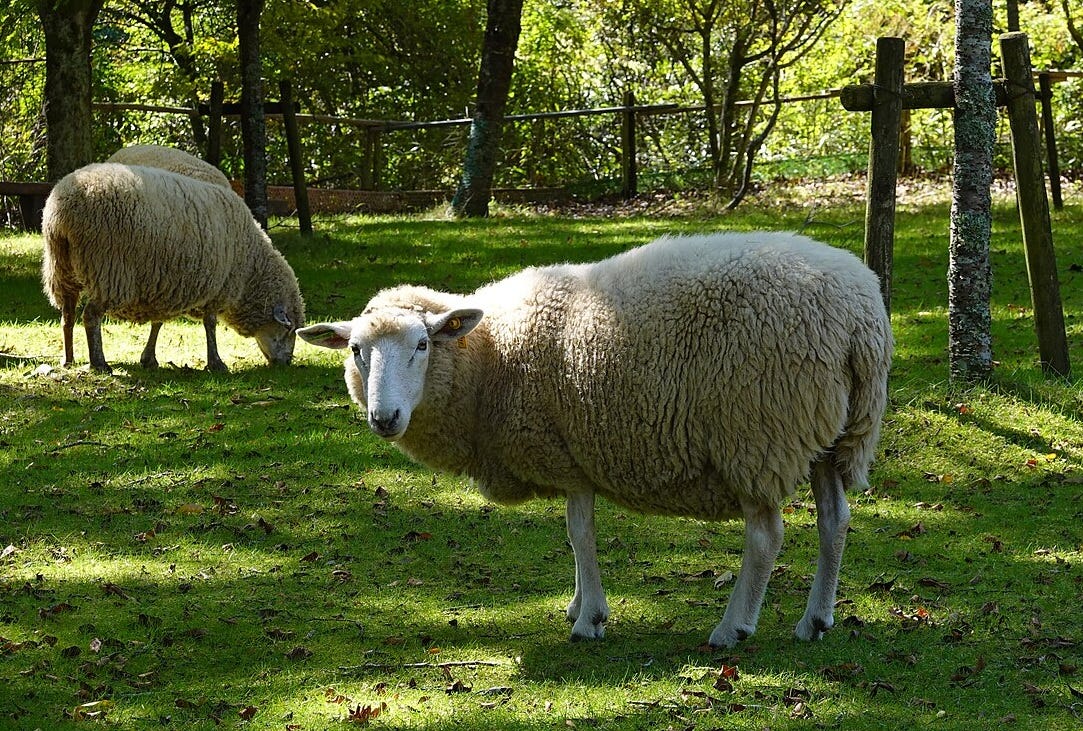

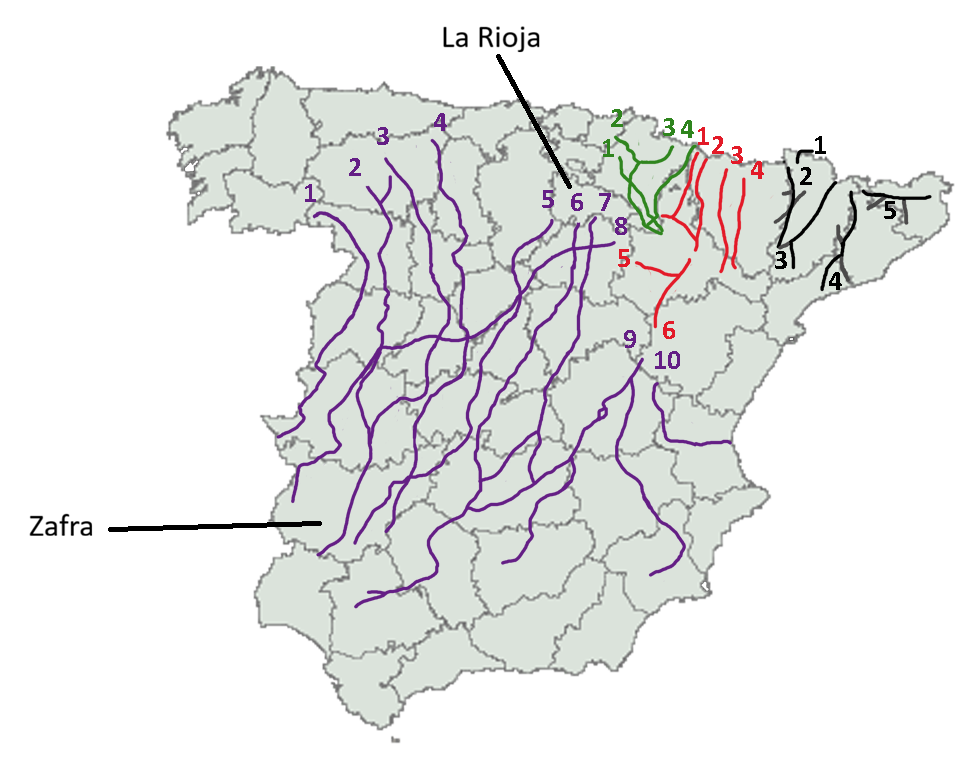
Among the privileges enjoyed by the Mesta, one of the most important ones was the control and maintenance of an extensive network of rights-of-way connecting northern sheep raising areas with southern pastures. Every winter, shepherds from northern regions of Spain - such as La Rioja, Soria and León - drove their flocks south to graze in the green pastures of Extremadura and Andalusia.
Thus, over its centuries-long existence, the Mesta fostered social and economic contact between shepherds and sheep owners coming from the north and the local residents of Extremaduran towns. One such Extremaduran town, located in the south of the region, was Zafra.

Like many medieval towns in southern Spain, Zafra was originally a Muslim settlement. It was conquered by Christian forces during the Reconquista - not once, but twice - in 1229 and 1241, becoming part of the Kingdom of León.
In the north, the sheep-farming region of La Rioja did not belong to the Kingdom of León, but to the Kingdom of Castile (and previously to Navarre). Nevertheless, the process of expansion and integration of the northern Christian Kingdoms eventually brought La Rioja and Zafra under the same political entity, making possible the creation of Spanish institutions like the Mesta.
Starting in 16th century, several villages and towns in La Rioja specialized in processing the wool from their flocks and producing cloth for export to other regions. The Mesta routes then created trade opportunities for Riojan cloth merchants. After centuries of annual migrations to the winter pastures of Extremadura, Riojan merchants could now take advantage of the contacts their fellow Riojan shepherds and sheep owners had established in Extremaduran towns. Zafra became not just a winter destination for Riojan shepherds, but also a market for Riojan cloth.
Over time, some Riojans decided to settle permanently in Zafra, and from the late 16th century a colony of Cameranos, Riojans from the Cameros district, became firmly established in the town and heavily involved in commerce. This was aided by Zafra’s location along a major trade route, linking Seville to northwestern Spain.
During the 18th century, the Cameranos community grew and prospered so much that by 1792 around half of all nobles in Zafra were originally from Cameros1. By the early 19th century, they probably made up at least 5% of Zafra’s total population, and possibly as much as 10%. Their numbers continued to grow during the 19th century, partly due to the decline of the Mesta (it was dissolved in 1836) and growing competition from the Catalonian textile industry, both of which diminished economic opportunities in La Rioja and made Zafra an attractive destination to try their luck.
Other Extremaduran towns also attracted enterprising Riojans, but Zafra was exceptional in how large and influential the community became, with Cameranos dominating commerce and holding a majority of municipal council seats by the late 18th century2.
Arguably, Zafra was likely the town in southern Extremadura - modern province of Badajoz - where non-Extremaduran influence was strongest in the late 18th and early 19th centuries. It was large enough to attract many Cameranos, yet small enough3 for them to have a disproportionate impact on Zafra.
If you read footnote 19 of my A little slice of Non-Andalusia in the middle of Andalusia post, and paid close attention to the map I included there (I know, I know), carefully examining the whole map (I know), you might have noticed what looked like an error in the area of southern Extremadura shown on the map.
Let me show you what I mean:
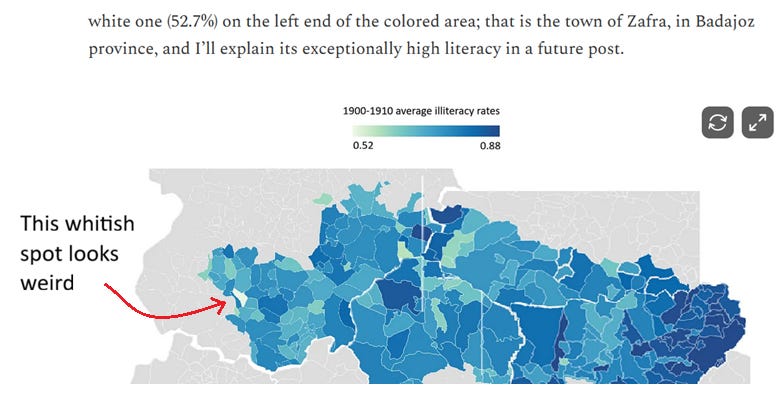
Well, you’ve probably guessed it by now. That whitish spot in southern Extremadura, which looked like an error, is the municipality of Zafra. And no, it’s not an error.
The map shows the average (1900-1910) illiteracy rate4 for each municipality. I presented it as evidence for my argument that areas of Andalusia which were less Andalusian in the late 19th century showed higher literacy than the rest of Andalusia. Zafra’s average illiteracy rate was 52.7%, the lowest among all municipalities that I included in the map. That’s why it looks so whitish (color scale goes from white to blue).
I included areas of Badajoz and Ciudad Real provinces in the map because they border the Andalusian provinces I was focusing on; I didn’t expect to find an exceptionally high-literacy municipality in those border areas.
After I realized that Zafra’s rate was not an error5, I began reading on its history to understand what might explain its high literacy. That’s when I came upon the Riojan connection and realized that Zafra’s illiteracy rate was much closer to La Rioja’s (51.1% in 1900) than to the rest of Badajoz province6.
Zafra’s high literacy wasn’t simply a consequence of many Cameranos happening to live there. The causal mechanism was - just like we saw in the case of high-literacy Andalusian municipalities - increased access to primary education. Zafra’s student-to-population ratio (which I presented in the previous post) in the early 19th century was a remarkably high 15.5 students per 100 residents. To put that into context, that’s higher than any of the ratios I calculated for the provinces of Córdoba and Jaén.
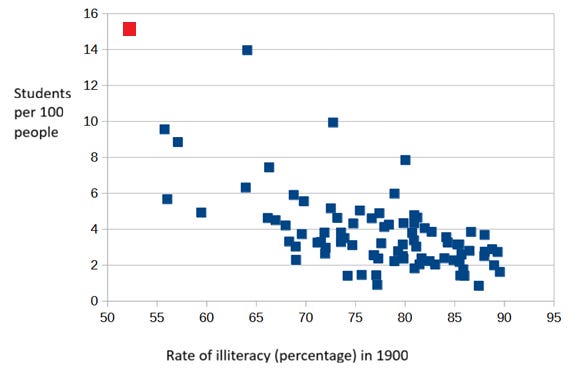
Yet that ratio was not unusual in La Rioja, where Cameranos came from. These immigrants appear to have imported their northern high literacy rate by bringing along their northern wider access to primary schooling.
Notice that since Cameranos were not a majority of the population (maybe less than 10%), the causal mechanism for broader access to schooling can’t just be demographic dominance of a more literate-inclined group. Instead, the primary cause appears to have been cultural dominance, which in the case of Cameranos was achieved through their large economic and political influence in Zafra.
After this brief detour into the history of Zafra and its exceptionally high 19th-century literacy rate, here’s an updated and expanded map of illiteracy rates by municipality, including the provinces I’ve discussed so far (Badajoz, Córdoba, Jaén, Huelva). The rates shown are averages for the years 1900 and 19107, which should help reduce the noise introduced by random errors in the census data.
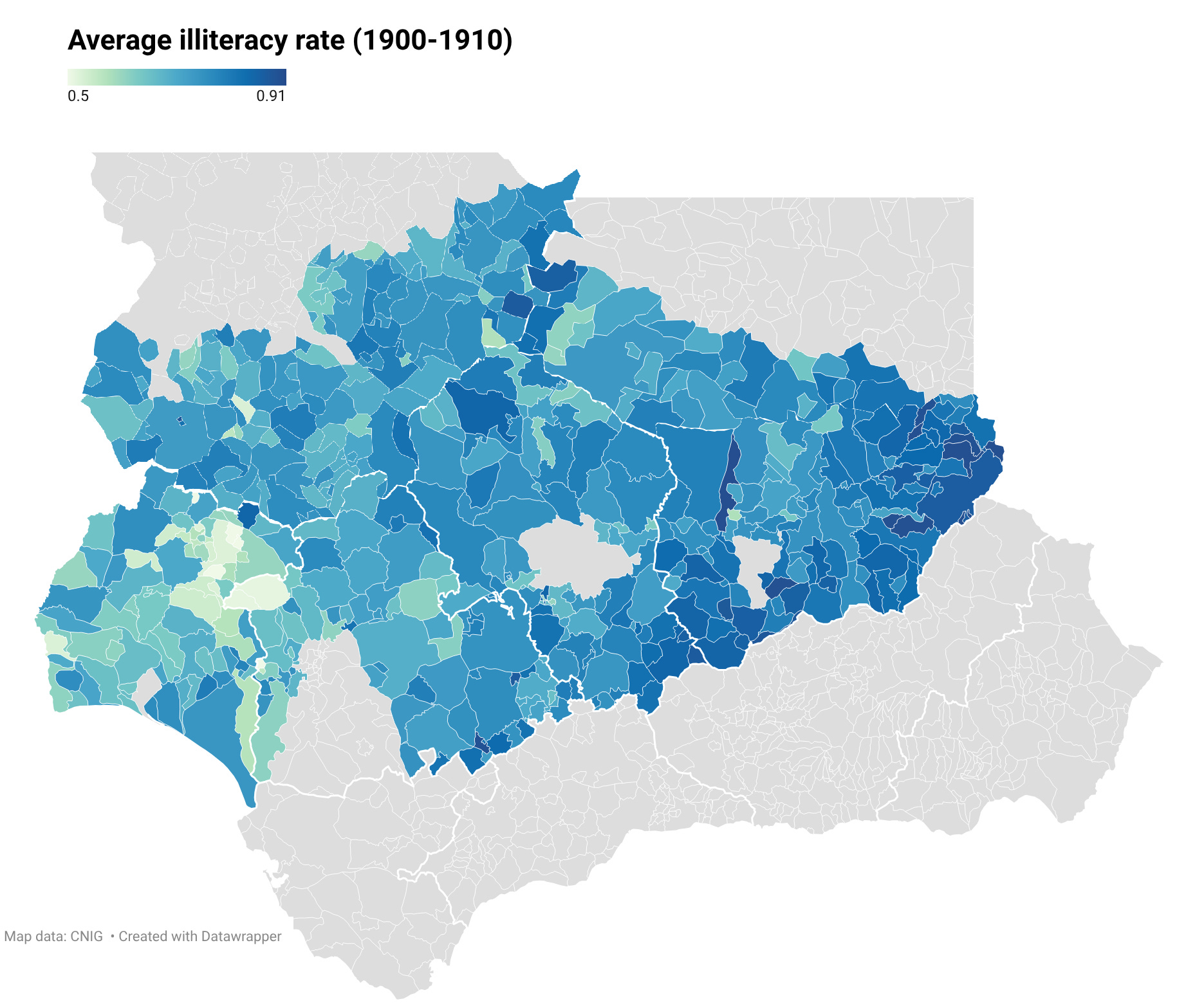
As I’ve mentioned previously, Huelva province (in the southwest corner of the map) was remarkably literate compared to the rest of southern Spain in 1900. The above map allows us to examine Huelva and other regions more closely, and notice patterns that were not visible at the provincial level. And the most striking one is that higher literacy was concentrated in the sparsely populated northern part of Huelva.
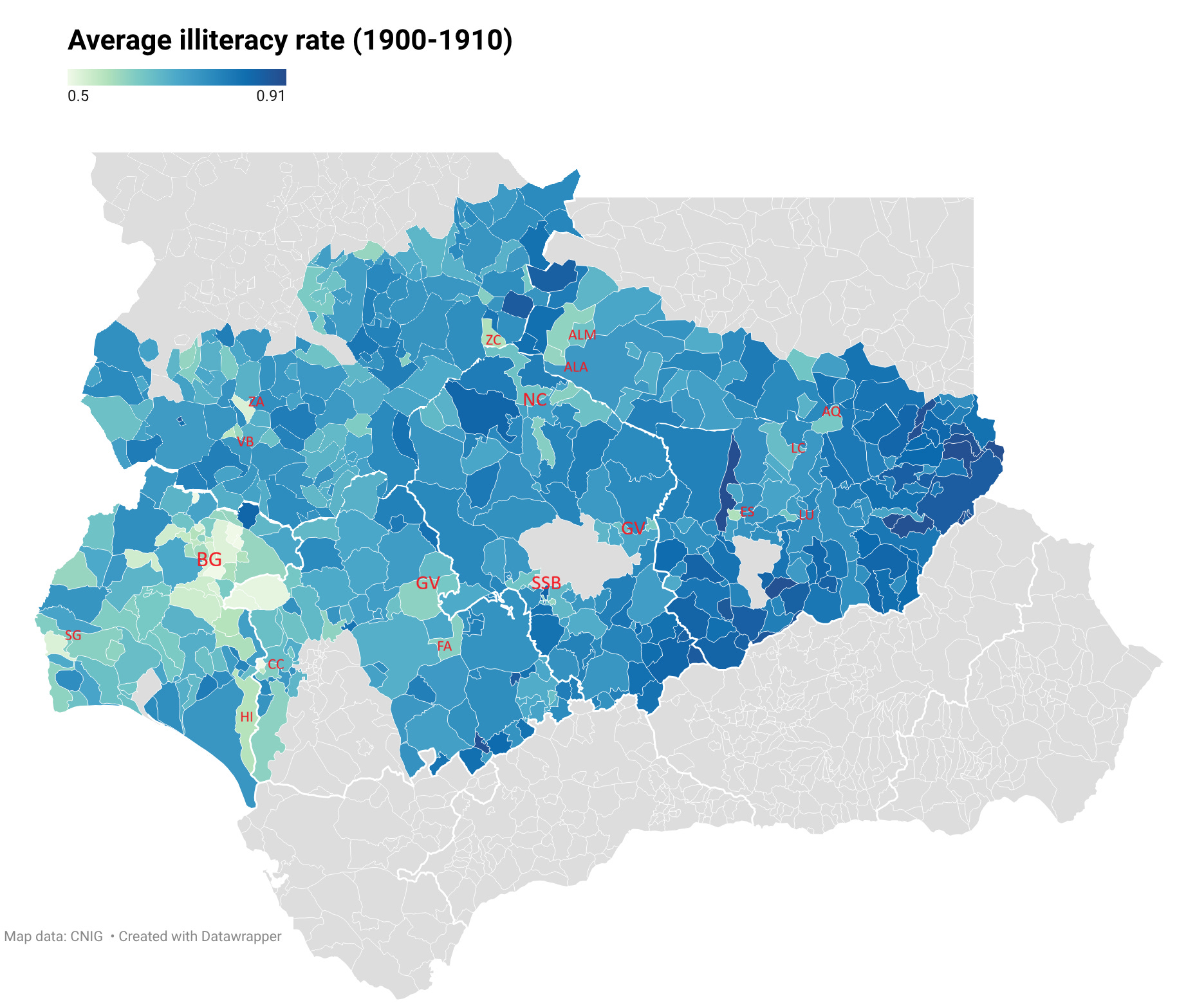
Adding northern Huelva to the list of high-literacy municipalities and areas I’ve already mentioned (what started as a single post has become a series on literacy differences between Spanish regions8), here is a comprehensive list of high-literacy municipalities and areas, including the ones I’ve already mentioned in this series, and a few others. Remember that this is 1900-1910 high literacy relative to their neighbors, not necessarily on a national scale9.
Aldeaquemada municipality (“AQ”), La Carolina (“LC”)10, and San Sebastián de los Ballesteros (“SSB”) and its surrounding area; all part of the New Settlements of Sierra Morena and Andalusia, which I’ve already discussed.
Espeluy (“ES”). In the late 19th century, Espeluy developed into a major railway junction. It’s highly likely that a large share of its residents became relatively educated railway workers.
For centuries, the town of Almadén (“ALM”) was one of the few producers of Mercury in the whole world. Mercury was essential for refining gold and silver and extensively used in Spain’s American colonies. I’ll assume its high literacy is related to this (mining wealth, immigration, mining academy, etc).
Zafra (“ZA”) and Alamillo (“ALA”). Alamillo, right next to Almadén and the northern Córdoba area, was also heavily affected by the pastoralist activity of the Mesta11. I suspect this is the most likely explanation for its high literacy.
I couldn’t find any obvious explanation for the high literacy of the following municipalities: Zarza-Capilla12 (“ZC”), Lupión (“LU”), Fuentes de Andalucía (“FA“), Sanlúcar de Guadiana (“SG“), Castilleja del Campo (“CC”) and Hinojos (“HI“). All these you can locate by their labels on the modified map you can find here13.
Regarding the northern Córdoba area (“NC“), which roughly corresponds to Los Pedroches district, my preferred explanation continues to be its cultural affinity with areas further north. In fact, this area was also the terminus of several Mesta routes.
Valverde de Burguillos (“VB”) is very close to Zafra, but I don’t know if there’s any relationship there14.
When discussing Córdoba province, I mentioned the central Guadalquivir valley (“GV“) to the east of Córdoba city. I’ve now also tagged another section of the valley (Vega del Guadalquivir), halfway between Córdoba city and Seville.
Lastly, the most important addition to this list is the high-literacy northern area of Huelva (“BG”), which roughly corresponds to the region traditionally called Banda Gallega (Galician Belt). As its name implies, this region was mainly settled by Galicians from northwestern Spain during the 13th century15.
The settlement of the Banda Gallega by northern Spaniards follows the same pattern we’ve encountered in other areas of southern Spain: an area is settled by migrants from northern Spain - or in the case of the New Settlements, partly by central Europeans - and centuries later that area shows higher literacy than the surrounding region.
A good question for a future post might be: what other cultural or social traits that differ between Spanish regions could be subjected to the same analysis as literacy (and academic performance). Do any of those traits follow the same pattern we’ve seen when comparing literacy between northern-settled areas and the rest of southern Spain?
Nobility was common in the Cameros district, though it didn’t necessarily imply wealth. Conversely, not all Cameranos held noble status (hidalgo). See “Breve aproximación a los Cameranos en Zafra en los siglos XVI y XVI“, by Carmen Fernández-Daza Álvarez.
See “Breve aproximación a los Cameranos en Zafra en los siglos XVI y XVI“, by Carmen Fernández-Daza Álvarez.
Compare to the city of Málaga, in Andalusia. There’s a whole book about the large Riojan influence in Málaga: “His brother, Pedro Alonso García, was the first Camerano mayor of Málaga - the author is also the grandson of mayor Pedro Luis Alonso….In 1860, the Cameranos occupied half [of the stores] in the main commercial street in the area: Calle Nueva”. Nevertheless, Málaga had around ten times the population of Zafra in the early 19th century; the Riojan community never amounted to a significant share of the total population.
I averaged two years to reduce the noise introduced by random errors in the illiteracy rate data.
A few municipalities show implausibly high or low rates in certain census years. I listed some of these in a previous post. Also, some “errors” in census illiteracy rates might actually be the consequence of changes in the population being recorded. Occasionally, a municipality might have had a number of transient residents (“transeúntes“) large enough to distort its illiteracy rate for that census.
It was also very low in 1860. Out of 96 Badajoz municipalities, Zafra had the fifth-lowest illiteracy rate, although a couple of those are probably errors (e.g. Valencia de las Torres).
Huelva’s figures are estimated based on 1900 alone. The difference between Huelva’s provincial 1900 rate and 1910 rate is less than one percentage point.
I hope. I’d like to move on to other subjects, and I suspect you want me to move on as well.
You’ll notice I only tagged one are and two municipalities in Huelva province, despite it being the most literate province in this analysis. Only those three stood out from their neighbors.
Note that La Carolina’s literacy level might have been affected by the mining activity in the northern Jaén mining district.
Wikipedia says: “[the Alcudia valley where Alamillo is located], in which the ‘serrana‘ transhumance (that is, from central and northern Castilian lands), left its mark (customs, language, etc.). Not only was the winter season (about six months a year) conducive to continuous contact with these highland shepherds and cattle breeders, who represented almost the entire population of the Alcudia valley, but marriages between them and the women of Alamillo have been and continue to be frequent.“
Although, as you can see in footnote 13 (look for “ZC”), Zarza-Capilla is close to Alamillo and the northern Córdoba area.
Tagged version of the average illiteracy rate map:
Notice also its neighbor, Atalaya. At first I thought Valverde de Burguillo’s rate might be an error, since it droped almost 20 percentage points from 1900 to 1910. Yet, its student-to-population ratio was 7.35, which is very high.
Some sources say the settlers were more likely Leonese, coming from what are now the provinces of León and Zamora, also in northwestern Spain. Both these provinces had even higher literacy rates than Galicia in 1900. See Historia de la Banda Gallega.
Can't help but wonder if the Mesta is part of the reason why Spain's genetic variation is mostly east-west rather than north-south